So, you think you can’t do Inquiry-based Learning: Better ask the gnome

“Scientific inquiry starts with observation. The more one can see, the more one can investigate.”
Martin Chalfie

In 1995 the National Research Council published the National Science Education Standards in which they recommended as one of its central point’s learning science through inquiry. As defined in the National Science Education Standards inquiry has two meanings:

Scientific inquiry refers to the diverse ways in which scientists study the natural world and propose explanations based on the evidence derived from their work. Inquiry also refers to the activities of students in which they develop knowledge and understanding of scientific ideas, as well as an understanding of how scientists study the natural world. (p23)

Five years later a companion book Inquiry and the National Science Education Standards: A Guide for Teaching and Learning was released. The purpose of this companion book was to help teachers understand and implement inquiry in their classrooms. In 2018 almost, a quarter of a century later implementation is still let’s be kind and say incomplete.

If we teach science as a method of looking at the world and asking questions Which is what science is instead of a collection of facts, principles, and ideas that many people view it as then the inquiry-based teaching method is critically important. So why isn’t inquiry-based STEM education universal?

The most common answer I hear is “I can’t do inquiry my class is too big.”  In my mind, this means you can collect bigger data sets. Followed closely by “My students aren’t ready for inquiry,” well instead of full inquiry try guided inquiry.  Lastly, “I have too much material to cover there is no time for inquiry.”  There might be something to say for that last statement, but that is a soapbox for another time, but I would say design your learning goals into the inquiry tasks.

Another way to address these questions, is to ask the question, does inquiry require complicated questions with lots of complicated equipment? Let’s ask a Gnome.

The Gnome Experiment
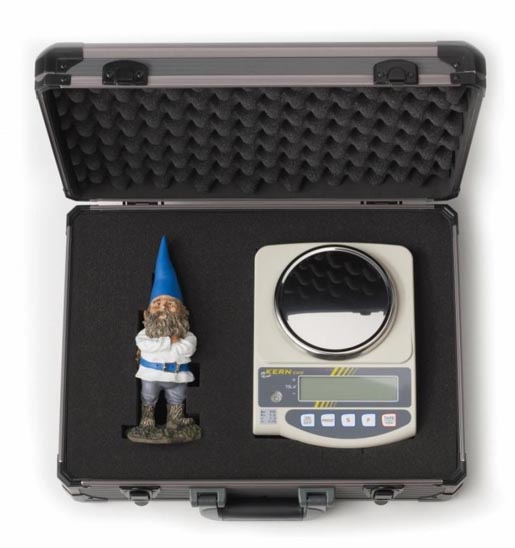
KERN the gnome in a case with his digital scale
Kern the gnome packed with his scale. Image: Gnome Experiment

The humble garden gnome is practically a cultural icon. To some garden gnomes are a passionate collectible, to others a novelty, and to still others the butt of the joke. However, there is one gnome that taught us about gravity while researching the physical makeup of our planet.

I think I first heard of the Gnome Experiment from a TED talk. The question proposed was could you measure the difference in gravity around the earth on a basic scale. To test their scales the Kern company got one of their scales a garden gnome and started shipping them around the world where the gnome’s recording weight and a picture at each stop. Here are some of the places the gnome has been

KERN the Gnome photographed in four different locations around the world.
Kern the gnome packed with his scale. Image: Gnome Experiment

The result of the experiment is a resounding yes. Kern the gnome weighed different amounts in different places.  Using a similar process what could you teach your students. While the phenomenon of gravity is simple to describe, it’s a difficult concept to grasp in real life.  Weight is dependent on gravity, and the amount of gravitational attraction on the surface of the Earth is dependent on the distance to the center of the planet and mass (density) of the material underneath you.  Apply this information correctly, and it can teach you about gravity and the earth.

For instance, suppose we were to conduct this experiment again.  Only this time in addition to the gnome and scale we also included a GPS/altimeter. I live in Colorado a quick search gives us a list of 20 roads that have an elevation over 12,000ft.  Suppose we took our gnome on a road trip and used our altimeter to measure the weight at 12,000ft on each of these roads. Since we have now controlled for elevation, what would it mean if we got different results?

As a teaching aid, the gnome experiment can be quite fun and useful. The idea that a garden gnome can be used to conduct science is a great icebreaker. More importantly, the Gnome Experiment shows how you can ask a genuine inquiry with a simple experiment and only a little bit of equipment. Stop and think about experiments you can ask you’re not asking your students to win the Nobel prize.  Think up some simple experiments and have your class address them.  I suspect what we need is a database of inquiry-based experiments for education, like the database of test and exam questions that are out there.


Thanks for listening to my musings

The Teaching Cyborg

My Silver Bullet Failed Me!

“There is no silver bullet. There is always options, and the options have consequences.”
Ben Horowitz

I can’t count the number of times I’ve read an article or heard from a colleague about some new piece of technology that is going to change everything. This new technology was the “The silver bullet!” that was going to solve all our problems. Then I either never hear about it again or get told how it didn’t work. I’ve even had some people wonder why their silver bullet didn’t work while looking for something to blame.

To start with your silver bullet didn’t work because you are not Bass Reeves.

Bass Reeves first African-American Deputy US Marshal west of the Mississippi.

If you’ve never heard of him, Bass Reeves was born a slave and after the civil war became the first African-American Deputy US Marshal west of the Mississippi. He worked extensively in what was then called the Indian territories in Arkansas and the Oklahoma territories; he arrested more than 3000 felons. Lastly, he gave out silver dollars as his calling card; many people believe he is the real-life inspiration for the Lone Ranger. Look him up his life is a fascinating story.

Okay enough Lone Ranger references, why did so many technologies fail to fundamentally change education when so many, often talented and intelligent individuals thought they would. In 1922 Thomas Edison said, “The motion picture is destined to revolutionize our educational system, and in a few years, it will supplant largely, if not entirely, the use of textbooks.” Perhaps, we should start by looking at some of these technologies that were supposed to change education but didn’t.

  • The motion picture
    • How many of you fill every class period with movies and assign movies instead of textbooks?
  • Radio
    • I usually find myself asking students to take out their earphones and turn off the music.
  • Videodisc
    • Do any of you even remember this one?
  • MOOCs
    • When I first heard of MOOCs, they were going to replace everything and put schools out of business.
  • Pokémon Go
    • This bandwagon started even before the app came out. I read multiple articles about how Pokémon Go was the future of apps and technology in the classroom. Perhaps we’re still too early, and we should wait and see, but I’m thinking not.

As a comparison let’s look at some technologies that have worked and changed learning.

  • Textbooks
    • Before the internet, the book was the greatest democratization of knowledge the world had ever seen.
  • The Magic Lantern
    • The Magic Lantern and its descendants all the way to the modern Digital projector gave teachers the ability to show complex materials, notes, and images to whole classes. The information limit wasn’t the instructor’s ability to draw with chalk.
  • Student Response systems
    • Have allowed real-time feedback during lessons between instructors and their class. Giving the teacher the ability to adjust their teaching on the fly.
  • Learning Management Systems
    • Has created a simple single point of interaction for students and teachers to share information about all their classes.

There must be a difference between the technologies on these two lists.  What is that difference? The difference is the purpose, what purpose do these technologies serve. Look at laser disks finding individuals that have used these is a very difficult even in their prime they were costly. Yes, the image quality was superb especially in the days before HD, but that was all there was to them. If movies didn’t take over education why would movies with a better-quality image change everything? The real question to ask is, what was the problem laser disks solved or created? The answer, there wasn’t one they were just cool if you liked movies.

Now let’s look at one from the second list, the student response system (SRS). When you’re teaching a class one of the hardest things to do is figure out if your students are “getting it.” Asking the class “Was that clear?”, Or “Do you understand?” usually leads to a lot of head shaking when it’s time to grade the exams. Several faculty started adopting a practice where they would post multiple-choice questions during these lessons and have students raise their hands or colored cards to indicate their answer. However, since the students could see what response their fellows were giving the answers were often biased. The SRS gave the faculty the ability to ask these questions privately and then adjust their lectures based on what the student needs were.

We can tell similar stories about other items on the list. These items were adopted not because they were cool technologies but because they solved an educational problem. The technologies in the first list were technologies looking for a problem. That is why your silver bullet failed.

Don’t get me wrong I’m a tech geek I built my desktop computer, I travel with top-end phones, tablets, readers, and laptops. I have a smart house with phone controllable lights the whole 9 yards. While I deeply believe in the ability of technology to improve education, when dealing with the education I always start with the pedagogy. What are your educational goals? What are your learning outcomes? What are you trying to achieve? What problems are you having reaching your learning goals? Once the issues are known, do a little research and see if someone has already come up with an intervention for it. Is there a solution that already exists? Don’t reinvent the wheel; there’s plenty of other problems. Once you have finished all these steps, now it is time to consider what technology might do for you.

Think about some of the technologies that you know that have been successes and failures do they follow the pattern I listed above? What are the best Ed tech successes you know? Can these successes help you solve other problems?


Thanks for listening to my musings

The Teaching Cyborg

So, You Think You Recognize the Words, But Do You?

I am sometimes amazed that human beings have any ability to communicate. Have you ever heard the statement “My blue is different than your blue”? One of the ideas behind this statement is if I take a blue object the way my brain processes that color is different than the way your brain processes it. This idea that perception might affect the ways each of us views the world is different from the technical definitions. With my science background, I might define blue as “light with a wavelength between 492-450 nm”. While the Merriam-Webster’s dictionary defines Blue as “1: of the color whose hue is that of the clear sky”.

Perception is not the only point to complicate communication. If you and I had just met and I showed you this cup of tea and said the word “solbränna.”

A cup of tea with milk, in a white cup on a white saucer. The saucer also holds two think rectangular cookies. It all sits on a maroon cloth.
A cup of tea with a cookie Photo by Paul Bowney, CC BY 2.0

Would you know what the word meant? Do I mean tea, cup, saucer, cookie, liquid, hot, how many options are there? Think about it for a while and see what you think. (Take your fingers off the keyboard I didn’t say Google the word!)

I could continue with different ideas showing the complexities of human communication. However, I think this should be good enough to highlight why I think it is amazing any two people can communicate at all. Yes, I hear you “At least within a given group it’s easy. We learn to speak using the same words as everyone else”. Okay, I’m going to give you a list of words.

  • Theory:
  • Law:
  • Insult:
  • Abstract:
  • Significant:
  • Sensitive:

These are all words in the English language. Words that most people can define. In fact, from an educational standpoint, most people knew these words before they started college. So, let me ask you when you’re teaching or giving a presentation do you think about the meaning of the words you are using? Perhaps more importantly do you think about what definitions your audience might be using?

What got me thinking about this was a recent debate I saw about the theory of evolution. What got to me was the fact that the two individuals were talking about two entirely different things. In fact, one of the most common arguments against evolution involves the word theory. People state that we can ignore evolution, or we should teach other things than evolution because after all evolution is just a theory. So, let’s get back to the list of words have you thought about them? What are your definitions?

Did you come up with these definitions?

  • Theory:
    • an unproved assumption: conjecture
  • Law:
    • a binding custom or practice of a community
  • Insult:
    • to treat with insolence, indignity, or contempt
  • Abstract:
    • disassociated from any specific instance
  • Significant:
    • having meaning
  • Sensitive:
    • receptive to sense impressions

How about these definitions?

  • Theory:
    • is a more or less verified explanation accounting for a body of known facts and phenomena.
  • Law:
    • A virtually irrefutable conclusion or explanation of a phenomenon.
  • Insult:
    • An injury, attack, or trauma.
  • Abstract:
    • A condensation or summary of a scientific or literary article or address.
  • Significant:
    • In statistics, denoting the reliability of a finding or, conversely, the probability of the finding being the result of chance.
  • Sensitive:
    • Responding to a stimulus

No matter which set of definitions you choose you are correct. The first set comes from the Merriam-Webster dictionary, while the second set comes from my high school science textbook (interestingly many of these words are not in college texts) and Stedman’s Medical Dictionary. The reason for these different definitions is that in science or any intellectual pursuit existing words are often given new meanings to meet the needs of the field. Since these definitions apply to specific fields, they are not necessarily the general definitions that the public knows.

Let’s apply this to our two debaters if we look at what each said we can see the differences. When the scientist said the theory of evolution he meant “Evolution is a phenomenon that is supported by many scientific studies and experiments over a long period of time.” When his opponent said the theory of evolution, he means “A guess as to how life came to exist as it is.” While I’m not suggesting everyone would have suddenly agreed with each other about the whole concept of evolution if they had taken a little bit time to clarify their meanings they at least could have debated the actual experimental studies of the topics (I know its a dream).

These differences in definitions are one of the reasons it is so important to learn and teach the language of your field. However, when you’re designing your lessons or planning an article do you ever stop and think about what your audience already knows? If you seem to have problems communicating with someone, do you think about how your definitions may vary from there’s? Does your field have definitions outside the common parlance? Do you think about this enough when you are communicating? Lastly, why don’t we use the most powerful of all language tools and coin new words when we need them? It might make communication a little bit easier.  After all, things are just going to get worse, according to this New York Times article, the word Run now has 645 meanings.


Thanks for listening to my musings

The Teaching Cyborg


P.S. The word “solbränna” means tan the color of the tea, did you get it?