We Need a Language to Talk About Ed Tech

“Communication is about what they hear, not what you say.”
Dave Fleet


As our understanding of learning and educational theory has grown how we teach and design educational tools have also developed.  Additionally, changes in society and our daily lives have affected how schools’ function.  We are currently in the middle of vast technological changes in society and our daily lives.  Technology has changed or is poised to change most of the aspects of our lives, communication, travel, entertainment, and shopping to name a few.

It is natural that these technological changes will affect education.  Some of the technologies will affect education because they improve the educational experience, other technologies will change education because they are the way we do things. Guessing how technology will influence education is as Arthur C. Clarke said, “Trying to predict the future is a discouraging, hazardous occupation.”

With my interest in educational technology, I am often involved in educational technology projects, especially concerning the STEM disciplines.  Quite frequently I read an article or hear a talk about a new piece of technology at a school, described many times, as cutting-edge technology.

I often find myself thinking about the term cutting-edge technology, what does it mean?  According to Techopedia cutting-edge technology means:

“Cutting-edge technology refers to technological devices, techniques or achievements that employ the most current and high-level IT developments; in other words, technology at the frontiers of knowledge. Leading and innovative IT industry organizations are often referred to as “cutting edge.””

One of the things I still constantly hear about is cutting-edge mobile phones and apps. I can hear some of you now “Still?” what do you mean by that?  What I mean is that smartphones are not cutting-edge technology. The first smartphone was IBM’s Simon in 1994; the phone came with many features (what we call apps today). Nokia and then Blackberry followed Simon. Finally, we got the iPhone and Android phones. If smartphones and apps have been in existence for about a quarter century are they cutting-edge?

Often, I think what people mean when they say cutting-edge is something new to their school or classroom. I wonder if I’m correct in this thought? If we are going to deal with educational reform and development it deserves clear and critical thinking; for that, we need to be clear in our language.

For a long time, we’ve known that clear communication in education is essential — the publication of a Taxonomy of Educational Objectives, Handbook I: Cognitive Domain in 1956 simplified communication in educational research. In time this book would come to be called Bloom’s Taxonomy. Over the last 62 years, this book has influenced education especially in the area of assessment.  What some people no longer remember was that Bloom’s Taxonomy was developed to help educators communicate with greater precision.

“You are reading about an attempt to build a taxonomy of educational objectives. It is intended to provide for the classification of the goals of our educational system. It is expected to be of general help to all teachers, administrators, professional specialists, and research workers who deal with curricular and evaluation problems. It is especially intended to help them discuss these problems with greater precision.” Bloom, B. H. (1956). Taxonomy of Educational Objectives, Handbook 1: Cognitive Domain. New York: David Mackay Co. pg. 1.

With the creation of a uniform taxonomy educational professionals could communicate clearly and precisely with each other.  Using the taxonomy, everyone knew what the word analysis meant.

Today we need a language to talk about technology in education.  A terminology about educational technology would not only assist in the clarity of communication, but with the types of technology, we use.

As an example, the emerging area of wearable technologies like the new generation of augmented reality (AR) glasses, Microsoft HoloLens, Garmin Varia Vision, or Google Glass Enterprise Edition is on the cutting-edge of technology.  The future of this technology along with Virtual Reality (VR) is so open as to be almost indescribable.  The biggest problem with AR and VR technology as well as most cutting-edge technology is the cost.

Should education invest large amounts of resources into cutting-edge technologies or should we wait until these technologies mature?  To discuss whether we should be working with technologies, we need to be able to agree on the type of technologies we are discussing.

In the case of education, we should not use terms like cutting edge, brand new, or emerging when we mean a technology that is new to teaching or worse new to just my school or program.  A new educational innovation could mean a technology that is in use in business or society but has little or no use in education.  A newly adopted technology could mean something that is used elsewhere in education but is new in a specific school or program.

Even if my suggested terminology is not the best (let’s be honest it’s doubtful it would be), I think we are in desperate need of an agreed upon language for the incorporation of technology in education.  As our world becomes more and more technological, we need to have the ability to discuss not only what technology to integrate into teaching but why we are incorporating it. What do you think, have you gotten confused when talking about technologies in education?  Do we need a language for technology? Would a language for educational technology lead to better and more critical discussion of educational technology?  So, when can we get A Taxonomy of educational terms: Technology.


Thanks for Listing to My Musings

The Teaching Cyborg
How Deep is Deep Enough?

“Perfection is the enemy of the good”
Voltaire


Education is about depth. Generally, we start with overviews and the big picture. Then we move on filling in the gaps and providing additional information. To fulfill one of my general education requirements, I took an Introduction to Western Civilizations course. We covered the rise of western civilization from prehistory all the way up to the modern age. This course included only the most essential points.  If I had gone on and studied western history, we would have expanded on the main points covered in the Introduction to Western Civilizations course.

As an example, there were courses on the Middle Ages like The Medieval World and Introduction to Medieval People, and then going into more depth Medieval Women. Each course led to a narrower but deeper dive into the topic.

Another example of this depth occurred during my science education. In my Introductory Chemistry courses, we learned about the laws of thermodynamics; there are four laws if you include the zeroth law. The laws of thermodynamics were only a single chapter in my introductory textbook, covered in just a couple of class periods.

Several years later as part of physical chemistry, I took thermodynamics, a required course for chemistry and biochemistry majors.  We spent the entire course studying the laws of thermodynamics, including mathematically deriving all the laws from first principles.

While I have used a lot of my chemistry over the years, I’ve never used that deep dive into thermodynamics. There are fields and research areas where this information is needed, however, I wonder how many chemistry students need this deep a dive into thermodynamics.

Determining what to teach students and what depth they need to learn each of these topics is a critical point of the educational design process. There has recently been a change to a topic that all (US) science students need to cover, the International System of Units abbreviated SI for Système International d’unités or classically the metric system.

The SI system is the measurement system used in scientific research. The SI system has seven base units, and 22 (named) derived units (made by combine base units).   In the US we teach students the SI system because the US is one of three countries that didn’t adopt the SI system. Science students need to use the SI system; the question is how much they need to know about the system.

The French first established the original two unit’s, length (meter) and mass (kilogram) in 1795. The system was developed to replace the hundreds of local and regional systems of measurement that were hindering trade and commerce.  The idea was to create a system based on known physical properties that were easy to understand, this way anyone could create a reference standard.  The definition of the meter was 1/10,000,000 of the distance from the North Pole to the equator on the Meridian that ran through Paris. The Kilogram was the mass of 10cm³ or 1/1000 of a cubic meter of distilled water at 4°C.

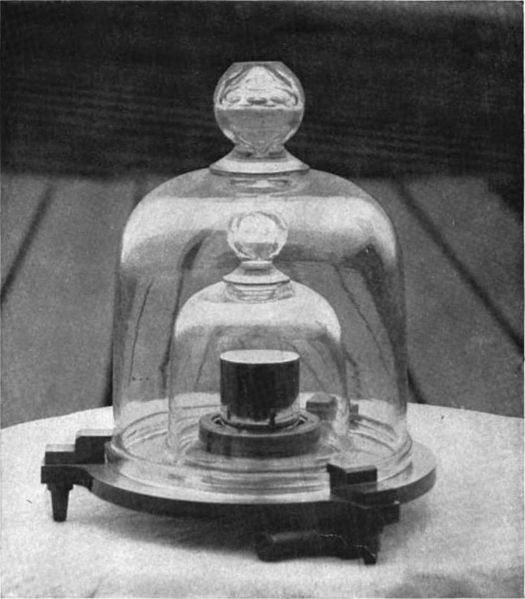
Basing the units on physical properties was supposed to give everyone the ability to create standards, in practice difficulties in producing the standards meant the individually created standards varied widely.  In 1889 the definitions of the meter and kilogram were changed to an artifact standard; an artifact standard is a standard based on a physical object, in this case, a platinum-iridium rod and cylinder located just outside of Paris France.

The original Kilogram stored in several bell jars.
National Geographic magazine, Vol. 27, No.1 (January 1915), p. 154, on Google Books. Photo credited to US National Bureau of Standards, now National Institute of Standards and Technology (NIST).

The use of the artifact standers lasted for quite a while; however, as science progressed we needed more accurate standards and the definition’s changed again, the new idea was to define all the base units on universal physical constants.  Skipping over the krypton 86 definition, in the 1960s the definition of the meter was changed to the distance light travels in a vacuum in 1/299,792,458 of a second (3.3 nanoseconds).

The speed of light was chosen to define the meter because it contains the meter, the speed of light is 299,792,458 m/s. This definition might seem a little strange, but it makes a lot of sense.  The speed of light is a universal constant, no matter where you are the speed of light in a vacuum is the same. To determine the length of the meter, you measure how far light travels in 3.3 nanoseconds. If your scientific experiment requires higher precision, you can make a standard with higher accuracy, instead of using 3.3 nanoseconds you could measure how far light travel in 3.33564 nanoseconds.

On November 17, 2018, the definition of the kilogram changed at the 26th meeting of the General Conference on Weights and Measures. The new definition of the kilogram uses the Planck’s constant which is 6.62607015×10⁻³⁴ Kg m2/s.  Like the meter, the definition of the kilogram applies a constant that contains the standard.  Just like the meter the determining the precision of the kilogram is dependent on the accuracy of the measurements.

Up to this point, we’ve taught the kilogram as an object; the definition of the kilogram was a cylinder just outside of Paris no matter what happened that cylinder was the kilogram. However, with these new definitions, it becomes possible for students to derive the standards themselves. Scientists at the National Institute of Standard and Technology (NIST) created a Kibble or watt balance, the device used to measure the Planck constant, built out of simple electronics and Legos.

It is surprisingly accurate (±1%) you can read about it here. Using the Kibble or watt balance, it would be possible to develop lab activities were students create a kilogram standard and then compare it to a high-quality purchased standard.

With the change to the kilogram standard, is now possible to use the metric system to teach universal constants and have the students derive all the SI standards based on observations and first principles. The real question is, should we? For the bulk of the science students and scientist for that matter, how deep does their knowledge of the SI system need to be? Most are not going to become metrologist’s the scientist that study measurements and measurement sciences. With the ever-growing amount of scientific information, we need to think about not only what we teach but how deep we teach. What do you think, students can now derive the standards of the SI system from first principles, should they? We can’t teach everything how do we determine what to teach and how much to teach?


Thanks for Listening to My Musings

The Teaching Cyborg
Obviously, They Should Read 40 Pages, Right?

“No two persons ever read the same book.”
Edmund Wilson


The designing of a course is about more than what happens in the classroom.  A course also includes homework, papers, and reading assignments to name a few.  According to the Carnegie unit recommendation, all the out of class work should fit into a period equal to two hours for ever credit.  Therefore a 3-credit course would have 6 hours of work outside classroom a week, how should that time be divided.  A question often asked is how much reading should I assign?

What this usually means is how much reading is reasonable considering all the other learning obligations the students have.  In the book, Academically Adrift: Limited Learning on College Campuses, Richard Arum, and Josipa Roksa state that students that have at least 40 pages of reading a week had more substantial gains on the College Learning Assessment. Since the information on the reading is self-reported, we don’t know what kind of reading this represents.  There are multiple types of reading, as an example, there is skimming, scanning, intensive, and extensive another set of options is surveying, understanding, and engaging used by the Center for Teaching Excellence at Rice University.

When students read for the survey, they are just trying to find the main points.  Reading for understanding requires the student to attempt to understand all the text down to the level of single sentences.  Finally Engaging with the book requires all the skills of reading for understanding while using the book to solve problems and build connections.

A book being viewed through a magnifying glass.
Book viewed through a magnifying glass. Image by Monica Velazquilo (CC BY-SA 3.0).

One way to estimate how much time it will take students to read a specific number of pages is a course workload calculator on the Reflections on Teaching & Learning blog on the Center for Teaching Excellence site at Rice University.  Using the workload calculator if the students reads 40 pages in a survey mode it takes 1.43 hours, Understanding takes 2.86 hours, while Engaging takes 5.71 hours.  If a three-credit class has an out of class workload of 6 hours, reading for engagement would take up all a student’s out of class time. Therefore if the point of your reading assignments is reading for engagement either 40 pages is too heavy, or it is the only thing the students should be doing.

There are other factors beyond the type of reading that affect how long the reading takes, like the complexity of the text.  The more significant the amount of new information in a book the longer it is going to take to read.

While the 40+ page suggestions from Academically Adrift is one of the few research-based examples I have seen there are additional suggestions.  In one case a course that meets on Tuesdays and Thursdays the instructor suggest assigning 80 – 120 pages for the period between Thursday and Tuesday and 30 – 40 pages for the period from Tuesday to Thursday.  The argument being that the weekend adds 48 hours, so the students have more time and can read more.

I don’t like this argument, the students have additional time, so they should do more reading.  The main point of the reading assignments is to get ready for in-class activities or to reinforce class activities.  In this example, the two class periods are the same length the amount of material used to prep for the class should be the same.

So, how many pages should be an assignment for each class period?  It should be clear that this is not a simple or straightforward issue.  Let’s start with a 3-credit class that meets Monday, Wednesday, and Friday, 3-credit hours times 2 hours per credit means this course has 6 hours per week for reading and assignments.  So, if we assume, we are talking about an introductory course that uses a textbook, and we devote half the total students time to reading (reading for understanding) then using the Rice tool the students would reading 42 pages in 3 hours. The 42 pages suggested by the tool match the reading recommendation from Academically Adrift.

Dividing the 42 pages by the three, students should read approximately 14 pages for each class period.  In a regular semester excluding exams and holidays, there are 40 class periods this gives us a maximum of 560 pages per semester.

How does 560 pages compare with what courses are doing? Looking at the reading list for some introductory science courses, the total number of pages assigned are 261, 256, 338, 463, 475, and 347.  The average page number is 375 ± 87. If we divide the average by the total number of class periods (40) that would mean students would be reading about 9.4 pages for each class or 28.1 pages per week.

So, what does this mean, are introductory science courses are underperforming?  I don’t think so.  For instance, the estimation tool I have been using lists different word densities for different types of books.  For a paperback book, it lists 450 words per page while a textbook has 750 words per page. If we went with word count, then 40 pages of a paperback equal 24 pages of a textbook.

Beyond word count, we should also ask about the number of new concepts? Additionally, is the student reading to prepare for a discussion, to get a general overview of a topic, or to gain a deeper understanding?  While I would love to have a rule or a set of rules that will help us design the best learning experiences, I don’t think we are there yet.

Is course design by word count the way we should go?  Again, I don’t think straight numbers whether pages or word count is the way to go. Because of variables like words per page, number of new concepts and types of reading I’m not sure we will ever have a single rule that determines the optimal number of pages to read.

Just using a number does not consider the reason for the reading assignment or the number of new topics in the text.  Since new concepts and long-term learning are impacted by things like working memory, and short- and long-term memory, I think the number of new ideas and the complexity of the text may end up being the most critical aspects when determining the length of reading assignments.

To determine the amount of reading appropriate for a course we defiantly need more research.  However, I’m not sure this is something that is really on the research radar.  If your students are having trouble do you ever think about changing the amount of reading?  How important do you think the reading assignments are to your students learning?  Do you think we are too concerned with how much reading we assign to students?


Thanks for Listening to My Musings

The Teaching Cyborg

But I Thought I Knew That!

“We are infected by our own misunderstanding of how our own minds work.”
Kevin Kelly


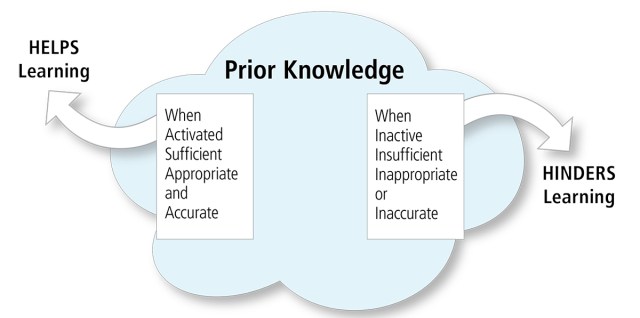
Over the last several decades we have learned a lot about teaching and learning.  One of the most critical things with regards to education is the addition of new information to memory. The storage of new information in memory and our understanding of that information is dependent on what we already know. According to Jean Piaget’s Cognitive theory, three critical components of learning depend on preexisting knowledge Equilibrium, Assimilation, and Accommodation.

In Piaget’s modal assimilation occurs when the new information matches a learner’s preexisting views and without changing can be incorporated into their view.  Accommodation happens when new knowledge conflicts with the learner’s preexisting view of the world, in this case, the student’s view must change to incorporate the new knowledge.  Equilibrium is the condition where most new knowledge can be dealt with by the students existing view.

In simpler terms, preexisting knowledge can either help or hinder a student’s learning.  If the preexisting knowledge aligns with the existing knowledge, it helps, when the current information does not align with existing knowledge it hinders.

PriorKnowledge_Combined Files-1

Modified From: Exploring Research-based Principles of Learning and Their Connection to Teaching, Dr. Susan Ambrose

Since no student is a blank slate, they will always have a view based on their own life experiences.  When a student learns something that does not fit their view, either their view must change (accommodation), or the new information is altered to fit their view (incorrect assimilation).

In modern education, we call these incorrect views a misconception.  To overcome misconception so that accommodation can occur students must actively acknowledge their misconceptions.  These misconceptions can be especially impactful in science education where many of the ideas taught can’t be touched or physically observed.

In chemistry, we teach students about atoms and molecules, which are too small to see or feel. In astronomy, we teach students that the earth is orbiting around the sun at 67,000 miles per hour.  However, do we feel that speed on the surface of the planet?

Beyond misconceptions derived from observations, students can also acquire misconceptions from language.  In the field of genetics, a common misconception is: A dominant mutation is the most likely one to be found in the population. This misconception likely comes from the word dominant which has six definitions according to the Marian-Webster dictionary.

Dominant

  1. a: commanding, controlling, or prevailing over all others the dominant culture
    b: very important, powerful, or successful a dominant theme a dominant industry the team’s dominant performance
  2. overlooking and commanding from a superior position a dominant hill
  3. of, relating to, or exerting ecological or genetic dominance dominant genes dominant and recessive traits
  4. biology: being the one of a pair of bodily structures that is the more effective or predominant in action dominant eye used her dominant hand
  5. music: the fifth tone of a major or minor scale (see scale entry six sense 2)
  6. a: genetics: a character or factor that exerts genetic dominance (see dominance sense 1b)
    b: ecology: any of one or more kinds of organism (such as a species) in an ecological community that exerts a controlling influence on the environment and thereby largely determines what other kinds of organisms are present dominant conifers
    c: sociology: an individual having a controlling, prevailing, or powerful position in a social hierarchy: a dominant (see dominant entry one sense 1) individual in a social hierarchy

Most of the definitions have to do with importance, power, and control, which is likely why students think a dominant mutation is the most likely one to be found in a population.  However, there is another genetic term for the most common allele in a population, wild-type.  In genetics the term dominant must always be used about something else, for example, the phenotype of the dominant allele B is expressed instead of allele b.

I have always preferred to use the five-terms established by Hermann Muller to classify the specific types of genetic mutations over general terms like dominant and recessive.  Regardless of the words used, the students need to understand that we are discussing mutations that change the function of genes which has nothing to do with a mutation’s frequency in a population.

Another common genetic misconception is that all mutations are harmful.  At the DNA level, a mutation is simply a change to the DNA, a lot of mutations do not affect.  As an example, if a mutation occurred in a coding region, there is a good chance it will not change the final product.  If the mutation occurred in the third position of the alanine codon GCT and became GCC, it would still code for alanine, in fact, all four GCx codons GCT, GCC, GCA, and GCG code for alanine. That means any change in the third position of this triplet will not affect the protein formed. There are a lot of other misconceptions in genetics, but that is a discussion for another day.

When it comes to helping students deal with their misconceptions, it can help to try and understand where the misconceptions came from, and what might be influencing them.  As a faculty member once said, “If you want to understand what a student is thinking, ask them.”  If a student does not comprehend new information, it might be because of previous notions.  Learning what the student’s assumptions are and how the assumptions are interfering with the students learning will only make you a better teacher.


Thanks for Listening To my Musings

The Teaching Cyborg

We Need CSS for e-books

“The layout of textbooks, I think, has been done with an assumption that students don’t read.”
James W. Loewen


Throughout several decades, I have watched the development of the technology used to build websites. I hand coded my first website using HTML 2 while I was still an undergraduate.

With each additional release of HTML, the addition of features allowed us to add more and more to websites. Additionally, many other technologies have added to websites like JavaScript and cascading style sheets (CSS).

I think CSS was one of the most significant changes to web design. One of the most apparent advantages of CSS is greater control of layout and design. While it would not be the best way to design a website with CSS, you can determine the position of every element on a webpage down to a single pixel.

Modern websites also use CSS to produce different layouts for desktop and mobile viewing. The reason I think CSS was such a significant change is CSS requires a different way of thinking about design and layout.

Proper use of CSS separates the content from the layout. CSS gives us the ability to move, position, and style content any way we want without changing the content. CSS layout is dependent on the use of tags, by giving each element of the website a unique identifier we can use CSS to place that element anywhere we want.

As an example, suppose we wrote three separate paragraphs and gave then CSS tags para1, para2, and para3.

One way to add the tag looks like this:

<p class=”para1”> Lorem ipsum dolor sit amet, consectetur adipiscing elit, sed do eiusmod tempor incididunt ut labore et dolore magna aliqua.</p>

Without the unique tag it would look like this:

<p> Lorem ipsum dolor sit amet, consectetur adipiscing elit, sed do eiusmod tempor incididunt ut labore et dolore magna aliqua.</p>

In and of itself that is not a big deal. However, since the paragraphs are now named elements, I can use CSS to style them independently of each other on the page.

If I do nothing, the three paragraphs will come one after the other. With just a little bit of CSS, I can make paragraph 2 right justified while the other two paragraphs stay left justified.

The code is:

.para2 {  text-align: right;  !important; }

The other paragraphs will stay left aligned because that is the default.

With some other code, I can make one of the paragraphs disappeared.

.para1 { display: none; }

This code would hide the first paragraph.

As the last example, I can change the order of the paragraphs.

p { display: flex; flex-direction: column;}

.para1 {order: 2 }

.para2 {order: 1 }

.para3 {order: 3}

This code would flip the order of the first and second paragraph while leaving the third where it is. These examples show that the code needed to make changes is rather small.

Now, why am I talking about CSS? Not long ago I wrote a blog discussing the problems I had with glossaries in several textbooks (read that blog here). In short, the traditional glossary at the end of a book was broken up and placed at the end of each chapter. For many reasons, I think this makes glossaries harder to use.

The reason for the glossary at the end of chapters is the fact that textbooks, especially open-source ones, are not meant to be used in their entirety but only the parts that fit your course. Since the book designers do not want extra words in the glossary, they split the glossary up.

Now imagine if we took the readability and accessibility of the electronic publication (EPUB) format and coupled that with the layout advantages of CSS. Now instead of copying, pasting, and editing the text of an open-source textbook with a few lines of code you can make a book for your course. Additionally, if something changes in your class, you can easily edit the book by making changes to the CSS. As an example, suppose we tagged all the text in a chapter with a unique name like chp#. If we added the same tag to the words in the glossary the words would behave the same as the chapter when formatted with CSS.

Now if we hide chp# not only will the chapter text disappear but so will the glossary words. However, you might ask “What if we wanted to move chp#? That will also move the glossary entries.” If the glossary entries moved, we would have the same problem with a glossary that I talked about before.

However, CSS has another little trick I skipped over; you can add tags together. As an example, your chapter text is a paragraph which has the default tag p. The glossary is a list, so each word is a list item which has the default tag li.

If I only wanted to move the chapter text, I would use the tag chp#.p this tag will leave the glossary words alone. To make a change to just the glossary words, I would use the tag chp#.li.

The makers of modern electronic books have done their best to re-create books just like their paper versions. While that is fine even desirable in some cases, we should not limit ourselves to it. After all, it should be comparatively easy to add functionality to electronic books.

We already have the code to make use of CSS it is in every web browser currently in use. This code can be added to e-reader software to give e-readers the ability to handle CSS. As for the creation of the books, we could start with any of the website creation tools and add the ability to export and save the documents (sites) as an EPUB document with CSS.

Having electronic books with expanded capabilities would give us tremendous advantages in addition to just CSS we can imagine being able to embed all kinds of additional content; media, live video, tests, and chat/discussions now books aren’t merely repositories for knowledge but a tool for learning.

We currently have all the tools we need to expand the functionality of the EPUBs format all we need to do is bring them together. Having this new EPUB format as a new tool would give us tremendous abilities as we design new and improved books for the use in the classroom.


Thanks for Listening to My Musings

The Teaching Cyborg