My Students Need to Turn Knobs in Labs

“In general, obsolete technology is obsolete for a reason. Monocles are no exception.”
Neil Blumenthal

Many science faculty view laboratory classes as a central component of science education.  Many groups have come out in favor of the laboratory class. According to the America Chemical Society (ACS), “Hands-on laboratory science experiences are critical to the learning process across all areas of study, beginning with kindergarten and continuing through post-secondary education.” (Public Policy Statement 2017-2020) The National Science Teachers Association says “For science to be taught properly and effectively, labs must be an integral part of the science curriculum.” (NSTA Position Statement)

What is the laboratory class? According to America’s Lab Report: Investigations in High School Science “Laboratory experiences provide opportunities for students to interact directly with the material world (or with data drawn from the material world), using the tools, data collection techniques, models, and theories of science.” (NRC 2006 p. 3) while the ACS says, “well-designed laboratory experiences develop problem-solving and critical-thinking skills, as well as gain exposure to reactions, materials, and equipment in a lab setting.” (ACS Public Policy Statement 2017-2020)

While these definitions have some similarities, they also have differences.  I know science faculty that think we should get rid of science labs and faculty that believe we can’t teach science without them.  The thing that surprises me the most is that a many science faculty tell me that one of the most important aspects of laboratory science is learning to use the equipment.

I was involved in a redesign of a physics laboratory course; this course had not been reviewed or updated in, let’s just say “a really long time.”  We were discussing an acceleration due to gravity lab.  The main goal of this lab was to understand that acceleration due to gravity is independent of mass.  This experiment is often run using an air track which is a device that uses air to produces a relatively frictionless surface for a “car” of different masses to run on.  I won’t go into the reasons but setting up the air track to get accurate readings can be difficult.

Several of us proposed some changes to make the set-up easier so that students could collect more significant amounts of data; this would give us more opportunities to build analysis and data testing into the lab report. One of the faculty members argued that he set up his lab so that the students had to spend 80+% of their time setting up the equipment because the most important thing for the students was to “learn” how hard it was to collect accurate data.  Ask yourself what does this have to do with the learning goal?

While developing biology labs, many faculty members have told me “my students have to learn to twist the knobs on a microscope.”  I graduated from graduate school in 2006 even then every microscope I used was connected to a computer and most of them could not be run without a computer.  I rarely twisted knobs.  Additionally, most of these labs had learning goals associated with learning to identify cellular organelles or the differences between different types of muscles.  Even if the students end up using a non-automated microscope what does twisting knobs have to do with the learning goals?

Beyond an incorrect aliment with learning goals in a world where technology is rapidly evolving it is almost impossible for student labs to teach the use of equipment that will not be obsolete by the time they graduate.  As Hofstein and Lunetta said “It is unreasonable to assert that the laboratory is an effective and efficient teaching medium for achieving all goals in science education” (Review of Educational Research Vol. 52, No 2 pp. 201-217) They do suggest that laboratory activities can be used to develop inquiry, problem solving, and observational skills.

Over the last few decades, all this mixed information has allowed laboratory education to come under increased attack.  Several years ago, I worked with an assistant dean of engineering to develop an assessment tool he could use to reinforce the value of lab classes because the college wanted to cut back on lab classes.  Beyond this example lab classes have been subject to a lot of attack over recent years.  From an administrative point of view, there are questions about the cost; laboratory classes are the most expensive classroom on campus. 

Beyond cost laboratory classes are often assigned the same learning goals as the lecture classes.  Some argue if the two classes are doing the something couldn’t the extra time be better used on additional material? Especially since there are countries that don’t have lab courses in their curriculum. (Science Education Vol 88, #3, p. 397-419)

So, what does this mean for faculty members and instructional designers in science?  First when it comes to laboratory classes making sure we have clearly defined learning goals may be even more critical than it is in lecture classes.  Making sure that the activities in the lab support the learning goal are a must.  Lastly, we need to spend more time thinking about why we use labs, what labs can be used for that other forms of education can’t and focus on them.  If we want lab science courses to last, we need to start fighting for them now.

Thanks for Listening to My Musings

The Teaching Cyborg

I’m Awarding 10 points for Learning

“I went to Columbia University because I knew I wanted to go to a school that was academically rigorous. I prided myself on getting good grades, but I also hated it.”
Ezra Koenig

When you’re a student, it can seem that your life revolves around points. Your points determine whether you pass a class which determines what else you can take and whether you graduate.  It’s no surprise that one of the most come questions students ask is “Will this be on the test?”

Regardless of the school points affect your life.  In J.K. Rowling’s Harry Potter books the phrase “… points for Gryffindor” occurs at least 21 times.  This phrase has had such an impact it made its way in the most import of all art forms the meme (Note Heavy Sarcasm)

Memes based on awarding points to Gryffindor in the Harry Potter Books.

In the Harry Potter books, the points are used to give the hero’s a reword at the end of a book or just as comic relief.  In real life, students find points stressful or focus on points (grades) to the exclusion of learning.

Some discussions suggest grades, at least as we are using them, might be harming student learning. It is stated in the article Teach more by Grading Less (or Differently)


“Grades can dampen existing intrinsic motivation, give rise to extrinsic motivation, enhance fear of failure, reduce interest, decrease enjoyment in class work, increase anxiety, hamper performance on follow-up tasks, stimulate avoidance of challenging tasks, and heighten competitiveness.”

So why do we use points, as educators our role is to provide the best learning experience possible.  If there is any chance that something could be hindering learning shouldn’t we be exploring other alternatives?

When it comes to the idea of eliminating points, I remember a talk I attended in the early days of student response systems (Clickers).  A physic instructor was using clickers to poll students in real-time and then using pear-pear instruction to enhance learning.  At first, many students were not responding. The effectiveness of the clickers in education is dependent on students responding. However, he did not want the students to feel that clickers were an exam. 

The instructor chooses to assigned points to the clicker questions. However, these points only counted as 1% of the course total.  This low amount of points was enough to get most of the students to engage.  The instructor then used learning gains to show how learning in his class had improved with this increased participation.  In this case, points undoubtedly helped motivate students to learn.

So, points can motivate students and promote learning.  Well yes, however, the critical thing to remember the physics instructor assigned the points for a specific pedagogical reason.  We did not choose many of the parts of the standard grading system for pedagogical purposes.

Have you ever thought about the grading scale A, B, C, D, and F what happened to the E?  It turns out the first record we can find for a modern grading scale comes from Mount Holyoke College in 1887 their scale was A (excellent, 95-100%), B (good, 85-94%), C (fair, 76-84%), D (barely passed, 75%), and E (failed, below 75%) there’s that missing E.

Over the years the standardization of the grading scale lost the E.  In the case of the current grading scale standardized is an important word.  As society changed and grew, more and more students transferred between schools or continued their education at an institution of higher learning.  To mediate student movement school needed a way of communicating student abilities and success.  Therefore, one of the most significant driving forces of the modern grading system was the need to communicate quickly and precisely between schools.

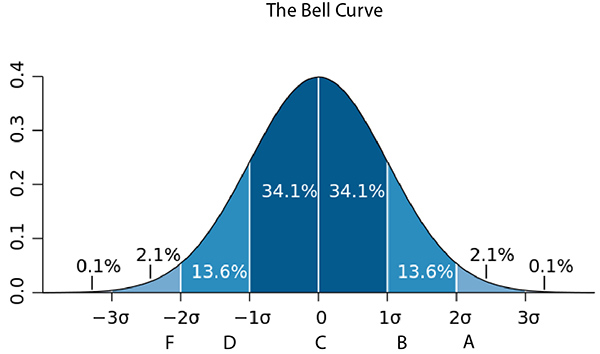
However, you will also note that the percentages for the Holyoke scale are different than many today. Today the difference from one letter grade to the next is usually 10%, and failing is 60% and bellow. Additionally, there was a push in the early to mid-parts of the 20th century to standardize grade distributions to the Normal Distribution/Bell Curve with the C set to the mid or average position.

The Bell Curve modified form Standard Deviation diagram.svg,, Auther M.W. Toews from Own work, based (in concept) on figure by Jeremy Kemp, on 2005-02-09. This file is licensed under the Creative Commons Attribution 2.5 Generic license.

The bell curve added a component of sorting to a system that was supposed to represent mastery.  There is also the question of whether a system (the bell curve/normal distribution) that describes the distribution of physical characteristics (height, weight, strength, etc.) is appropriate to measure learning?

While there is a lot to be said for other grading and assessment methods, the standard grading system is not going to go away anytime soon.  We can’t replace the A – F system quickly because it has many advantages, especially in a mobile society.  As educators, we need to remember that our job is to motivate and encourage learning, the grades will come from knowledge.

When we design our courses, the assignment of points should be for pedagogical reasons.  Just like the clicker in the physics class, we should use points to encourage learning activities.  Points should be assigned based on the activity’s importance to learning, not the need to fill a spreadsheet. Lastly, enough points should be used to allow for a complete and accurate assessment and feedback.

Do you consider the pedagogical impact of your point assignment? Do you think about the effects of grades on your students learning and motivation?  Lastly, why don’t we spend more time discussing something as important as the effects of points and their associated grades on student learning?

Thanks for Listing to My Musings

The Teaching Cyborg

We Have Always Argued Against Ed Tech

“Classrooms don’t need tech geeks who can teach; we need teaching geeks who can use tech.”
David Guerin

One of the arguments I often hear when it comes to educational technologies is: “we’ve always done it this way.” The idea that we have always done something is such a typical answer about why we use a technique that I once informed a group of academic professionals that I banned that answer from the discussion, and told them if they use it I will ignore everything they said.

Whether or not I would have ignored what they said shall remain a mystery. However, the statement was shocking enough to get the audience to stop and think. Aside from the fact that it is just a lazy answer, it is consummately untrue. What this statement means is in my 10 to 30 years of teaching this is what I’ve always done, or this is what my classes were like when I was a student.

Nothing we do in education has been a part of education since educations inception. Blooms Taxonomy (Taxonomy of Educational Objectives, Handbook 1: Cognitive Domain) was published in 1956, 63 years ago. The Myers-Briggs Type Indicator (1956) and the Kolb Experiential Learning Theory (1984) have both influenced how we teach.  The theory of constructive in education (the late 1800s), the Socratic Method (5th – 4th century BC) and the invention of written language (earliest known 3400 – 3300 BC), in their time all changed education. All these developments fall far short of the 150 – 200 thousand years since modern humans evolved in Africa.

Teaching has occurred from our earliest ancestors take the form of oral histories or skills passed down from elder to youth in small groups likely the family. I would guess this type of education, accounts for more than 90% of human existence. It is not until the advent of modern civilization about 10,000 years ago that some forms of education even became possible.

We always view changes in education with skepticism. Socrates is an excellent example of this. Today we have the Socratic method as a teaching style. However, we do not have any written words directly from Socrates about his beliefs in teaching. In his writing, The Phaedrus Plato writes about an exchange between Socrates and Phaedrus to demonstrate Socrates dislike for the written word because he felt it made the mind weak and would decrease memory.

So, there you have it Socrates someone still admired thousands of years after his death for teaching was opposed to the technology of writing. According to stories he was often found teaching outdoors while sitting on rocks. I would almost be prepared to say the man was a technophobe. But for the fact that he ran his family’s stone masonry business.

Today the value we place on good written communications makes the teaching of writing and its act an essential part of modern education. The benefits of long-term storage of knowledge, the sharing of the thoughts and ideas of a master, makes books valuable to learning. The formation of the modern University was dependent on the rarity of early books. Try and think about what modern education would be like without books.

Technology has defined the shape of the modern classroom. Some because it is just what we do and how we live in our modern world, electric lighting, heating and air-conditioning, and A/V systems. (If you happen to be fortunate enough to live in the developed world.) Other things whiteboards/smart boards the modern descendant of the slate because it solved a problem. The slate (chalkboard) was used in the classroom because the teacher could present to multiple students at once. Is there a real difference for the students if we show material on chalkboards versus whiteboards?

Some people argue, in some cases correctly, society has driven changes in the classroom because of changes in the underlying technology of society. A great example of this is computers and printers. When I was in middle school, I turned in all written assignments in hand-writing. In high school, we had the option to turn it in typed or hand-written. In my undergraduate days, we had to use computer printers on all our assignments. Nowadays I work with people that except writing assignments as digital files or blog posts. These changes have mirrored the changes in how we write in our day-to-day lives. Remember we do things like we always have.

However, the changes from the handwritten to the computer word processor isn’t universally like. For instance, the teaching of handwriting (cursive) has all but disappeared from modern education. The Common Core Standards prefer the keyboard over hand-written words starting in elementary school. Some research, however, suggests that the elimination of hand-writing will affect the development of the brain, especially concerning reading. The effect of handwriting on the development of the mind is an area where more research is needed.

It is essential to be critical about changes in education after all the goal is to provide the best educational experience we can. However, a knee jerk rejection to something, because it is “technology,” is as equally harmful as excepting everything without thought. After all, everything we use and work within the classroom is technology. So, why do we resist change? Part of the reason for this resistance is our psychology as humans; there are psychological effectors that affect our approach to change.  Alternatively, as Ronald Heifetz says, “What people resist is not change per se, but loss.” The Practice of Adaptive Leadership: Tools and Tactics for Changing Your Organization and the World.

Like so many things the truth about resistance to ed tech is more complicated than our expectation. Regardless of which side of the ed tech debate you belong to do you ever think about why the other side is doing what they are doing? If you’re in favor of a new piece of technology have thought about why people might be resisting the change, is there a better way to present your idea? If you are resistant to the idea of new technology, have you thought about why your resisting? It is import that we all engage with new technology so that it can be used thoughtfully instead of being imposed from the outside.

Thanks for Listening to My Musings
The Teaching Cyborg
Stop Abusing Numbers, It Will Help You

“There are three types of lies — lies, damn lies, and statistics.”
Benjamin Disraeli

Numbers are useful; they give us the ability to make comparisons, identify trends, and identify gains.  We built a lot of modern civilization on numbers, architecture, engineering, finance, the ability to elect politicians or vote on laws.  We use numbers to support arguments or draw attention to a problem we see.

However, it is essential to pay attention to the use of numbers.  Why are you making the choices you made?  When I read an article that starts with numbers and then stops using them, I get suspicious.  I have been thinking about this a lot since I read an article back in October, that article was ‘Fortnite’ teaches the wrong lessons in THE CONVERSATION.

The article argues that the video game Fortnite is teaching the wrong lessons and this will be harmful to society.  To quote the article,

“I couldn’t help but notice how much the game seems to teach children the wrong lessons about how to function as an adult and interact with others. I came away from my “Fortnite” experience thinking that the game is raising young people to be self-centered, not good citizens.”
Nicholas Tampio

The central argument of the article is that the number of players compounds the games “problems.”  Around October 2018 epic games announced it had 125 million players by December 2018 this number had grown to 200 million players. These are undoubtedly large numbers, especially if you write them out 125,000,000 – 200,000,000, most people can’t comprehend numbers that size it triggers an incomprehensible response.

Undoubtedly that is the response the author wanted.  I would argue that this is, in fact, a miss representation and an egregious one at that.  After all, there is another number that is important 7,545,224,830 or 7.6 billion which is the world population according to the Census Bureau world population clock at 5:34 PM January 9, 2019.  Why is this important? The world population is significant because the 125-200 million Fortnite Players are worldwide.

More importantly, the author could have presented this information differently.  Specifically, what would you say if I wrote an article arguing that Fortnite was a problem for the future of society and I based my whole argument on the fact that 1.7% – 2.7% of the population played Fortnite?  I would guess you would probably not take me seriously.

Now then the Fortnite player numbers of 125 – 200 million are worldwide numbers, and the numbers calculate out to 1.7% – 2.7% of the world population.  What’s more important 1.7% means the same thing as the 125 million used in the original article and it is easier to understand.  That is a little incorrect if the author had written the number correctly, 1256 million players would be 125 million people around the world or 125 million out of 7.6 billion people, then they would have been the same.

The only reason to use the numbers this way is the shock value.  From the point of content, there would have been little differences with the opening paragraph if the author had left out the number.  Don’t believe me read the two options below.

The opening paragraph as written in the article.

“In recognition of the fact that “Fortnite” has quickly become one of the most popular video games in the world – one played by more than 125 million players – I decided to play the game myself in an attempt to understand its widespread appeal.”

The opening Paragraph without the numbers.

“In recognition of the fact that “Fortnite” has quickly become one of the most popular video games in the world I decided to play the game myself in an attempt to understand its widespread appeal.”

Both paragraphs get the same message across. So why use the number to shock people, there is another place in the article were numbers are miss represented.  In the section titled a time-consuming habit, the author presents information about the average length of play. The average player plays between 6 and 10 hours a week with 7% playing more than 21 hours.

However, let’s spend some time looking at these numbers, how many hours are there actually in a week?  The answer is 168 hours, so what percentage do 6 – 10 hours workout to 3.6% – 6% of a week.  Looking at the high end 21 hours is 12.5% what if they played for 30 hours a week that would be 17.8%.

Let’s look at another couple of points, if you get the recommended 8 hours of sleep a night that is 56 hours a week or 33.3% repeating (Leroy Jenkins anyone? Sorry couldn’t help myself.) of the week.  A full-time job is 40 hours or 23.8% of the week.  If you played Fortnite for 30 hours a week, got 8 hours of sleep a night, and worked a full-time job that would add up to 75% of the week you would still have 42 hours a week for other things.  Personally, these numbers don’t seem all that problematic.

Also, there are several points where numbers are conspicuously absent.  One of these is that couples are starting to blame Fortnite for their divorce. To begin with, this is not the first time video games have been blamed for a divorce, see this article from 2008 about the World of Warcraft video game.  More importantly, according to the American Psychology Association, the divorce rate is 40% – 50%.  Let’s ask the important question if we look at all the Fortnite players do more then 50% of the married Fortnite players get divorced? The only available answer that addresses this is from England were 5% of the divorces filed with Divorce Online sited Fortnite.  So does Fortnite have a fundamental effect on Divorces, personally I don’t think so (at least not yet)?

Another point made in the article is the hiring of tutors to improve your Fortnite play.  The author presents tutors as unique to Fortnite.  However, this is not true the first time I became aware of hiring tutors for video games was when several websites offered links to tutors when Hearthstone launched in 2014. The reality is video game tutors are more dependent on the emergence of the e-sports market then Fortnite.

One of the last points is the idea that video games cause adverse developmental effects.  The developmental effects of video games are a topic that can fill up entire books.  The only thing I will say is that for every study saying that video games are bad there is a study showing they are not.  To present a single review and say video games are dangerous without the counterpoints is a gross miss representation of the data. I think the data is leaning in the direction of video games not having an adverse impact on development, but that’s a different argument. The only thing we can conclusively say about video games is that we don’t know what kind of effect they have on development. 

While I think this article badly miss represents the data about Fortnite I believe there is an even more critical point here.  I don’t think Fortnite is a problem, however, maybe it will become one or a video game in the future will be a problem.  However, as an author of a document miss using numbers undermines the believability of your writing.  You could be presenting correct ideas, but if you show your data incorrectly, you give your opponents the ability to ruin your arguments.

Using data to fear monger is never the correct approach.  If you want to influence people and policy, you need to present arguments that lay out all the viewpoints and present your viewpoint in a logically unassailable way.  When you use numbers make sure you use them correctly, or you may hurt yourself more than you help.

Thanks for Listing to My Musings

The Teaching Cyborg
Tell Me a Story

“A story has no beginning or end: arbitrarily one chooses that moment of experience from which to look back or from which to look ahead.”
Graham Greene

Story it’s an interesting word like so many words in English it has many meanings.  If you look in the Mariam Webster’s Dictionary, the word story has 18 definitions if you include the sub-definitions.  We use story a lot in the sciences.

How do I know when my research is ready for publication?  You’re ready for publication when you can tell a story.  How will I know when I’m prepared to write my dissertation?  You’re prepared to write your dissertation when you can write a complete story. The answer to many a question is when you can tell a story.

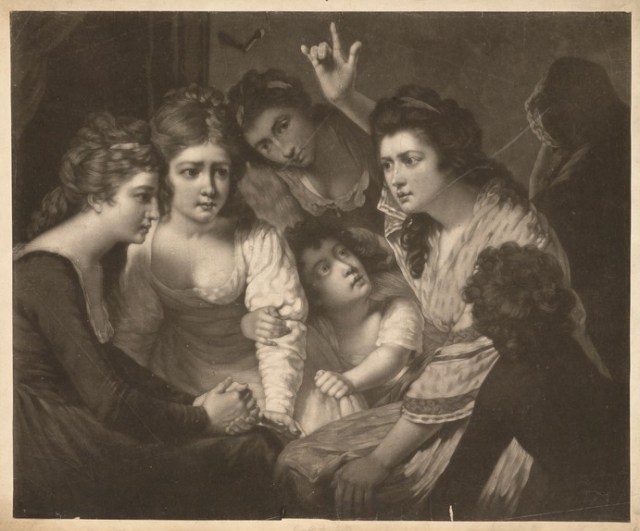
A lady telling a gripping story to young women and children. Mezzotint by V. Green, 1785, after J. Opie. Credit: Wellcome Collection, CC BY

Why a story?  A story is a very efficient way to teach something.  A properly constructed story helps us understand what is going on by logically presenting information and highlighting the links and connections between separate facts and events.  There is even a word for this storification in the paper Storification in History education: A mobile game in and about medieval Amsterdam the authors talk about the advantages of storytelling in History,

“In History education, narrative can be argued to be very useful to overcome fragmentation of the knowledge of historical characters and events, by relating these with meaningful connections of temporality and sequence (storification).” (Computers & Educations Vol 52, Issue 2, February 2009, p449.)

Storification also makes sense in regards to working and short-term memory.  Working memory and short-term memory are transient; permanent information storage takes place in long-term memory.  However, they are both critical to the establishment of long-term memory.  Information enters the memory system through Short-term memory, and processing and connections happen in working memory.

Unlike long-term memory, both short-term and working memory have limits on their capacity.   Recent work suggests that the size of working memory is 3 – 5 items.  For example, I could reasonably be expected to memorize a list of letters; H, C, L, I, and Z. I know some of you were going to say seven items as in the magical number seven, I break down the changes in our understanding of working memory in another blog post, you can read about it here.

However, we can quickly see a problem with 3-5 items; I can also remember a sentence, “All the world’s a stage” this sentence has 18 characters 19 if I count the apostrophe. I can hold this sentence in short-term memory.  I can remember these 18 characters due to a process called chunking coined by George Miller in his paper The Magical Number Seven, Plus or Minus Two Some Limits on Our Capacity for Processing Information.  Miller describes it as “By organizing the stimulus input simultaneously into several dimensions and successively into a sequence of chunks, we manage to break (or at least stretch) this informational bottleneck.” (Psychology Review Vol. 101, No. 2 p351)

In our example’s words are chunks; specifically, each word is a list of letters that have a specific meaning.  If I were to present that list of letters to you in a different way as zilch, it would be much easier to remember. Chunking is the same idea behind storification or storytelling; you are organizing the information into related chunks to make it easier for the mind to remember and digest.

With all the complicated information in a scientific paper, A story is a perfect format to present new scientific knowledge.  A scientific paper starts with an abstract which gives an overview. Then the paper has an introduction which places the new information in context with the old. Then we show the experiments (in the order that explains the information the best. not necessarily chronologically). Lastly, there is a summary that reiterates the new information in context with the old and what directions the research could go next.

A faculty advisor of mine once described writing a science paper as tell them what you are going to tell them, tell it to them, then tell them what you told them.  That might seem a bit excessive, in fact, I once had a non-science faculty member after hearing this triple approach to paper writing say, “what are scientists stupid?”  I think it’s a smart strategy, after all, have you ever had a teacher tell you how many times you need to hear something to commit it to memory? (I always heard it was three)

There is one thing I find quite strange about storytelling in science education.  It seems to me that helping students make connections and tie information together is the most important in the earliest stages of education — for instance, the steps of education that use textbooks.  However, the writing of most current science textbooks presents information as separate chunks.

Like I have said in previous blog posts the reason for writing the modern textbook as independent chunks are so we can use the textbook in any class and any order. However, if we want textbooks to be as useful as possible shouldn’t they be written as a story?  We should write the textbook so that we group information into meaningful chunks, we should write the textbook so that we present information in ways that reinforce the relationships and dependencies between new information and preexisting knowledge.

What do you think is the lack of storytelling harming modern textbooks?  Has our desire to produce textbooks (commercial and open source) that can be used in as many different classes as possible hurting the usability of the modern textbook?  Can we create textbooks that are storified or would they be unusable in current courses?  However, if a storified textbook helps the students learn and if we can’t use them in current courses is the problem with the textbook or the course?

Thanks for Listing to My Musings

The Teaching Cyborg