Genetics, Sorry Its Actually Math

“The truth, it is said, is rarely pure or simple, yet genetics can at times seem seductively transparent.”
Iain McGilchrist

Depending on the type of biology degree a student is earning the classes taken can vary. However, in a lot of programs, you will take a basic genetics course as the second or third course of the introductory sequence.

Sometimes I think genetics is a lot like the game of GO simple to learn but challenging to master. Genetics relies on simple rules and principles. These rules and principles can combine to form surprising complexity. There are only five types of genetic mutations and three laws of Mendelian inheritance. A Punnett square (a tool to analyze potential outcomes of a genetic cross) for a cross between to heterozygous (Aa) parents has four boxes. A Punnett square for a five gene heterozygous (AaBbCcDdEe) cross has 1024 boxes.

However, for all the simplicity of basic genetics, many students drop out of biology during or after that first genetics class. So, if the foundation of genetics is simple why do so many students leave or fail genetics. The reason is math, invariably a week or two into a genetics class I always hear students say something like “I choose biology, so I didn’t have to do math.”

Thinking biology does not use math is a funny statement to anyone that has completed any science degree because we all know science always includes some math. Most science degrees require at least some level of calculus graduate. For most biology students’ genetics is the first time where a lot of math is part of the biology.

Beyond the fact that genetics integrates math the bulk of the math is statistics, you could even say that genetics is statistics. Even if the students had statistics, it was probably not embedded into biology. While students might know the basics of statistics, they might have problems with transference, the ability to take preexisting knowledge and apply it to a new situation.

If students are having problems with transference concerning the principles of statistics, or even worse have not had a statistics course, they are not going to be able to focus on biology. Think about a simple piece of information; we tell the students that the probability of a baby being a girl is 50%. Then on a quiz, we ask the students this question (I have seen it used) “In a family with four children how many are girls and how many are boys?” The answer that the instructor is looking for is two girls and two boys. However, I know families that have four girls, or four boys, or three girls and one boy, or 1 girl and three boys. If a student put down one of these other answers, it is technically correct because all these options have happened.

While one problem is the poorly written questions, there is also a problem with understanding what a 50% probability means. One of the most important things that students need to understand is that a 50% probability is a statistic based on population. It is entirely possible for probabilities to vary widely with small sample sizes, as the sample size gets larger the probability of heads to tails to get closer and closer to 50%.

A simple way to think about the sex ration is coin flips. When we flip a coin, we say you have a 50% chance of getting heads. Now suppose I flipped a coin three times and got tails on all three, what is the probability that the fourth flip will be tails? There is two answer I hear most often 6.25% and 50%. The correct answer is 50%. You see every coin flip is an independent event that means each coin flip has a 50% probability of coming up tails.

Coin Toss by ICMA Photos, This file is licensed under the Creative Commons Attribution-Share Alike 2.0 Generic license.

Now if we were to flip a coin 200 times in a row, the total data set would average out to be close to 50% heads to tails. However, even in this larger sample, there are likely to be several relatively long runs of heads or tails in some case more than seven in a row. People can quickly detect fake versus real data directly from the fact that most faked data does not have long enough runs of heads or tails, you can read about it here.

Therefore, one of the most important things we can teach students is the principle of significance. Students need to understand that it is not essential to merely show that probabilities and averages are different but that the difference between them is significant.

What does all this mean for genetics education? First, students should have a basic understanding of statistics before they take genetics. I believe that if statistics are not required to take statistics as a prerequisite for genetics you are not seriously trying to teach genetics to everyone.

However, even if the students have a foundation in statistics genetics lessons should be designed to help the students transfer knowledge from basic statistics into genetics. The transfer of information is also a situation where technology can help. In many math classes especially at calculus and above students often use software like Mathematica to solve the math equations once the student determines the correct approach and writes the equation.

In a genetics’ class students don’t need to derive or prove statistical equations. The students need to know what equations to use and when to use them. There are several statistics analysis software programs available. We should let the students use these tools in their class, a lot of professional scientists do. If we made statistical analysis software available, then students could focus on learning what calculations to apply were and focus on the biology that the statistics are highlighting.

What do you think should we design genetics classes to try and reach all the students? Could statistical analysis tools help the students taking a genetics class? Have you tried helping your students transfer knowledge from their statistics class to their genetics class? How often do we consider transference when we design new courses, should we be doing it more?

Thanks for Listing To my Musings

The Teaching Cyborg
Let Them Run Their Own Labs

“Research is creating new knowledge.”
Neil Armstrong

I suspect that people have been arguing about teaching science since we started teaching science. There are multiple groups that each have their models and best practices. In recent years we have even seen the progression of specialized undergraduate majors. Which suggests that some schools think content that used to be part of a foundational bachelor’s degree is no longer necessary.

One of the things that most of the groups interested in science education agree on is the more like real science we can make the learning experience the better the learning and understanding of science will be. There are even some schools like Reed College that requires all their students to complete a senior thesis and oral defense, under a faculty members supervision, to earn a bachelor’s degree.

Imagine if every bachelor’s student could spend a year studying and writing about a topic in their field that interested them. Not only would students get to “geek out” about a topic that interested them, think about how much we would learn.

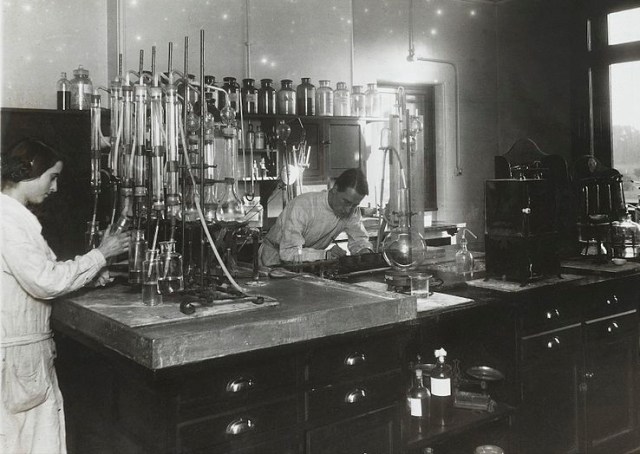
Chemical research lab, Beckenham. Two chemists at work, surrounded by equipment and apparatus. Archives & Manuscripts, This file comes from Wellcome Images, license CC BY 4.0

The problem with Reed’s model is that it does not scale. Reed College has an enrollment of 1400 students and a 9 to 1 student to faculty ratio. It’s not feasible to scale this to a Tier 1 research institution that has 25 – 40 thousand students and nowhere near a 9 to 1 student to faculty ratio. Faculty don’t have space in their research labs to support student populations in the 10s of thousands.

There have also been a lot of programs developed and tested to provide students with research experiences. Most of these programs are small only 20 – 30 students. Also, a lot of these programs are short 8 – 12 weeks during summer. Additionally, since most are small, they have become highly competitive leading to access to only the top students.

While these programs have their heart in the right place, they are not going to provide research experiences to all students with program sizes of 20 – 30 students. If we are going to have a goal of providing research experiences for all bachelor’s students, we need another approach.

I have put a lot of thought into the idea of incorporation research into required laboratory science classes. If we incorporated a year-long research project in required laboratory courses all students would get research experiences. Additionally, the class would be more coherent because experiments would flow one to the other based on the results from previous work. However, research as a lab course is an idea for another day.

I recently came across an article that potentially presents another way to give students real research experiences. Before I get to the article, I want to show some of the background ideas that make this idea possible.
One of the most significant problems with scaling research experiences in a large university is the availability of space in faculty research labs and the availability of research mentors. It might be possible to reduce the burden on faculty by using the knowledge of the crowd.

We already use per – per instruction in large lecture classes, why not use it in research. After all, in professional research, you can’t look up the answer to your research question. In professional research, we talk to our colleagues and try out experiments until we get a direction or answer the question. Additionally, many of the groups that are interested in science education suggest having students work in groups.

The idea for undergraduate research comes from an article Pushing Boundaries: Undergrad launches student-driven particle astrophysics research group published in CU Boulder today on November 16, 2018. The article describes a research group formed by Jamie Principato that was established and run by undergraduates. The group is composed of 30 undergraduates who are designing and building an instrument to measure cosmic radiation. The group’s detector has already flown on high altitude balloons. You can read the full article here.

From my point of view, one of the most interesting things is that the 30 members of the group had little or no previous research experience. While Jamie Principato is an exceptional student, I can’t help but think undergraduate formed research groups could be the solution or at least part of the solution to undergraduate research experiences.

Depending on the question some of these groups could run for years with new undergraduates joining each year. If we think of undergraduate research groups having about 30 students than a departmental graduating class of 250 students would need nine groups a class of 500 would require 17 groups. With some proper planning and organizing this seems a reasonable number of groups for a department.

What do you think could student-run, and organized research groups be the solution to undergraduate research experiences for all students? Do you think undergraduate research experiences for all students are something we should be trying to develop? I think student-run and organized research groups could be the solution to undergraduate research experiences for all students, especially at large universities.

Thanks for Listing to My Musings
The Teaching Cyborg

It Might Have Happened, We Don’t Know for Sure, But Now We Freak

“We wait until Pandora’s box is opened before we say,”Wow, maybe we should understand what’s in that box.” This is the story of humans on every problem.”
Peter Singer

Louis Brown was born July 25, 1978, for some people she was surprising maybe even scary, you see Louise Brown was the first in vitro fertilized (IVF) baby ever born. Today IVF is a technique that barely causes people to bat an eye. In fact, according to the Society of Assistant Reproductive Technologies (SART) from 1987 – 2005 in the US one million babies have been born through IVF and other reproductive technologies.

We have two more names Lulu and Nana born November 2018. Lulu and Nana might not be their real names, we don’t know their last name, and the public has not seen them. However,according to Dr. He Jiankui of the Southern University of Sciences and Technology in Shenzhen China, they are the first human beings to be genetically engineered. The announcement of the first genetically engineered human beings raises a lot of questions.  Including do these children even have genetically engineered genes?

However, before we get into the issues with Dr. Jiankui’s work,I want to cover a little history to show that it might be possible to engineer humans genetically. Two techniques have been hanging over human reproduction for decades. They are cloning and genetic engineering.

The reason cloning is important is that it makes genetic engineering easier,more on that later.  Most people have heard of Dolly the sheep the first mammal cloned by nuclear transfer from an adult somatic cell she was born July 5, 1996. With Dolly the critical words are adult somatic cells, scientists cloned a sheep from an embryonic cell in 1984.

Dolly was all over the news when she was born. However, who has heard of Polly and Molly? Who is that you say? While Polly and Molly are cloned female sheep like Dolly, however, Polly and Molly were genetically engineered to produce human factor IX in their milk. Factor IX is the clotting factor missing in people with hemophilia B, Polly and Molly were born in 1997.

Here is where cloning helps with producing genetically engineered organisms. Growing cells in culture make it easier to create genetic changes lots of different techniques are available.  Then you can select for cells that have the change — scientists then use the changed cells for somatic cell cloning.  This technique using cultured cells is what produced Polly and Molly.

The critical point is that with regards to humans, theoretically, all the tools needed to produce genetically engineered humans was in place in the late 1990s.  That was the time to start discussing the laws and ethics in the late 1990s or early 2000snot 20 years later. I know some of you are going to say, but that was only sheep (also I didn’t know about factor IX). Well, sheep are mammals just like human beings.

However, there is something that Dolly (perhaps the media’s fixation on Dolly) distract us from, a week after Dolly was born Neti and Ditto were born they are a pair of Rhesus macaque monkeys produced by nuclear transfer cloning in this case the nuclei were from embryos. Then on October 2, 2000, ANDi, a genetically engineered Rhesusmonkey was born.

The genetic engineering of a Rhesus monkey means that everything needed to do human genetic engineering has been done in a primate and was technically feasible in humans by 2000. The only real technical problem remaining was the methods used to introduce DNA at the time they were random and inexact potentially producing unintended effects.

Then from 2005 – 2011 we identified the function of Clustered Regular Interspersed Short Palindromic Repeats (CRISPR)and the CRISPR associated (Cas) genes. The CRISPR DNA sequences and associated genes are a mechanism of adaptive immunity in bacteria and archaea they help these organisms defend themselves against viruses. The important thing about the CRISPR/Cas complex is that it is highly sequence specific. In2012 it was shown that the CRISPR/Cas complex could be targeted to a sequence of the researchers choosing. In 2013the CRISPR/Cas9 system was used to create site-specific gene editing.

While the CRISPR editing process is tremendously useful in basic research it also potentially gives us the ability to make specific gene edits in humans (this point still up for debate). However, again in 2013, it was the time for discussion, not 2018.

In 2015 a group of researchers tried to use CRISPR/Cas9to edit tripronuclear zygotes (human)they got gene edits. However, there were mistakes in the edits and off-target changes.  The scientists recommend further refinement of the CRISPR/Cas9 system before clinical applications.

Which brings us back to Dr. Jiankui and little Lulu and Nana, the most significant technical argument from the scientific community is that Dr.Jiankui shouldn’t have done this because he can’t guarantee the unintentional production of changes.

Beyond the question of whether the procedure produces unanticipated changes, there are other issues. According to Dr. Jiankui, the purpose of the trial was to create children resistant to HIV infection. Couples in which the man was HIV positive, had their embryos treated with the CRISPR/Cas9 system at the single cell stage during in vitro fertilization. They created defects in the CCR5 gene which is the gene used by HIV to enter cells.

Let’s look at some more issues with Dr. Jiankui’s procedure to mutate CCR5.  First, few if any over sight organizations would give genetic engineering of CCR5 approval as a clinical trial since there are already treatments which prevent embryos from contracting HIV. We don’t introduce new and potentially dangerous techniques when we already have a functioning therapy in place.

Second, the embryos were not already HIV-positive so is this a medical treatment or is it something else like genetic enhancement?  Genetic enhancement is something that most organizations oppose.  There is a big difference between treating a disease and make a change without a need.

Third, Dr. Jiankui says he explained the consequences to the parents. Without being able to talk to the parents is impossible to know if they understood the consequences as Dr.Jiankui explained them. Additionally, how can Dr. Jiankui explain the consequences of a procedure when the best scientific studies say we don’t know the consequences.

We now find ourselves scrambling to catch up as a society because some self-centered researcher was more interested in getting himself into the history books that he was in doing his actual job.  Simply put Pandora has opened her box and we all know once something escapes Pandora’s box it’s not going back.

As we try and deal with the appearance of human genetic engineering,we also need to do a better job at looking to the future and dealing with issues before they happen.  As I showed, human genetic engineering has been a possibility for 20 years. Having the ability to talk about the future is why a basic understanding of science is vital to modern society. While science communication needs to be better,it is also reasonable to expect that individuals pay attention to what is happening in the world around them.

We now find ourselves in a situation where something has already happened. There will be a tendency to call everything associated with it wrong and evil.  However, we need to remember that techniques and knowledge are not inherently good or bad how we use them that is good or bad. The atomic bomb is bad; nuclear medicine helps cure cancer that’s good they both come from the same foundational research. The techniques that Dr. Jiankui abused are tremendously useful to science and may someday solve problems that we currently can’t even begin to understand.

Lastly, as we discuss what we want to use genetic engineering for let’s remember that Lulu and Nana are children none of this is their fault.They have every right to live their lives, to grow up, to be happy, and free of abuse and prejudices. Don’t call them monsters, don’t say they are a threat to all of us, and most certainly don’t suggest that they are not human.  In the end,society is measured by how it treats its most vulnerable.

Thanks for Listening to My Musings

The Teaching Cyborg

Making Science

“The advance of technology is based on making it fit in so that you don’t really even notice it,so it’s part of everyday life.”
Bill Gates

There was a time when all biologists were also artists because they had to create drawings of their observations. Even after the invention of the camera, it was still easier to reproduce line art on a print press then photographs for quite some time.

Modern chemists purchase their glassware online or through a catalog. However, there was a time when a lot of chemists were also glass blowers. After all, if you can’t buy what you need, you must make it.  When I was an undergraduate, my university still had a full glass shop.

Early astronomers like Galileo designed and built their telescopes. Early biologists like van Leeuwenhoek, the discoverer of microorganisms, made their microscopes.  The development of optics for both telescopes and microscopes is a fascinating story in and of itself.

In a lot of ways, the progression of science is the progress of technology. The use of new technology in scientific research allows us to ask questions and collect data in ways that we previously could not, leading to advancements in our scientific understanding.

There are still fields like physics and astronomy were building instruments a standard part of the field. However, for many areas, the acquisition of new technology is most often made at conference booths or out of catalogs.

There is a problem with the model of companies providing all the scientific instrumentation. While standard equipment is readily available companies know about it and can make money, companies rarely invest in equipment with a tiny market.  It just happens the rare and nonexistent instrumentation is where innovation can move science forward: Unfortunately, only the scientists working at the cutting edge of their fields know about these needs.

Historically building new equipment has been a costly and challenging process. The equipment used to make a prototype has been expensive and took up a lot of space.Depending on the type of equipment created the electronics and programming might also be complicated.

However, over the last couple of decades, this has changed. There are now desktop versions of laser cutters, vinyl cutters, multi-axis CNC machines;I even recently saw an ad for a desktop water jet cutter. There is also the continuously improving world of 3-D printers. On the electronic side, there is both the Arduino and the Raspberry Pi platforms that allow rapid electronics prototyping using off-the-shelf equipment. Additionally, these tools allow the rapid creation of sophisticated equipment.

This list only represents some of the equipment currently available. The one thing that we can say for sure is that desktop manufacturing tools will become more cost-effective and more precise with future generations.

However, right now I could equip a digital fabrication(desktop style) shop with all the tools I talked about for less than the cost of a single high-end microscope. If access to desktop fabrication tools become standard how will it change science and science education?

There are currently organizations like Open-Labware.net and the PLoS Open Hardware Collection, making open-source lab equipment available. These organizations design and organize open-source science equipment. The idea is that open-source equipment can be cheaply built allowing access to science at lower costs. Joshua Pearce, the Richard Witte Endowed Professor of Materials Science and Engineering at Michigan Tech,has even written a book on the open-source laboratory, Open-Source Lab, 1st Edition, How to Build Your Own Hardware and Reduce Research Costs.

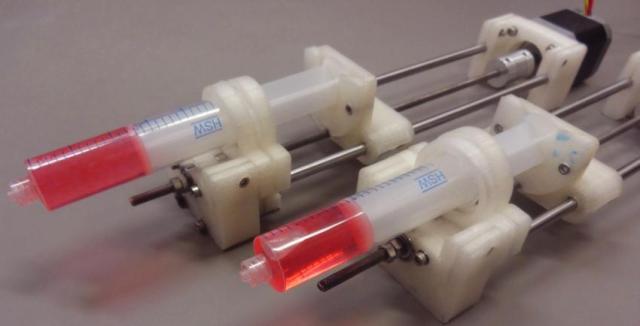
Imagine a lab that could produce equipment when it needs it.It would no longer be necessary to keep something because you might need it someday. Not only would we be reducing costs, but we would also free up limited space. As an example, a project I was involved with used multiple automated syringe pumps to dispense fluid through the internet each pump cost more than$1000.  A paper published in PLOS ONE describes the design and creation of an open-sourceweb controllable syringe pump that costs about $160.

Researchers can now save thousands of dollars and slash the time it takes to complete experiments by printing parts for their own custom-designed syringe pumps. Members of Joshua Pearce's lab made this web-enabled double syringe pump for less than $160. Credit: Emily Hunt
Researchers can now save thousands of dollars and slash the time it takes to complete experiments by printing parts for their own custom-designed syringe pumps. Members of Joshua Pearce’s lab made this web-enabled double syringe pump for less than $160. Credit: Emily Hunt

Let’s take this a step further, why create standard equipment. As a graduate student, I did a lot of standard experiments especially in the areas of gel electrophoresis. However, a lot of the time I had to fit my experiments into the commercially available equipment. If I could’ve customized my equipment to meet my research, I could’ve been more efficient and faster. 

Beyond customization what about rare or unique equipment, the sort of thing that you can’t buy. Instead of trying to find a way to ask a question with equipment that is”financially” viable and therefore available design and builds tools to ask the questions the way you want.

What kind of educational changes would we need to realize this research utopia? Many of the skills are already taught and would only require changes in focus and depth.

In my physical chemistry lab course, we learn Basic programming so that we could model atmospheric chemistry. What if instead of Basic we learned to program C/C++ that Arduino uses. If we design additional labs across multiple courses that use programming to run models, simulations, and control sensors learning to program would be part of the primary curriculum.

In my introductory physics class,I learned basic electronics and circuit design. Introductory physics is a course that most if not all science students need to take.With a little bit of refinement, the electronics and circuit design could take care of the electronics for equipment design. The only real addition would be a computer-aided design (CAD) course so that students/researchers can learn to design parts for 3-D printers and multi-axis CNC’s. Alternatively, all the training to use and run desktop fabrication equipment could be taken care of with a couple of classes.

The design and availability of desktop fabricating equipment can change how we do science by allowing customization and creation of scientific instruments to fit the specific needs of the researcher. What do you think,should we embrace the desktop fabrication (Maker) movement as part of science?Should the creation of equipment stay a specialized field? Is it a good idea but perhaps you think there isn’t space in the curriculum to fit in training?

Thanks for Listening to My Musings

The Teaching Cyborg

We Need a Language to Talk About Ed Tech

“Communication is about what they hear, not what you say.”
Dave Fleet


As our understanding of learning and educational theory has grown how we teach and design educational tools have also developed.  Additionally, changes in society and our daily lives have affected how schools’ function.  We are currently in the middle of vast technological changes in society and our daily lives.  Technology has changed or is poised to change most of the aspects of our lives, communication, travel, entertainment, and shopping to name a few.

It is natural that these technological changes will affect education.  Some of the technologies will affect education because they improve the educational experience, other technologies will change education because they are the way we do things. Guessing how technology will influence education is as Arthur C. Clarke said, “Trying to predict the future is a discouraging, hazardous occupation.”

With my interest in educational technology, I am often involved in educational technology projects, especially concerning the STEM disciplines.  Quite frequently I read an article or hear a talk about a new piece of technology at a school, described many times, as cutting-edge technology.

I often find myself thinking about the term cutting-edge technology, what does it mean?  According to Techopedia cutting-edge technology means:

“Cutting-edge technology refers to technological devices, techniques or achievements that employ the most current and high-level IT developments; in other words, technology at the frontiers of knowledge. Leading and innovative IT industry organizations are often referred to as “cutting edge.””

One of the things I still constantly hear about is cutting-edge mobile phones and apps. I can hear some of you now “Still?” what do you mean by that?  What I mean is that smartphones are not cutting-edge technology. The first smartphone was IBM’s Simon in 1994; the phone came with many features (what we call apps today). Nokia and then Blackberry followed Simon. Finally, we got the iPhone and Android phones. If smartphones and apps have been in existence for about a quarter century are they cutting-edge?

Often, I think what people mean when they say cutting-edge is something new to their school or classroom. I wonder if I’m correct in this thought? If we are going to deal with educational reform and development it deserves clear and critical thinking; for that, we need to be clear in our language.

For a long time, we’ve known that clear communication in education is essential — the publication of a Taxonomy of Educational Objectives, Handbook I: Cognitive Domain in 1956 simplified communication in educational research. In time this book would come to be called Bloom’s Taxonomy. Over the last 62 years, this book has influenced education especially in the area of assessment.  What some people no longer remember was that Bloom’s Taxonomy was developed to help educators communicate with greater precision.

“You are reading about an attempt to build a taxonomy of educational objectives. It is intended to provide for the classification of the goals of our educational system. It is expected to be of general help to all teachers, administrators, professional specialists, and research workers who deal with curricular and evaluation problems. It is especially intended to help them discuss these problems with greater precision.” Bloom, B. H. (1956). Taxonomy of Educational Objectives, Handbook 1: Cognitive Domain. New York: David Mackay Co. pg. 1.

With the creation of a uniform taxonomy educational professionals could communicate clearly and precisely with each other.  Using the taxonomy, everyone knew what the word analysis meant.

Today we need a language to talk about technology in education.  A terminology about educational technology would not only assist in the clarity of communication, but with the types of technology, we use.

As an example, the emerging area of wearable technologies like the new generation of augmented reality (AR) glasses, Microsoft HoloLens, Garmin Varia Vision, or Google Glass Enterprise Edition is on the cutting-edge of technology.  The future of this technology along with Virtual Reality (VR) is so open as to be almost indescribable.  The biggest problem with AR and VR technology as well as most cutting-edge technology is the cost.

Should education invest large amounts of resources into cutting-edge technologies or should we wait until these technologies mature?  To discuss whether we should be working with technologies, we need to be able to agree on the type of technologies we are discussing.

In the case of education, we should not use terms like cutting edge, brand new, or emerging when we mean a technology that is new to teaching or worse new to just my school or program.  A new educational innovation could mean a technology that is in use in business or society but has little or no use in education.  A newly adopted technology could mean something that is used elsewhere in education but is new in a specific school or program.

Even if my suggested terminology is not the best (let’s be honest it’s doubtful it would be), I think we are in desperate need of an agreed upon language for the incorporation of technology in education.  As our world becomes more and more technological, we need to have the ability to discuss not only what technology to integrate into teaching but why we are incorporating it. What do you think, have you gotten confused when talking about technologies in education?  Do we need a language for technology? Would a language for educational technology lead to better and more critical discussion of educational technology?  So, when can we get A Taxonomy of educational terms: Technology.


Thanks for Listing to My Musings

The Teaching Cyborg