It’s All in the Primes

“The greatest single achievement of nature to date was surely the invention of the molecule DNA.”
Lewis Thomas


When you’re an undergraduate student, two words mean a lot to you prerequisite and corequisite.  These two words let you know whether you must take courses one after the other or at the same time.  Ever since my undergraduate days, I have found these terms to be fascinating.  As a student, I often thought of the words differently.  Prerequisite meant we believe you need this information to understand our class, while corequisite indicated this information might be useful, but we don’t care.

That may seem a bit harsh, but that is the way it seemed to me when I was an undergraduate, and to be honest, it still seems that way to me. My experience for the first couple of years as a biology major was a little different than several of my classmates.  As a high school student, I had been fortunate enough to attend a school with a robust Advanced Placement (AP) and International Baccalaureate (IB) program, because of this I tested out of first-year biology and chemistry.  Then in a fit of madness, I took a full years’ worth of organic chemistry with labs over the summer.

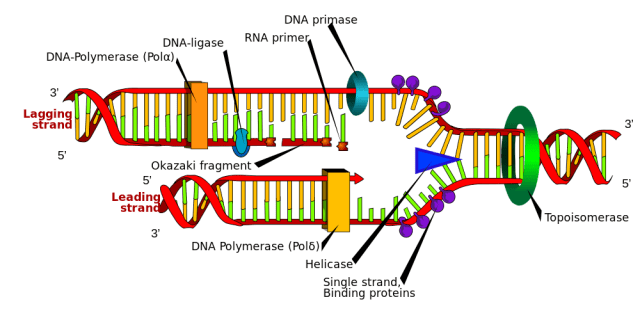
Biology students would take organic chemistry the same time the would take the second year introductory biology courses, i.e., corequisite.  The first biology class I took was Molecular Biology, one day we were sitting in class, and the professor was talking about DNA replication.  If you know anything about DNA you know, the terms 5’ and 3’ (also written 5 prime and 3 prime) get used a lot.  DNA is composed of two directional strands if one strand is 5’ to 3’ left to right the other strand will be 3’ to 5’ left to right.  DNA replication is carried out by DNA Polymerase III which synthesizes new DNA from 5’ to 3’.  I could go on, but that should make the idea clear enough.

DNA replication or DNA synthesis is the process of copying a double-stranded DNA molecule. This process is paramount to all life as we know it.
DNA Replication Image by Mariana Ruiz

One day my classmate turned to me and said, “I don’t understand anything he’s talking about what the hell does all this 5’ and 3’ stuff mean.” It took me a second to figure out what my classmate was saying the terms had been obvious to me.  I told him the names came from organic chemistry; they are referencing the 3rd and 5th carbon on the deoxyribose ring. Specifically, the 5’ carbon on one nucleic acid binds to the 3’ carbon on another forming the DNA backbone. Didn’t they cover numbering carbons in your organic chemistry course I asked, it turns out they had not gotten to that yet?

Many times during my undergraduate education corequisite courses did not cover material before it was needed.  It was this tendency of separate classes not to line up that lead me to start thinking of corequisite courses as “we really don’t care.”  As a student, I usually assumed corequisite courses would be no help in a class I was taking.

As a professional, I understand the constraints that impact educational choices.  Ideally, we are trying to fit all the courses needed for a degree in four years, that is four years minus summers.  I suspect if we made every corequisite a prerequisite we would not fit all the courses into a four-year program.  Interestingly according to the Marian Webster’s dictionary, the first known use of corequisite as we use it in education was circa 1948.  The fact that corequisite didn’t exist until 1948 suggests to me that we used to fit all the courses into a four-year degree without corequisites, I wonder what changed? I would assume this has to do with the growth in the amount of material covered in a Bachler’s program while maintaining the time to degree.

The other impact on the usability of corequisite courses is that they are taught by different faculty sometimes in other departments.  We hire faculty because of their experts in a field, to take full advantage of this expertise faculty are given the freedom to design and teach subject matter in the method they determine is best.  I wonder if schools are doing enough to promote communication between faculty members that teach courses related by corequisites.

Then again is a corequisite essential enough for a faculty member to change how they teach their course?  When thinking about curriculum design and degrees, I often think where is the line between the needs of the degree and the design freedom of a faculty member, is there a line? With the constant changes in many if not most fields and the growing amount of knowledge we must teach, we must rely on the experts in the field to keep the content of individual courses relevant.  With the continual work to keep course content relevant is it even possible to create a completely unified curriculum?

It may be that corequisite is the best we can do with respects to a degree’s curriculum.  However, I do know that anytime I deal with the curriculum of either a single course or a whole degree, I always remember “about what the hell does all this 5’ and 3’ stuff mean.”


Thanks for Listing To my Musings

The Teaching Cyborg

The Language of the Field

“All I know is what I have words for.”
Ludwig Wittgenstein

There are many components to a bachelor’s degree, part of the goal of the degree is to give students a wide range of skills and knowledge.  The single largest component of the degree is the disciplinary component.  While there is often overlap in basic skills in addition to the content knowledge of the field students learn how to think, analyze information, and communicate in and outside their field.

Throughout four (sometimes more) years that a bachelor’s degree takes students to build their skills.  Over the last decade or two, there has been a significant focus on the teaching of higher order thinking skills. Whether or not this focus on higher order thinking skills has been successful, I think, like many things we have embraced higher order thinking skills without a lot of thought, this focus on higher order thinking skills above everything is causing damage to our educational process.

While I agree that the introduction of higher order thinking skills can and should as early as possible, it is critical to realize that higher order skills don’t work independently of the so-called lower order thinking skills.  I remember consulting with an instructor that was having trouble with his student’s test performance; his students were performing significantly lower than students in other classes.  He brought in a couple of tests for me to look at, one of my first questions was what are your goals.  He said he was focusing on higher order thinking skills.

His tests had some of the most thoughtfully written questions I had seen.  It was composed almost exclusively of open-ended and long answer word problems.  Even though the questions were excellent, I immediately had an idea of what the problem was.  Most of the questions relied heavily on discipline-specific language.  Since he was teaching a lower division course, I asked if he is sure that his students understood the meaning of the words he was using, after a little discussion he realized he was assuming information about his students that he didn’t know.

After making some changes and including some content about language his student’s scores improved, which shows its essential to keep all skills in mind.  I have never liked the idea of defining skills as lower level and higher level. I think these skills are more of a gradient than levels.  Additionally, characterizing them as lower level and higher level suggests a hierarchy of importance that is not true. The skills we are teaching in a course should be dependent on the goals of that course not some external evaluation about the “best” skills.  However, that is probably a discussion for another day.

Continuing with the devaluation of “lower order thinking skills” I have been thinking about how this might be affecting textbooks.  In many fields, textbooks are used extensively in the introductory courses.  One of the most important things that take place in these introductory courses is teaching the students the language of their field. Since learning the language of a field is the main component of introductory classes textbooks should support learning the discipline language.

I have been looking at several textbooks lately especially open source textbooks, and I think I have started to see a problem.  Imagine you are a student working on a homework assignment, and you come across a word you don’t know or remember.  Yes, today I know it is likely that a student will Google it.  Let’s suppose instead they go to their textbook; how do they look up the word.  The student could look it up in the glossary.

Surprisingly this could be a problem; if you go to the back of many textbooks, you will find there isn’t a glossary in the back.  It turns out that many of the new books both open source and some commercial are designed to be customized.  You only choose the parts of the book that fit your course if, and I do mean if, the textbook has a glossary it has probably been divided into small sections and placed at the end of every chapter.

So how are you our student supposed to find the word you are trying to look up.  Since you can’t remember what the word means, in which section do you look?  You probably start with the most recent section you read if it’s not there well then, I guess you look through the entire book till you find the definition.

While we are currently trying to solve many problems with textbooks, cost, compatibility with curriculum, and accessibility we need to be sure we don’t introduce new problems by not paying attention to what we are doing. Students are not going to want to use textbooks that are difficult to use.  While many of the problems go away with the use of digital textbooks, isn’t the search function simply fantastic, we need to design textbooks for both digital and print.

While I understand the idea of designing textbooks so that you can pick and choose which parts you want to use splitting up the glossary confuses me.  It should be relatively apparent that separating the glossary into a lot of separate section through the whole book makes the glossary harder to use.  I wonder if this glossary design is because book designers think lower order thinking skills like memorizing definitions is unimportant.

Independent of the reason for this separate glossary model what is wrong with having a single glossary in the back of the book?  Why does it matter if the glossary has words in it that don’t appear in the text?  A single glossary in one place (I don’t care if it’s in the back) is much more usable than a scattered one.

I suppose if you think have extra words in a glossary is a problem the glossary could be laid out in a separate section like in an appendix.  We could label glossary sections by chapter and page, and each would be a separate section.  For example, G.12.2 would be the glossary for the 12th chapter second page.  Then you could leave out the unused parts of the glossary.

While a glossary organized by chapters might still require some searching by a student (if they don’t know what chapter a word they are looking for comes from), they would at least know where in the book to look.  Of course, I suppose if we are talking about Open Source textbooks we could edit the glossary and remove the extra words.

Lastly, if you think that a divided glossary is the best thing to do there is one other potential solution.  That solution would be to include all the words in the glossaries in the index.  Listing the glossary words in the index would give the students a single place they could look to find the definitions.

As we design the next generation of textbooks and learning materials we always need to remember that the most critical design consideration needs to be usability.


Thanks for Listening to My Musings

The Teaching Cyborg

Shh I’m hunting (for) Digital Natives

“Technology has become as ubiquitous as the air we breathe, so we are no longer conscious of its presence.”
Godfrey Reggio

Elmer Fudd holding finger to lips while hunting

Anyone that has worked in educational technology knows that there is often a lot of pushback when you try and introduce new technology to the classroom.  In some cases, pushback and questioning are good. It is always beneficial to think critically about all aspects of education after all the goal is to provide the best educational experience we can.

However, I have repeatedly encountered pushback from faculty that is not about whether a piece of technology is beneficial to teaching.  In these cases, the faculty says things like “I don’t want to use this (technology) because my students understand it better than I do.” This attitude comes directly out of the idea of the Digital Native.

Marc Prensky coined the term Digital Natives in Digital Natives, Digital Immigrants in 2001. Since then the idea of the Digital Native has been an almost a central theme in education spawning terms like Homo zappiëns and iGeneration and the notion that we need to redesign education because of the new abilities and skills these “new” humans have.

This belief in “new” humans has directly led to the fear that students know more about technology than their teachers.  I’m a biologist, and I have some questions about Digital Natives and their new skills and abilities.  Where did these new abilities come from are they magical?  I’ve even had people tell me it is the processes of evolution.

The idea of evolution and Digital Natives generates a teachable moment.  First, evolution is a slow process substantial changes are the result of many small changes over lots of generations.  Two, evolution is selective it is a process that plays on the parents.  For the appearance of Digital Natives to have been evolution, the parents would have to be Digital Natives, and being a Digital Natives would have had to confer an advantage in reproduction. There are several other points I can make, but I think it is safe to say that these new skills are not the product of evolution.

There is another possibility for the creation of Digital Natives the development of the brain.  A lot of neural development occurs in young children and according to some physiological studies continues at a high degree until around 25.  So maybe exposure to lots of technology from a young age leads to a difference in how the brain learns to work.  Fortunately for us, researchers have started looking at Digital Natives and their skills.

The research into Digital Natives is uncovering the same thing that I have experienced in my work.  The research results and my experience show that as far as having lots of computer/technologies skills and the ability to multi-task Digital Natives don’t exist.  One of my favorite comments about digital natives comes from a review paper The myths of the digital natives and the multitasker by Paul Kirschner and Pedro De Bruyckere “Many teachers, educational administrators, and politicians/policymakers believe in the existence of yeti-like creatures populating present-day schools namely digital natives and human multitaskers.”

A yeti holding a smartphone

In addition to a catchy phrase, the editorials section of Nature references it as “The digital native is a myth, it claims: a yeti with a smartphone,” Kirschner and Bruyckere make some crucial points.  First, when Prensky first coined the term Digital Natives, this was not based on any controlled research merely an observation about children born after the widespread adoption of mobile devices and how they interacted with them.  Because of these observations, he proposed several skills and abilities that these individuals would have as they grew up.

We are now collecting information about the Digital Natives, and the research is showing that while these students use a lot of mobile technology for communication and socializing, they don’t have a deep understanding of the technology.  I have often served as escalated tech support (especially for things I have built or helped to develop), many of the students I have worked with are from the generation of Digital Natives. Since so many people talked about the Digital Natives I think to some degree I even believed in the Digital Native.

When helping students, I quickly discovered that many of these students could not do any form of troubleshooting on their own.  If the button didn’t seem to do what they wanted, the students didn’t know what to do next. In one of the programs which involved fully online students, I would always start my troubleshooting with the question “What operating system are you using?”  Some of the answers I got were “I don’t know the computer says Toshiba.”, “I think I’m using Firefox.”, “how would I tell?” and these were not one-offs I got these answers a lot.

Beyond in-depth technical knowledge, Kirschner and Bruyckere also discuss the student’s ability to utilize the internet.  Looking at the papers Information behavior of the researcher of the future: Work Package II and The Google generation: The information behavior of the researcher of the future the researchers conclude that students of the Digital Native generation have pore information retrieval skills.  Specifically, the students have limited ability to deeply dive into information and often fail in critical thinking and evaluation of the information they do retrieve.

One of the most significant points of the internet and Web 2.0 and beyond was that we had reached a point where we were not just consumers of information but creators as well.  While there still needs to be more research, it also appears that Digital Natives are mostly passive consumers of information and not the general creators we assumed they would be.

All this information suggests that the idea that we should be scared to incorporate technology into our classrooms because the students know tech better than we do is a fallacy.  Closely related to this, the idea that we need to redefine and redesign the classroom because it is no longer suited to the skills and abilities of our students is also a fallacy.

As I have said, technology can be a huge benefit to the classroom.  Technology can be a massive equalizer in education.  However, we need to incorporate technology into the classroom based on educational pedagogy and as the solution to actual, not yeti-like, problems.  I do think we need to make some changes to education based on our modern technological world.  We should be teaching our students how to determine the value and validity of information sources on the internet.  If they are going to live in a technological world, we should teach them problem-solving skills, so they know what to do when the button does not do what they want.  We should be teaching communication skills, so they can make sure their thoughts and ideas get communicated.  Specifically, we should use good educational practices when we design our courses and programs, not yeti footprints.


Thanks for Listing to my Musings

The teaching Cyborg

You Don’t Own Critical Thinking

“I don’t want people to say, “something is true because Tyson says it is true.” That’s not critical thinking.”
Neil Degrasse Tyson

The Pink Panther movies are ridiculously hilarious. I’m not talking about the Steve Martin films but the original Peter Sellers movies. One of the great stories in these movies is the interactions between Peter Sellers Inspector Jacques Clouseau and Herbert lams Chief Inspector Charles Dreyfus. Their interactions are funnier because Clouseau doesn’t understand how much Dreyfus hates him.

“Dreyfus: The beggar was the lookout man for the gang.
Clouseau: That is impossible. How can a blind man be a lookout?
Dreyfus: [Insinuating Clouseau] How can an idiot be a police officer?
Clouseau: Well, all he has to do is enlist…
Dreyfus: Shut up!”
The Return of the Pink Panther – 1975

Over the course of several films, the interactions with inspector Clouseau slowly drives Dreyfus insane. A twitch in his eye foreshadows his descent into madness.

Chief Inspector Charles Dreyfus Eye Twitch The Return of the Pink Panther 1975

Lately, the term critical thinking is starting to do drive me a little crazy. It seems once, or twice a week I see or read another article bemoaning the loss of some form of education, liberal arts, social sciences, arts, or a type of degree english, history, foreign language, etc. Many of these articles suggest that without the their “stick” we will lose critical thinking. There was an article the other day that argued we should be getting degrees in the humanities and the reason, in the humanities we learn to communicate (speak), to work in teams, and here my eye twitch twitch critical thinking.

In another article, they argued why it was wrong to pursue degrees in computer science and programming and instead we should be getting degrees in the social sciences because they learn communication skills, problem-solving a couple of other things and twitch twitch critical thinking.

In a third article, the argument was to learn emotional intelligence and big data analysis we needed social sciences and anthropology. Furthermore, these skills in emotional intelligence and big data were needed to learn twitch twitch ” And then… I will kill you! Kill you!” (Charles Dreyfus The Pink Panther Strikes Again 1976) critical thinking.

Article after article all seeming to claim that without their field we will lose critical thinking. The idea that critical thinking is dependent on any one field is frankly ridiculous. The truth of the matter is that any field and any education can teach critical thinking.

Learning to design and write computer software is an enterprise in critical thinking pick up a book on program architecture. Learning to write a story especially something like a novel (creative writing degree) requires critical thinking. Learning to design research experiments in any of the science fields is the definition of critical thinking. Constructing logical arguments, supporting or contradicting a point in philosophy is critical making.

I could continue with examples in fields of study until I ran out of fields because like I said no single field or type of study owns critical thinking. Arguing that your field is needed for critical thinking probably does more harm than good by alienating everyone else that you just said couldn’t teach critical thinking.

While we all (hopefully) agree that critical thinking is important and the stories of schools cutting critical thinking are quite troubling, we should be all working together to make sure critical thinking is supported and taught regardless of what the student studies.

As to arguments concerning declining enrollments in many fields and types of education the solution is not to try to lay claim to things that belong to everyone. You’re also not going to solve the problem by trying to force an individual into programs with claims of fundamental importance if it isn’t true. Even if it’s true, the real problem is the students are not engaging or interacting the same way as they were before.

If we want to reverse these trends, we need to figure out why the students are not interested. Then engage the students, the argument that I’m a professor, and I understand all this information, and you should believe me isn’t going to work. To get the students into the classroom, we need to answer their questions and concerns honestly, and directly. We need to remember that their concerns while different than ours, are completely legitimate to the students and treating them any other way than respectfully will not help the situation.

Academics have a huge amount of knowledge and skill. However, we need to remember that outside our fields and academia your audiences have probably not read that paper that “everyone” knows. Take some time and instead of saying “like we all know” spend some time explaining the information, after all, if you want more students the people you need to convince probably don’t know what you know.
Thanks for Listening to My Musings

The Teaching Cyborg

Re-Envisioning the Ph.D. +13 Years

“Education is not the learning of facts; it’s rather the training of the mind to think.”
Albert Einstein


13 years ago, this month, the Woodrow Wilson foundation released the report THE RESPONSIVE PH.D. Innovations in U.S. Doctoral Education. The responses Ph.D. project was an attempt to test and evaluate programs that addressed “issues” with the Ph.D. The work revolves around four principles:

Principle one: a graduate school for real
The first principle of Woodrow Wilson’s initiative on the doctoral degree may appear at first bizarre or tautological. Every gripe, every conclusion from all the reports and our attempts to turn the reports into action prove one thing: the Ph.D. degree requires strong graduate schools and graduate deans with real budgets and real scope—a far stronger central administrative structure than typically exists at present.
THE RESPONSIVE PH.D. Innovations in U.S. Doctoral Education Page #6.

Principle two: a cosmopolitan doctorate
The second principle is a sibling to the first. Just as individual programs need to be connected more to each other in the shared experience of a strengthened graduate school, the doctorate in totality and every discipline will benefit enormously by a continuing interchange with the worlds beyond academia. The doctorate needs to be opened to the world and to engage in social challenges more generously. A responsive Ph.D. has implications for degree requirements, for the right administration of programs, for time to degree and the job search, and for improving the diversity of the Ph.D. cohort.
THE RESPONSIVE PH.D. Innovations in U.S. Doctoral Education Page #7.

Principle three: drawn from the breadth of the populace
Clearly, an expertise gap besets the United States. The Ph.D. cohort, source of the nation’s college and university faculty, is not changing quickly enough to reflect the diversity of the nation. The next generation of college students will include dramatically more students of color, but their teachers will remain overwhelmingly white.
THE RESPONSIVE PH.D. Innovations in U.S. Doctoral Education Page #9.

Principle four: an assessed excellence
The doctoral degree stakes a strong claim upon quality. Whatever the degree variously means, it guarantees that. And yet doctoral education, keen to interpret all phenomena expertly, almost entirely fails to interpret and evaluate itself. The quality of doctoral education depends upon assessment with reasonable consequences. Excellence is a receding horizon. Progress toward it is measured by 9 THE RESPONSIVE PH.D. the degree of success in achieving concrete objectives—objectives that can be redefined as circumstances require. Attainment of specific objectives can be rewarded through commensurate increases in valued resources. Numerous participants in the Responsive Ph.D. have established robust programs for connecting resources to outcomes in this way.
THE RESPONSIVE PH.D. Innovations in U.S. Doctoral Education Page #10-11.

My interest in this report has to do with The University of Colorado Boulder’s involvement with the project. Four years before the report was published seven graduate students at the University of Colorado Boulder were asked to provide feedback on several questions to the graduate school advisory council that was working with responsive Ph.D. project.

I was one of those graduate students. I’m also a bit of a pack rat, just recently I ran across my notes from this committee. I thought it might be interesting to look back and see how my thoughts have changed. The group of graduate students was asked several questions specifically what we thought about; Research, Teaching and the Responsive Ph.D., Interdisciplinary, Teaching and the Ph.D. Path, Mentoring and Advising, Scholarly Citizenship, and Time-to-Degree.

A lot of the questions concerning the Ph.D. and whether the degree was meeting current needs revolved around two points. One) most Ph.D.’s will not pursue careers exactly like their faculty advisers, they may even have different interests. The focus of research to the exclusion of all else limits the possible uses of the degree. While research should remain the focus, additional opportunities should be available to the students. Two) there are many underrepresented groups in Ph.D. graduates compared to the general population. Do specific aspects or approaches to the degree that limit the access of these groups?

What follows is excerpts from the graduate student presentations to the graduate advisory council. These presentations were created and assembled by the entire committee composed of graduate students from seven different colleges at the university

Research, Teaching and the Responsive PhD
Students often wish for a field of study that sharpens their research skills. However, many students would also like to develop complementary skills such as teaching. Many students report that their departments do not encourage development in teaching. The committee feels a paradigm shift is needed that recognizes both research and teaching as important components of the Ph.D. process.

Interdisciplinarity
Training opportunities should be available for interdisciplinary work. As a grad student, we had very little idea “research wise” what was going on in other departments and colleges. Additionally, it was often hard to take courses outside of our department. We also feel that graduating with a broad and diverse knowledge base would enhance our employ-ability both in and outside of academia. Schools should develop programs to encourage interdisciplinarity in graduate students.

Teaching and the Ph.D. Path
Since many academically employed Ph.D.s do not end up employed in R1 universities but other school and universities with a higher focus on teaching we feel that many Ph.D.s are being under-trained. Since most Ph.D.s come from R1 institutions these institutions, need to give more training to develop students teaching skills.

Mentoring and Advising
The current structure of the Ph.D. programs often limits the knowledge and advising available to students. Since advisers often only know about their careers. Especially in the STEM fields, a second adviser would be helpful.

Scholarly Citizenship
Many schools talk about citizenship and the importance of citizenship. Many projects occur but are often self-established by individuals. What could universities or graduate schools do to encourage and teach us how to establish projects around scholarly citizenship?

Time-to-Degree
One of the biggest concerns presented is time-to-degree. How do we include all the things we listed while shortening or at least maintaining the time-to-degree? The easiest way to do this is to focus on the requirements or skills that are necessary for the degree and to remove as much of the extraneous work as possible.

These short excerpts summarize what the graduate students (the seven on the committee) thought about the questions. After rereading the final documents, I’m not sure that our input had any impact on the final report. Conversely, the project included 20 schools, and I don’t know how many of the schools involved graduate students so we may have represented a very small part of the project.

The bulk of the report was composed of “white papers” about the programs that addressed the issues that the report brought up. A question I had was how many of these programs are still functioning? Conducting a quick web search, I was able to find current program information on 27 of the 41 programs, which means 66% of the programs are still functioning. 66% is quite good for universities where programs often vanish after grants or projects are over.

Let’s go back to the questions if I was asked these questions today how I would respond?

Research, Teaching and the Responsive Ph.D.
It is true still true that most Ph.D. students will not end up in careers like their advisers, especially if they’re getting their degrees from R1 institutions. However, the Ph.D. is a research degree. The central core of the degree should be and stay research. The only thing I would like to see would be more teacher training since the Ph.D. is also a teaching degree.

Interdisciplinarity
There’s always been a tremendous interest in interdisciplinary because of how interdisciplinary teams have solved problems. However, actively trying to create or force interdisciplinary does not work. The only thing I will say is that a student should be able to take any class or collaborate with any group that makes sense for their research. Departments shouldn’t limit their students to only what is available within their department.

Teaching and the Ph.D. path
As I said before if we’re going to call a Ph.D. degree a teaching degree, then we should include teaching as part of the curriculum.

Mentoring and Advising
Mentoring and advising are a critically important part of graduate education. Mentoring can impact everything from how you deal with imposter syndrome to what career path you take. Schools and departments should encourage students to talk and interact with as many people as possible. The Ph.D. is a research degree you should choose your adviser for their research abilities. If you get more out of a relationship with your primary adviser that is great. However, your research adviser should be chosen predominantly for their ability to help you get through your research.

Scholarly Citizenship
The purpose of the Ph.D. is to learn a skill set involving research and problem-solving. These skills are tremendously useful in many fields, and careers, how graduates choose to use them when they graduate should be entirely up to the graduates. However, if you want to be involved in citizenship (or community service) as part of your degree and you should choose a school or program that is already doing this type of work. I feel trying to force faculty to include “citizenship” in the research is directly contradictory to academic freedom. If we choose to believe in academic freedom, faculty must have the right to choose or not choose to do something.

Time-to-Degree
Time-to-degree comes up more than just about any other problem, people still discuss it regularly. I think this is probably a more complex issue than it seems. The biggest advantage of shortening the time-to-degree is a reduction in costs, which is, a very important consideration. The drawback is the amount of knowledge there is to learn nowadays. On top of the amount to learn we are living and working longer. With this increase in knowledge, we are starting to see more and more specializations in degrees at the bachelor’s level which I find sad. Personally, if there is a way to deal with the cost I would almost wish we gave the students more time to learn their field and all it has to offer.

13 years on I think the whole idea of re-envisioning the Ph.D. was ridiculous. While it is true that we did and still do have issues with diversity in advanced degrees the solution is not to change degrees but to engage and support the underrepresented. Also, if the Ph.D. is not suited to a job or career path again, the solution is not to change the degree. The Ph.D. is perfectly suited to its uses. If something different is needed, we should create a different degree not change one that already works. For the time being, I think I will close the door on the re-envisioned Ph.D., maybe ask me again in 15 years.


Thanks for Listening to my Musings

The Teaching Cyborg