Why I Use Models

“We all have mental models: the lens through which we see the world that drive our responses to everything we experience. Being aware of your mental models is key to being objective.”
Elizabeth Thornton

I like using models when designing courses and instructional interventions. When I say models, I mean a structured guide that help you build or develop components of a class. In general, I just like models, I generally believe the ability to create a model is strong evidence that not only do you have a deep understanding of the subject, but you can tell a complete story. Educational models have been around for a long time, The Socratic Method anyone? You could even say the Rosetta Stone was a model for teaching language. We might not have ever translated some writing without it.

An image of the front Rosetta Stone.

One of the problems with educational models is that there are so many of them and they can be controversial. For example, the number of things written in favor of and opposition to learning styles fills more space than the learning styles themselves. Additionally, there are a lot of learning styles according to Coffield et al. 2004 there are more than 70 learning styles just a partial list is

  • Neil Fleming’s Visual, Aural, Reading/Writing and Kinesthetics (VARK)
  • Felder and Silverman’s Index of Learning Styles
  • David Kolb’s Learning Style Inventory (LSI)
  • Myers-Briggs Type Indicator (MBTI)
  • Allinson and Hayes Cognitive Style Index (CSI)

I have in fact taught and used the Kolb learning style, and I think it can be helpful if used correctly, “i.e., the way I use it :)” but that is a discussion for another time.

So, with all the mind-numbing options why do I like models? It’s not because I believe there is a single silver bullet model. I don’t believe in the silver bullet, the idea that one thing can solve all our problems. That there is no one-size-fits-all solution to everything in education? Why? The process of teaching and learning is not one discrete whole it is tens, hundreds, thousands of little interacting pieces. Each of these pieces has their own specific needs requirements and issues. Therefore, I use different models for different things, some of the models I use are:

  • For Rubrics
    • Effective Grading: A Tool for Learning and Assessment in College, 2nd Edition
      Barbara E. Walvoord, Virginia Johnson Anderson
      Nov 2009, Jossey-Bass
  • Question Design
    • Taxonomy of Educational Objectives Handbook I: The Cognitive Domain
      Benjamin Bloom, M.D. Englehart, E.J. Furst, W.H. Hill, David Krathwohl
      1956 Longmans, New York, NY, USA
  • Syllabus Design
    • The Course Syllabus: A Learning-Centered Approach
      Judith Grunert O’Brien and Barbara J. Millis
      March 2008, Jossey-Bass
  • Per-Per Instruction and Student Response System
    • Clickers in the Classroom: How to Enhance Science Teaching Using Classroom Response Systems
      Douglas Duncan
      September 2004, Pearson
  • Course Design
    • Understanding by Design
      Grant P. Wiggins and Jay McTighe
      January 2005, Heinle ELT

I chose these models because they work with my internal model of education. Even when I am working with groups that have different focuses I still like using models. The first thing I like about models is that I am often working on courses that will be taught at multiple locations or by various instructors. Models allow for a consistency that can be reinforced by existing materials.

Consistency across courses, both from year to year and across multiple sections within the same year. Consistency can be especially useful if you have courses with different instructors. Consistency is also helpful internally in a class. Internal consistency frees up working memory for the students. The less students must focus on structure or course layout the more they can focus on content.

Models are also a great way to introduce new instructors to the art and craft of teaching. Models give them guides to follow. Having models for things like syllabi, rubrics, and question writing helps new instructors focus their time and energy on lesson planning and content.

Another advantage of remaining consistent over time is to improve your teaching. When you encounter a problem with your teaching, more specifically your students learning, you’ll want to try and find a way to solve the problem. Even if you’re only doing this for your class, this is educational research which means human research. One of the most challenging things with human research is controlling all the variables. In fact, many people will tell you it’s impossible to control for every single variable. Using models to support the design of your course means that your courses are going to be consistent from year to year and you can have a greater belief that the interventions you created made the difference in the student learning.

What do you think about models? Do you use models? What models do you use?


Thanks for listening to my musings

The Teaching Cyborg

Do You Know If Your References Are Biting You?

“Always…uh…never…forget to check your references.”
Dr. Meredith Real Genius 1985

The scene I’m quoting made just about everyone smile. The bright young student meets Dr. Meredith who says, “a bit of advice.” The student pulls out his notepad and says “Oh, uh, thank you?” eagerly awaiting the information. Dr. Meredith says “Always…uh…never…forget to check your references.” The student smile says “Uh, OK…thank you. I’d better be going.” and wanders off without taking a note (Real Genius). The scene works because everyone knows, even the non-academics, that professional researchers ALWAYS check their references.

Dr. Meredith in the bit of advice scene from the movie Real Genius

When I was an undergraduate, this topic came up all the time. Professors saying reviews are great places to start, However, always go back and check the sources. The PI in whose lab I worked had a quote from Frank Westheimer above his door that said, “A month in the laboratory can often save an hour in the library.” I’ll just let you think about that one.

However, something I have come to realize is that even though we know, we should we don’t “always check our references” nearly as much as we should. I know I have been guilty of it a time or two.  Why is that? As we move through our careers and lives, we have less and less time. So, we know that review went through peer review, so we don’t need to double check it do we? We have a colleague or friend that we respect, and we know they’re not trying to mislead us so sure, we don’t have to double check them, and so on and so on.

The problem is that we’re all human we make mistakes, not intentionally maliciously not even frequently, but it happens. One of the biggest reasons to check your references is to help each other. When we don’t, we let mistakes perpetuate over and over.

I will highlight this with a few examples from my own experience. How long does it take to learn something? Variations of this question come up all the time.  The number of times I have heard someone say 10,000 hours, which would be 1,250 days if you worked a solid 8 hours a day, is more than I can count. However, this is not true the 10,000-hour mark came from work by Anders Ericsson a professor of psychology at Florida State. His work looks explicitly at top-level performers, Olympic caliber athletes, chess grandmasters, etc., people at the very tip-top of fields. He asked how long it took them to reach that level of excellence and that turned out to be 10,000 hours. However, becoming an expert master is different from how long it takes to learn something. If you want to learn something, it only takes about 20 hours. I won’t go into the whole story of how 10,000 hours to become a top expert became 10,000 hours to learn something since Josh Kaufman does a much more entertaining job in his TED talk.

The next one is famous I’ve seen it referenced in books, newspaper articles, and many presentations. The study goes like something like this at Harvard in 1953 (or maybe Yale in 1979) graduates of the business school were asked about their goals and whether they had written them down.  The researchers created three groups from the graduates interviewed; goals and plans written down, goals that were not written down, and without goals. Ten years later these graduates were interviewed, graduates with goals were earning 3X as much as those without goals, while those that had written down their goals were making 10X as much as those without goals. I was going to use this study in a presentation I was giving. For reasons I won’t go into I needed the original reference. I quickly discovered that I couldn’t find it by doing a quick online search. So, I went in search of other sources that used it they all quoted other sources that it turned out quoted it from other sources.  Once I even went in a complete circle going through references and ending up back where I started.  Finding the source became a bit of an obsessive challenge with more in-depth searches and longer searches.

As I searched, I noticed several interesting things.  There were many similar but not identical stories.  The study happened at Harvard; it happened at Yale, it was conducted in 1953 or 1979.  The participants were reinterviewed 10 or maybe 20 years later.  The most telling piece of information I finally found was a post from Laura Sider a librarian and Associate Director of Frontline services at Yale University where she said,

It has been determined that no “goals study” of the Class of 1953 actually occurred. In recent years, we have received a number of requests for information on a reported study based on a survey administered to the Class of 1953 in their senior year and a follow-up study conducted ten years later. This study has been described as how one’s goals at graduation related to success and annual incomes achieved during the period.

That’s right this famous study never happened, you can see her full statement here. The goal setting study has become such a cultural phenomenon that the Yale library felt the need to state that it never happened. Where the story originally came from I don’t know. Mike Morrison has identified “two early reporters” Mark McCormack’s (What They Don’t Teach You in the Harvard Business School) and Brian Tracy’s (Goals!). You can see his full report here. I don’t know if he is correct or not once I convinced myself this study never happened I was able to escape the rabbit hole. However, it’s possible this false study might be causing harm.  Recent research actually out of the Harvard business school suggests that we have been ignoring the potentially harmful side effects of goal setting. The only thing clear to me is that we need more real research on goal setting.

Did any of this surprise you? Do you check your references? Have you ever checked a reference and discovered something you did not expect? I wonder how much we are taking for granted? Should we be checking absolutely everything? Maybe it’s time to work with some librarians and see if we can find out?


Thanks for listening to my musings

The Teaching Cyborg
So, you think you can’t do Inquiry-based Learning: Better ask the gnome

“Scientific inquiry starts with observation. The more one can see, the more one can investigate.”
Martin Chalfie

In 1995 the National Research Council published the National Science Education Standards in which they recommended as one of its central point’s learning science through inquiry. As defined in the National Science Education Standards inquiry has two meanings:

Scientific inquiry refers to the diverse ways in which scientists study the natural world and propose explanations based on the evidence derived from their work. Inquiry also refers to the activities of students in which they develop knowledge and understanding of scientific ideas, as well as an understanding of how scientists study the natural world. (p23)

Five years later a companion book Inquiry and the National Science Education Standards: A Guide for Teaching and Learning was released. The purpose of this companion book was to help teachers understand and implement inquiry in their classrooms. In 2018 almost, a quarter of a century later implementation is still let’s be kind and say incomplete.

If we teach science as a method of looking at the world and asking questions Which is what science is instead of a collection of facts, principles, and ideas that many people view it as then the inquiry-based teaching method is critically important. So why isn’t inquiry-based STEM education universal?

The most common answer I hear is “I can’t do inquiry my class is too big.”  In my mind, this means you can collect bigger data sets. Followed closely by “My students aren’t ready for inquiry,” well instead of full inquiry try guided inquiry.  Lastly, “I have too much material to cover there is no time for inquiry.”  There might be something to say for that last statement, but that is a soapbox for another time, but I would say design your learning goals into the inquiry tasks.

Another way to address these questions, is to ask the question, does inquiry require complicated questions with lots of complicated equipment? Let’s ask a Gnome.

The Gnome Experiment

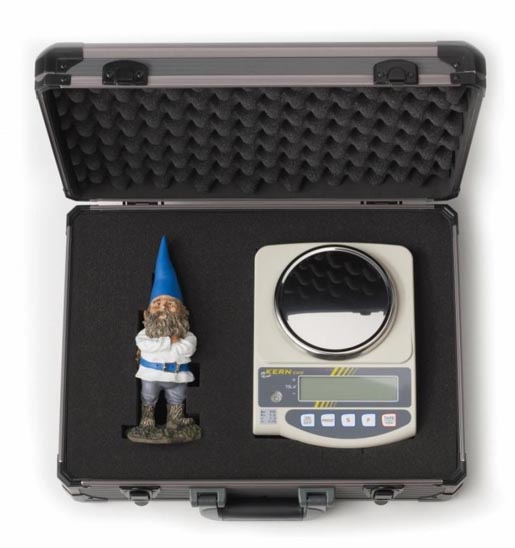
KERN the gnome in a case with his digital scale
Kern the gnome packed with his scale. Image: Gnome Experiment

The humble garden gnome is practically a cultural icon. To some garden gnomes are a passionate collectible, to others a novelty, and to still others the butt of the joke. However, there is one gnome that taught us about gravity while researching the physical makeup of our planet.

I think I first heard of the Gnome Experiment from a TED talk. The question proposed was could you measure the difference in gravity around the earth on a basic scale. To test their scales the Kern company got one of their scales a garden gnome and started shipping them around the world where the gnome’s recording weight and a picture at each stop. Here are some of the places the gnome has been

KERN the Gnome photographed in four different locations around the world.
Kern the gnome packed with his scale. Image: Gnome Experiment

The result of the experiment is a resounding yes. Kern the gnome weighed different amounts in different places.  Using a similar process what could you teach your students. While the phenomenon of gravity is simple to describe, it’s a difficult concept to grasp in real life.  Weight is dependent on gravity, and the amount of gravitational attraction on the surface of the Earth is dependent on the distance to the center of the planet and mass (density) of the material underneath you.  Apply this information correctly, and it can teach you about gravity and the earth.

For instance, suppose we were to conduct this experiment again.  Only this time in addition to the gnome and scale we also included a GPS/altimeter. I live in Colorado a quick search gives us a list of 20 roads that have an elevation over 12,000ft.  Suppose we took our gnome on a road trip and used our altimeter to measure the weight at 12,000ft on each of these roads. Since we have now controlled for elevation, what would it mean if we got different results?

As a teaching aid, the gnome experiment can be quite fun and useful. The idea that a garden gnome can be used to conduct science is a great icebreaker. More importantly, the Gnome Experiment shows how you can ask a genuine inquiry with a simple experiment and only a little bit of equipment. Stop and think about experiments you can ask you’re not asking your students to win the Nobel prize.  Think up some simple experiments and have your class address them.  I suspect what we need is a database of inquiry-based experiments for education, like the database of test and exam questions that are out there.


Thanks for listening to my musings

The Teaching Cyborg

My Silver Bullet Failed Me!

“There is no silver bullet. There is always options, and the options have consequences.”
Ben Horowitz

I can’t count the number of times I’ve read an article or heard from a colleague about some new piece of technology that is going to change everything. This new technology was the “The silver bullet!” that was going to solve all our problems. Then I either never hear about it again or get told how it didn’t work. I’ve even had some people wonder why their silver bullet didn’t work while looking for something to blame.

To start with your silver bullet didn’t work because you are not Bass Reeves.

Bass Reeves first African-American Deputy US Marshal west of the Mississippi.

If you’ve never heard of him, Bass Reeves was born a slave and after the civil war became the first African-American Deputy US Marshal west of the Mississippi. He worked extensively in what was then called the Indian territories in Arkansas and the Oklahoma territories; he arrested more than 3000 felons. Lastly, he gave out silver dollars as his calling card; many people believe he is the real-life inspiration for the Lone Ranger. Look him up his life is a fascinating story.

Okay enough Lone Ranger references, why did so many technologies fail to fundamentally change education when so many, often talented and intelligent individuals thought they would. In 1922 Thomas Edison said, “The motion picture is destined to revolutionize our educational system, and in a few years, it will supplant largely, if not entirely, the use of textbooks.” Perhaps, we should start by looking at some of these technologies that were supposed to change education but didn’t.

  • The motion picture
    • How many of you fill every class period with movies and assign movies instead of textbooks?
  • Radio
    • I usually find myself asking students to take out their earphones and turn off the music.
  • Videodisc
    • Do any of you even remember this one?
  • MOOCs
    • When I first heard of MOOCs, they were going to replace everything and put schools out of business.
  • Pokémon Go
    • This bandwagon started even before the app came out. I read multiple articles about how Pokémon Go was the future of apps and technology in the classroom. Perhaps we’re still too early, and we should wait and see, but I’m thinking not.

As a comparison let’s look at some technologies that have worked and changed learning.

  • Textbooks
    • Before the internet, the book was the greatest democratization of knowledge the world had ever seen.
  • The Magic Lantern
    • The Magic Lantern and its descendants all the way to the modern Digital projector gave teachers the ability to show complex materials, notes, and images to whole classes. The information limit wasn’t the instructor’s ability to draw with chalk.
  • Student Response systems
    • Have allowed real-time feedback during lessons between instructors and their class. Giving the teacher the ability to adjust their teaching on the fly.
  • Learning Management Systems
    • Has created a simple single point of interaction for students and teachers to share information about all their classes.

There must be a difference between the technologies on these two lists.  What is that difference? The difference is the purpose, what purpose do these technologies serve. Look at laser disks finding individuals that have used these is a very difficult even in their prime they were costly. Yes, the image quality was superb especially in the days before HD, but that was all there was to them. If movies didn’t take over education why would movies with a better-quality image change everything? The real question to ask is, what was the problem laser disks solved or created? The answer, there wasn’t one they were just cool if you liked movies.

Now let’s look at one from the second list, the student response system (SRS). When you’re teaching a class one of the hardest things to do is figure out if your students are “getting it.” Asking the class “Was that clear?”, Or “Do you understand?” usually leads to a lot of head shaking when it’s time to grade the exams. Several faculty started adopting a practice where they would post multiple-choice questions during these lessons and have students raise their hands or colored cards to indicate their answer. However, since the students could see what response their fellows were giving the answers were often biased. The SRS gave the faculty the ability to ask these questions privately and then adjust their lectures based on what the student needs were.

We can tell similar stories about other items on the list. These items were adopted not because they were cool technologies but because they solved an educational problem. The technologies in the first list were technologies looking for a problem. That is why your silver bullet failed.

Don’t get me wrong I’m a tech geek I built my desktop computer, I travel with top-end phones, tablets, readers, and laptops. I have a smart house with phone controllable lights the whole 9 yards. While I deeply believe in the ability of technology to improve education, when dealing with the education I always start with the pedagogy. What are your educational goals? What are your learning outcomes? What are you trying to achieve? What problems are you having reaching your learning goals? Once the issues are known, do a little research and see if someone has already come up with an intervention for it. Is there a solution that already exists? Don’t reinvent the wheel; there’s plenty of other problems. Once you have finished all these steps, now it is time to consider what technology might do for you.

Think about some of the technologies that you know that have been successes and failures do they follow the pattern I listed above? What are the best Ed tech successes you know? Can these successes help you solve other problems?


Thanks for listening to my musings

The Teaching Cyborg

So, You Think You Recognize the Words, But Do You?

I am sometimes amazed that human beings have any ability to communicate. Have you ever heard the statement “My blue is different than your blue”? One of the ideas behind this statement is if I take a blue object the way my brain processes that color is different than the way your brain processes it. This idea that perception might affect the ways each of us views the world is different from the technical definitions. With my science background, I might define blue as “light with a wavelength between 492-450 nm”. While the Merriam-Webster’s dictionary defines Blue as “1: of the color whose hue is that of the clear sky”.

Perception is not the only point to complicate communication. If you and I had just met and I showed you this cup of tea and said the word “solbränna.”

A cup of tea with milk, in a white cup on a white saucer. The saucer also holds two think rectangular cookies. It all sits on a maroon cloth.
A cup of tea with a cookie Photo by Paul Bowney, CC BY 2.0

Would you know what the word meant? Do I mean tea, cup, saucer, cookie, liquid, hot, how many options are there? Think about it for a while and see what you think. (Take your fingers off the keyboard I didn’t say Google the word!)

I could continue with different ideas showing the complexities of human communication. However, I think this should be good enough to highlight why I think it is amazing any two people can communicate at all. Yes, I hear you “At least within a given group it’s easy. We learn to speak using the same words as everyone else”. Okay, I’m going to give you a list of words.

  • Theory:
  • Law:
  • Insult:
  • Abstract:
  • Significant:
  • Sensitive:

These are all words in the English language. Words that most people can define. In fact, from an educational standpoint, most people knew these words before they started college. So, let me ask you when you’re teaching or giving a presentation do you think about the meaning of the words you are using? Perhaps more importantly do you think about what definitions your audience might be using?

What got me thinking about this was a recent debate I saw about the theory of evolution. What got to me was the fact that the two individuals were talking about two entirely different things. In fact, one of the most common arguments against evolution involves the word theory. People state that we can ignore evolution, or we should teach other things than evolution because after all evolution is just a theory. So, let’s get back to the list of words have you thought about them? What are your definitions?

Did you come up with these definitions?

  • Theory:
    • an unproved assumption: conjecture
  • Law:
    • a binding custom or practice of a community
  • Insult:
    • to treat with insolence, indignity, or contempt
  • Abstract:
    • disassociated from any specific instance
  • Significant:
    • having meaning
  • Sensitive:
    • receptive to sense impressions

How about these definitions?

  • Theory:
    • is a more or less verified explanation accounting for a body of known facts and phenomena.
  • Law:
    • A virtually irrefutable conclusion or explanation of a phenomenon.
  • Insult:
    • An injury, attack, or trauma.
  • Abstract:
    • A condensation or summary of a scientific or literary article or address.
  • Significant:
    • In statistics, denoting the reliability of a finding or, conversely, the probability of the finding being the result of chance.
  • Sensitive:
    • Responding to a stimulus

No matter which set of definitions you choose you are correct. The first set comes from the Merriam-Webster dictionary, while the second set comes from my high school science textbook (interestingly many of these words are not in college texts) and Stedman’s Medical Dictionary. The reason for these different definitions is that in science or any intellectual pursuit existing words are often given new meanings to meet the needs of the field. Since these definitions apply to specific fields, they are not necessarily the general definitions that the public knows.

Let’s apply this to our two debaters if we look at what each said we can see the differences. When the scientist said the theory of evolution he meant “Evolution is a phenomenon that is supported by many scientific studies and experiments over a long period of time.” When his opponent said the theory of evolution, he means “A guess as to how life came to exist as it is.” While I’m not suggesting everyone would have suddenly agreed with each other about the whole concept of evolution if they had taken a little bit time to clarify their meanings they at least could have debated the actual experimental studies of the topics (I know its a dream).

These differences in definitions are one of the reasons it is so important to learn and teach the language of your field. However, when you’re designing your lessons or planning an article do you ever stop and think about what your audience already knows? If you seem to have problems communicating with someone, do you think about how your definitions may vary from there’s? Does your field have definitions outside the common parlance? Do you think about this enough when you are communicating? Lastly, why don’t we use the most powerful of all language tools and coin new words when we need them? It might make communication a little bit easier.  After all, things are just going to get worse, according to this New York Times article, the word Run now has 645 meanings.


Thanks for listening to my musings

The Teaching Cyborg


P.S. The word “solbränna” means tan the color of the tea, did you get it?