How do our Students Identify Expertise?

“Ignorance more frequently begets confidence than does knowledge: it is those who know little, not those who know much, who so positively assert that this or that problem will never be solved by science.”
Charles Darwin

When can you use a title?  What makes someone an expert?  Over the years, I have built several pieces of furniture, tables, bookshelves, and chests does that make me a master carpenter?  I have met several master carpenters and seen their work; I am most definitely not a master carpenter.  Using the book Make Your Own Ukulele: The Essential Guide to Building, Tuning, and Learning to Play the Uke, I’ve built two ukuleles.  While the author of the books says once you’ve made “a professional-grade ukulele” you are a luthier I don’t think I will be calling myself a luthier anytime soon.

I have a lot of “hobbies,” I have made knives, braided whips, bound books, made hard cider, and cooked more things that I can remember.  The only one of my hobbies that I might be willing to use a title for is photography.  I have been practicing outdoor and nature photography for 30+ years, and if you caught me in the right mood, I might call myself a photographer.  What makes photography different? It’s not the time I have put into it, though I have long past the 10,000-hour mark.  I’ve had my work reviewed and excepted by people in the field, not every picture but enough to be comfortable with my skill.

I am selective when it comes to titles and proclaiming my expertise. However, there are people that are not selective about their expertise.  Believing your knowledge to be greater than it is, is common enough to have a name the Dunning–Kruger effect.  However, an even bigger problem than an individual mistaking their knowledge is when an individual mistakes their knowledge and present themselves as an expert.

The internet and self-publishing have increased our access to knowledge and different points of view.  Previously it was simply not possible, for multiple reasons, to publish everything, so editors and review boards had to decide what to publish.

While the benefits to open publications are significant, we must ask without “gatekeepers” how do we identify expertise?  Many people may ask, “why do we care?”  Well, we have issues like GMOs, STEM cell therapy, cloning, genetically engineered humans, and technology we have not even thought of yet.  How will people decide what to do with these technologies if they can’t identify expertise?

A great example of this is a recent study on GMO’s Those who oppose GMO’s know the least about them — but believe they know more than experts.  In the study, most people said that GMOs are unsafe to eat, which differs from scientist where the majority say GMOs are safe.  People’s views of GMOs are not a surprise news coverage of GMO clearly shows how people feel.  The interesting thing was the second point covered in the study.  The people that were most opposed to GMOs thought they knew the most about them.  However, when this group of self-identified experts had their scientific knowledge tested, they scored the lowest.

The difference between people’s beliefs and actual knowledge gets even more complicated when we move beyond GMOs.  While the consensus is that GMOs are safe and could be beneficial, their loss isn’t instantly deadly.  After all, we haven’t developed that GMO that will grow in any condition and solve world hunger or capture all the excess CO2 from the atmosphere.  However, what about the Anti-vaccination movement?  I’m not going to get into all the reasons people think they shouldn’t get vaccinated. However, let’s talk about how their action will affect you.

I know a lot of people say it’s just a small percentage and I’ve been vaccinated so ignore it.  You may even be one of them, let me ask you to have you heard about things like efficacy and herd immunity?  Additionally, do you remember or know that the measles can kill? Let’s look at the numbers, according to the CDC; the Measles vaccine is 93% effective.  Using the recommended two doses, 3 out of every 100 people that are vaccinated can get the measles.  Even if everyone in the US were vaccinated, there would be 9.8 million people still susceptible to measles.

A lot of people don’t believe this; after all, we don’t see millions of measles cases every year.  Herd immunity (community immunity) is the reason we don’t see millions of cases.  The idea is if enough people in a community are immunized, illness can’t spread through the community. So even if you are one of the individuals were the vaccine was ineffective, you don’t catch the disease because the individuals around you have an effective immunization.

What percentage of vaccination against measles grants herd immunity?   According to a presentation by Dr. Sebastian Funk Critical immunity thresholds for measles elimination for herd immunity to work for measles, the population needs an immunization level of 93-95%.  According to the CDC, the percentage of individuals 19-35 months is 91.1% while the percentage of individuals 13-17 years old is 90.2%. That is below the level needed for herd immunity.  Therefore, individuals choosing not to get vaccinated are endangering, not just themselves but others.

Fortunately, we know individuals can learn earlier this year Ethan Lindenberger, an 18-year-old teen that got himself vaccinated against his anti-vaccination mother’s wishes testified before congress about how he made the decision. A lot of what he talked about was reading information from credible sources and real experts.

So how do we teach students to identify credible experts and valid information?  I have heard a lot of faculty say identifying reliable experts is easy. You look at who they are and where they work.  Well, it’s not quite that easy; for example, Andrew Wakefield was a gastroenterologist and a member of the UK medical register and published researcher.  He claimed that the MMR vaccine was causing bowel disease and autism.  After his research was shown to be irreproducible and likely biased and fraudulent, the general medical council removed him from the UK medical register.  However, he continues to promote anti-vaccine ideas.

We need a better approach than where they work.  Dr. David Murphy suggests we interrogate potential experts using the tools of the legal system interrogation and confrontation. Gary Klein suggests a list of seven criteria;

  1. Successful performance—measurable track record of making good decisions in the past.
  2. Peer respect.
  3. Career—number of years performing the task.
  4. Quality of tacit knowledge, such as mental models.
  5. Reliability.
  6. Credentials—licensing or certification of achieving professional standards.
  7. Reflection.

While none of these criteria are guarantees individually taken as a whole, they can give a functional assessment of expertise.  However, we don’t often interview every individual we encounter in research. A third and likely most applicable approach involves reading critically and fact-checking.  To quote a phrase, “we need to teach students to question everything.”

One approach is the CRAAP test (Currency, Relevance, Authority, Accuracy, and Purpose) developed by Sarah Blakeslee of California State University, Chico.  The CRAAP Test is a list of questions that the reader can apply to a source of information to help determine if the information is valid and accurate.  The questions for Currency are:

  • When was the information published or posted?
  • Has the information been revised or updated?
  • Does your topic require current information, or will older sources work as well?
  • Are the links functional?

The currency questions address the age of the information.  Each section of the CRAAP test has 4 – 6 questions. The idea behind the CRAAP test is that once the researcher/student answers all the questions, they will be able to determine if the information is good or bad.

As an alternative or perhaps compliment, we should be teaching our student to think and behave like fact-checkers.  One of the most compelling arguments about fact-checkers comes from the book Why Learn History (When It’s Already on Your Phone)by Sam Wineburg.  In chapter 7: Why Google Can’t Save Us, the author talks about a study where Historians (average age 47) from several four-year institutions were asked to compare information about bullying on two sites. A long-standing professional medical organization maintains one site. While a small splinter group maintains the other (the issues that caused the split was adoption by same-sex couples).  A group of professional fact-checkers also examined the two sites.

Many of the professional histories decided that the splinter group was the more reliable source of information.  In contrast, the fact-checkers decided that the original organization was the most reliable.  The difference between the two groups is what the author calls vertical (historians) versus lateral (fact-checkers) reading.  The historians tend to read down the page and look at internal information.  The fact-checkers jump around and leave the page to check additional information like where these two organizations came from, what others write about them, and what other groups and individuals say about the same questions.

The way information is published and disseminated has changed and will likely continue to change as the tools become easier to use and cheaper.  Education needs to change how we teach our student to evaluate information.  I think I will argue for a bit of lateral thinking.

Thanks for Listing to My Musings
The Teaching Cyborg

Writing, Chances Are You Are Doing It Wrong

“You can always edit a bad page. You can’t edit a blank page.”
Jodi Picoult

Writing is a central component of education.  We could argue that writing is the ultimate goal of higher education.  After all, the final project of an academic student is the writing and acceptance of the dissertation.  Even during undergraduate education, there is a lot of focus on writing.  Most undergraduate classes have at least one or two multipage writing assignments.  With all this focus on writing the US should be turning out the greatest writers in the world.

However, there are a lot of essays saying college graduates can’t write.  In $100K, You Would At Least Think That College Grads Could Write from the Forbes website, the author states “They (students) take lots of courses and study lots of stuff (or at least seem to), but don’t even learn how to use the English language well.”  Many others agree that students don’t learn to write.  “I didn’t say the ugly truth: that her bright boy might not graduate as a solid writer, no matter how good the college.” (Maguire)

In the book Academically Adrift Limited Learning on College Campuses the authors state “At least 45 percent of students in our sample did not demonstrate any statistically significant improvement in CLA performance during the first two years of college.” (Arum and Roksa 2011, 204) The CLA uses open-ended questions to test critical thinking, analytic reasoning, problem-solving, and written communication.  According to this study, almost half of all students show no improvement in writing ability after two years.

Outside of higher education, we see similar views.  George Leef starts his post on writing by saying, “One of the loudest complaints about college graduates once they enter the workforce is that they can’t write well.” (Leef, George. “Why So Few College Students Can Write Well.” National Review. retrieved August 24, 2019, from https://www.nationalreview.com/corner/college-students-cant-write-well/) In his essay for education week, Marc Trucker states, “My organization decided a few weeks back that we needed to hire a new professional staff person.  We had close to 500 applicants. Since the task was to help us communicate information related to the work we do, we gave each of the candidates one of the reports we published last year and asked them to produce a one-page summary.  All were college graduates.  Only one could produce a satisfactory summary.  That person got the job.” (Trucker, 2017)

How did we get to this point were college graduates can’t write?  There are multiple issues that impact a student’s ability to write.  I have demonstrated one of the problems in paragraphs 2-4 of this blog post.  Can you identify it?  I will give you a hint.  In her article for Inside Higher Ed, Jennie Young talks about the problems that face the mostly adjunct Instructors (or graduate students) that teach the writing courses.  Based on the course load, these instructors carry, it is almost imposable to address all the problems in all the essays they need to grade. As she says, “Naturally, you begin looking for the easiest way to whittle down your load — some way to count some papers “in” and move others out of the way. And now imagine that just within your reach is the low-hanging fruit of MLA format (or APA, or Chicago or whatever).”  The title of the article is The Weaponization of Academic Citation.

Grading on style is easy, quick, and unambiguous.  The style manuals create the rubric. You can point to the rule or rules and say you didn’t follow the rules, and they are the base requirement.  Well, I followed the rules in paragraphs 2-4 of my blog; what do you think?  Actually, I followed five sets of rules (I will let you figure out which styles I used). 

I have written more than 54,000 words on my blog to this point.  I often conduct research when writing my posts.  However, I don’t follow a rigged citation or writing style. I use what feels right.  I want my readers to be able to find the works I’m referencing if they wish to, but my focus is on the thoughts and arguments I’m writing.  Would it improve my writing and arguments if I rigidly followed a style?  I guess you will have to tell me.  I do know that no style no matter how rigidly followed will correct incoherence.

Another issue with students writing abilities is the field of study.  I have had the opportunity to work with students, faculty, and administrators in many different disciplines.  What I have discovered over the years is how varied fields can be.  After all, a written critique of a new painting in the modernist style is not going to be like a research report describing a new and improved method to synthesize an organic compound.

Even within a single discipline thing can get confusing.  If you are in a field were publication is primarily through Journals articles well it seems each journal has its own rules and style guides.  If your field publishes books, it seems each publishing house has different requirements.

With all these differences between fields, publishers, and even writing styles the truth of the matter is that no matter how you write from someone’s point of view your essay, manuscript, or journal article is miswritten.  It’s a lot like the answer to the question Is hell Exothermic or Endothermic, “Some of these religions state that if you are not a member of their religion, you will go to Hell. Since there are more than one of these religions and since people do not belong to more than one religion, we can project that all people and all souls go to Hell.”  Concerning writing, we could say, since every group or field has a correct way of writing, and the author can only write in one method, all writing is incorrect.

While the previous statement is an exaggeration, it is not entirely incorrect.  But I think it leads to a more critical question. At the undergraduate level, what are we trying to teach the students when it comes to writing?  What’s more important in an introductory writing class learning to construct well thought out and coherent sentences or committing to memory the proper position of every comma and period for your citations in the MLA, APA, and Chicago styles.

To reference Einstein, “why would I waste my time memorizing something I can look up in a book.”   At least for the undergraduates writing should focus on good writing, not styles.  There are tools like Zotero that will format citations and create bibliography correctly in whatever style your publisher wants.  Additionally, citation software can keep your citation style up to date without you having to thoroughly read through each new addition of a style guide looking for changes.

Yes, teaching students to write well is hard.  Much harder than taking the easy way out and quickly grading papers on incorrect styles, page lengths, and formatting.  However, no amount of style and proper formatting will save an essay from incoherent sentences and poorly constructed paragraphs. At the undergraduate level, the bulk of the focus should be on good writing.  Sometimes I think we forget that undergraduate majors don’t follow a single path.  I know students that have earned a BA in Spanish language that have gone on to pursue cares in Law, International Business, Medicine, or Professorships.  I often think the push towards specialization in undergraduate education has come at the cost of general education.

Ask yourself when you are developing an undergraduate writing assignment is that assignment helping the students learn to write? Or is it teaching them structure without substance? In the meantime, I think I will continue “citing” information in my blog based on what feels right.

Thanks for Listing to My Musings
The Teaching Cyborg
Reference

Arum, Richard, and Josipa Roksa. 2011. Academically adrift: limited learning on college campuses. Chicago: University of Chicago Press.

Maguire, John. “Why Many College Students Never Learn How to Write Sentences.” The James G. Martin Center for Academic Renewal, 1 APR 2016, https://www.jamesgmartin.center/2016/04/why-many-college-students-never-learn-how-to-write-sentences/

Trucker, M. (2017). Our Students Can’t Write Very Well—It’s No Mystery Why Retrieved from http://blogs.edweek.org/edweek/top_performers/2017/01/our_students_cant_write_very_wellits_no_mystery_why.html 

Teaching Sciences: Where Should We Start

“Chemistry ought to be not for chemists alone.”
Miguel de Unamuno

Recently a video showed up on LinkedIn.  The video was a demonstration of an Augmented Reality (AR) app The Atom Visualizer made by Machine HaloThe Atom Visualizer is the first ARCore app.  In the LinkedIn demo video, the app functions with chemistry flash cards.  The demo is not the first AR flashcards several already exist, like AR Flashcards and AR Talking Cards, to name a couple.  The Atom Visualizer is the first app to use Google’s AR framework ARCore.

While there is a lot to discuss with respects to AR and education, one person compared it to televisions and said it therefor would never work.  Another talked about problems with implementation.  However, I might talk about these issues another time.  What stood out to me as I looked over the comments were comments about chemistry and education.

S., A.
“I am glad to see something like this, but unfortunately this is sending a wrong note. For ex: Oxygen is never O, it is O2 & 2 atoms of Hydrogen combine with 1 O2 atom to form H2O Sodium as Na doesn’t react with Chlorine directly, it instead reacts with HCL (Hydrochloric acid) to form H20 & NaCl.
It would be wonderful if we teach them right things right & help humanity learn faster!!” (retrieved Aug 12, 2019, from https://www.linkedin.com/posts/ajjames_augmentedreality-ar-innovation-activity-6562906886130241536-wNCY/)

A., I.
“I would like to note that electrons are not volumetric particles (spheres) that orbit the atom nucleus, indeed they are present around the nucleus in the form of electron cloud, this is the probability of finding the electron at a certain point with respect to the atom. Additionally, the electron is a volume less particle. I would be amazed if really the correct model is shown and not some old classical physics incorrect info. This old model caused a lot of students to confuse chemistry as they go a little deeper into the subject.” (retrieved Aug 12, 2019, from https://www.linkedin.com/posts/ajjames_augmentedreality-ar-innovation-activity-6562906886130241536-wNCY/)

M., C.
“Interesting idea, but the shape of the water molecule is wrong. There are some cool (free) apps that display correct geometries though :)” (retrieved Aug 12, 2019, from https://www.linkedin.com/posts/ajjames_augmentedreality-ar-innovation-activity-6562906886130241536-wNCY/)

I would say these comments are both correct and incorrect at the same time.  After all, since the demonstration video only shows a few cool looking animations, we don’t know what the educational objective the creator of the cards was trying to achieve.  The video itself would have been much more effective presented as a 1 – 2-minute teaching lesson.  After all, perhaps the creator was trying to help people connect molecular formulas to materials H2O (water) NaCl (table salt).  In that case, the cards are not that bad.

If they are trying to teach chemical reactions, then the cards have several problems.  However, even if they are trying to explain chemical reactions should the electrons be displayed as clouds or discrete bodies.  Anyone that has a chemistry degree knows that electron clouds are the correct representation.  However, to understand electron clouds, you need to get into quantum mechanics. Leaving aside the question of whether the students have the math skills to truly delve into quantum mechanics are they ready to learn quantum mechanics.

Anyone that teaches knows we can’t learn everything all at once.  Also, successful education requires a framework to build on.  Students incorporate new information into existing knowledge.  That information needs a starting point.  One of the problems with chemistry is that we can’t directly observe a lot of the things we teach.  In cases like this, models and cartoons are a good starting point. 

Using representations, we can start building up knowledge.  The dotes make it easier for students to understand that covalent bonds are a sharing of electrons and that two atoms bound together share electrons.  Does that come across to early student if we use two or three different shaped clouds?  While an understand stoichiometry and what form elements take in the environment, they need to understand chemical bonds and the role electrons play. 

The important thing about teaching tools and models is to use them where they are appropriate. Representations like dot structure are not intended to teach students the physical structure and form of electrons. Educations is not merely the process of moving from simple to complex but also building up a framework and helping student incorporate new and more complex information. The introduction of misconceptions in STEM education is rarely because teachers present the wrong information but because the tools are misused.  

Still I wonder when and how we should start teaching quantum mechanics?

Thanks for Listing to My Musings
The Teaching Cyborg

If We Want to Discuss Scientific Ethics, We Need to Teach Scientific Literacy

Science literacy is the artery through which the solutions of tomorrow’s problems flow.”
Neil deGrasse Tyson

Late last year a Chinese scientist He Jiankui announced that his team had created two genetically engineered human embryos that lead to the birth of two female siblings.  I wrote an article about why this shouldn’t have surprised anyone (It Might Have Happened, We Don’t Know for Sure, But Now We Freak.) While there may still be some questions, all the technology needed currently exists.

In June 2019 Russian scientist Denis Rebrikov announced that he plans to seek approval from several government agencies to perform a similar experiment to He Jiankui. It is not currently clear that human genetic engineering is legal under Russian law, or that Dr. Rebrikov will receive approval for his trial.

Beyond genetically engineering humans a few days ago (Aug 3, 2019) a report came out about the creation of a Human-Monkey chimera First Human–Monkey Chimeras Developed in China. Professor Juan Carlos Izpisúa Belmonte’s group of the Salk institute conducted the experimented in China.  According to the report, the scientists chose to perform the research in China to avoid legal issues. The same group produced a human-pig chimera in 2017.

On top of questions concerning human experimentation, there are questions about Genetically Modified Organisms (GMOs).  Just like debates about human genetic engineering, the discussions about GMOs are occurring after the fact.  Today more then 90% of the Hawaiian Papaya crop is Genetically modified (How GMO Technology Saved the Papaya).  Other conventional crops like corn, soybeans, and canola oil are also mostly GMO.

I could continue listing procedures that are emerging that have or will have ethical debates associated with them.  However, if we are going to have meaningful discussions, it is essential that individuals have a basic scientific understanding.  Specifically, what are the techniques scientists use and why were they chosen.  What is genetic engineering?  What is a Chimera?  What are stem cells?  Why are we interested in these techniques?  Why should we use them? 

Let’s start with the basics according to Merriam Webster

  • Genetic engineering: the group of applied techniques of genetics and biotechnology used to cut up and join together genetic material and especially DNA from one or more species of organism and to introduce the result into an organism in order to change one or more of its characteristics
  • Chimera: an individual, organ, or part consisting of tissues of diverse genetic constitution
  • Stem cells: an unspecialized cell that gives rise to differentiated cells

While a few of these definitions could lead to additional questions, what does “diverse genetic constitution” mean, I can live with them.  These definitions would be a good starting point for discussions in class.  However, a lot of today’s society is like to go to Wikipedia instead of the dictionary.

  • Genetic engineering: Genetic engineering, also called genetic modification or genetic manipulation, is the direct manipulation of an organism’s genes using biotechnology.
  • Chimera: A genetic chimerism or chimera (/kaɪˈmɪərə/ ky-MEER-ə or /kɪˈmɪərə/ kə-MEER-ə, also chimera (chimæra) is a single organism composed of cells with distinct genotypes.
  • Stem cells: Stem cells are cells that can differentiate into other types of cells, and can also divide in self-renewal to produce more of the same type of stem cells.

Fortunately for society, many of these definitions are excellent; in fact, the Wikipedia definition of Genetic Engineering and Stem cells is probably better than Merriam Webster’s definition.

So that means that GMOs are the product of Genetic Engineering. So why would you want to create GMOs?  There are lots of reasons let’s talk about Golden rice.  Golden rice is a GMO designed to combat vitamin A deficiency.  Due to starch content, white rice is a good source of calories. However, rice lacks several essential nutrients (including vitamin A).

To combat Vitamin A deficiency, scientists engineered rice to produce β-carotene, which the human body turns into vitamin A.  Scientists created Golden rice by the insertion of two genes into the rice genome.  The final product is rice, that is a golden color and provides β-carotene.  So, in the case of golden rice, the reason for genetic engineering was to combat malnutrition. Other researchers are trying to create crops that need less fertilizer or pesticides, that have better yields, or to do less damage to the soil.

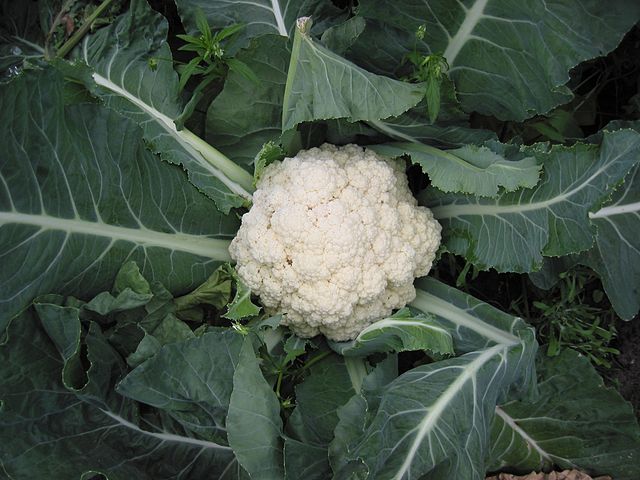
There are people that no matter what the goal is will say GMOs should be outlawed.  The question, of course, is why? After all, we have been modifying our food for thousands of years.  Let’s talk about Cauliflower.  The many types of cabbage, broccoli, kale, kohlrabi, and cauliflower are all descended from the same plant. Brassica oleracea also called wild cabbage (The extraordinary diversity of Brassica oleracea).

Brassica oleracea (wild cabbage) photo by Kurt Kulac,. Licensed under the Creative Commons Attribution-Share Alike 2.5 Generic license.

Over thousands of years farmers selected for traits they found desirable, leading to all the variants, many of which don’t even look like the same plant like cauliflower.

A cauliflower plant photographed by Bloemkool. Licensed under the Creative Commons Attribution-Share Alike 3.0 Unported license.

Research into Arabidopsis thaliana flower development by scientists using a mutagen (a chemical compound that creates changes in DNA) to create mutations.  One of these mutations produced plants that looked like cauliflower (Molecular basis of the cauliflower phenotype in Arabidopsis).  Additional research showed that the gene muted in Arabidopsis to produce the cauliflower phenotype was the same naturally occurring mutation in Brassica oleracea that was selected to produce cauliflower.

The research into plant development means that I could reproduce cauliflower in three different ways.  One, I could selectively breed Brassica oleracea to produce cauliflower.  Two, I could create mutations in Brassica oleracea using chemical mutagens and select for cauliflower.  Three, since we know the gene, I could use genetic engineering to create cauliflower from Brassica oleracea.  Most importantly done correctly, I could produce cauliflower using all three of these methods, and genetically, they would be identical.  However, even though there would be no difference between the three varieties, people would insist that the GMO cauliflower caused all kinds of problems, why?

While GMOs are already out in the wild and because of the spread of pollen, it is unlikely that society will ever put GMOs back in the box.  With several of the recent occurrences, it might also be too late for human genetic engineering, human GMOs.  Now let’s talk about Chimera’s. 

One of the primary goals for human-monkey or human-pig chimeras is the production of organs for transplant.  A common statistic is that 20 people die every day in the US waiting for a transplant. In the case of organ transplants, individuals would donate cells that scientists combine with an early pig embryo. The human cells would then give rise to the lungs, which doctors would transplant.  Currently, scientists have not produced chimeras with enough human cells to create organs that are viable for transplant.  However, it is only a matter of time until this becomes possible.  Will people wait until the first transplant occurs to talk about chimeras?

However, just as significant as the question, “will we discuss something before it happens?” Is the question of whether we are doing enough to teach science so the general society can adequately discuss the issues?  How important do you think science classes for nonmajors are?  Nonmajors class might make all the difference to the future of scientific research and medical improvements.

Thanks for Listing to My Musings
The Teaching Cyborg

Increasing STEM Graduation Numbers

“You cannot teach a man anything; you can only help him discover it in himself.”
Galileo

For decades the United States government has told us that we need to turn out more STEM graduates.  I remember hearing in my youth the government talk about needing more science graduates; Rita Colwell had not yet coined the term STEM.

On December 18, 2012, President Barack Obama announced a plan to add 1 million more STEM graduates over the next decade (Obama White House.)  In 2018 the Committee on STEM education in their report CHARTING A COURSE FOR SUCCESS: AMERICA’S STRATEGY FOR STEM EDUCATION said, “Since 2000, the number of degrees awarded in STEM fields has increased, but labor shortages persist in certain fields requiring STEM degrees.”

Researchers have proposed that one of the biggest reasons for the lack of STEM graduates is the lack of Primary and High School STEM teachers.  Especially high school physics teachers, according to a 2011 report by the US Department of Education only about 46.7% of all high school physics class are taught by a teacher with a degree in the subject.  Furthermore, according to a report from the U.S. Department of Education Office for Civil Rights, only 63% of US high schools offer physics.

Decades into the problem, what do we do to increase the number of people graduating with STEM degrees?  Most of the programs focus on expanding the pipeline getting more people interested in STEM careers at an earlier age.  While these types of programs are essential and vital, especially in the cases of underrepresented groups, I wonder if there might be a better way to increases STEM graduates.

Another way to increase graduation rates would be to increase STEM retention.  Even all these years later, I still remember my first core biology course as an undergraduate.  The professor taught the course in the largest lecture hall on campus; there were over 500 students in that class.  By the end of the core biology sequence, there were less than 250 students left.

According to the National Center for Educational Statistics report STEM in Postsecondary Education: Entrance, Attrition, and Course taking Among 2003−04 Beginning Postsecondary Students, 27.8% of the 2003-04 starting class registered as STEM majors.  According to the same report, 51.7% of the students that started in STEM degrees graduated with a STEM degree. Also, according to the National Center for Educational Statistics, the total student enrolment for fall 2003 was 16,911,481 (https://nces.ed.gov/programs/digest/d13/tables/dt13_303.10.asp retrieved July 27, 20019.)

Using these numbers, the 2003-04 incoming class had 4.7 million registered STEM majors.  By the 5-year graduation mark, the 2003-04 starting class had graduated 2.4 million students with STEM degrees.  Which means the 2003-04 class had lost 2.3 million STEM majors.  If the 2003-04 graduating class had graduated 73% instead of 51.7%, there would have been 1 million more graduating STEM majors.  The same number that Obama set but in half the time and without any changes to the incoming pipeline.

Beyond just increasing the overall number of STEM graduates, increased retention can help in other areas.  For example, from the 2003-04 incoming class, 14.2% of the female students that started as STEM majors left postsecondary education while 32.4% left STEM for other majors. (STEM Attrition: College Students’ Paths Into and Out of STEM Fields Statistical Analysis Report)  Conversely, 23.1% of the Hispanic students that were STEM majors left postsecondary education entirely while 26.4% left STEM majors for other fields. We see similar trends in Black students, 29.3% left higher education without a degree, and 36% left STEM for other majors.  The numbers were lower for Asian students, 9.8% left without a degree, while 22.6% changed to other majors. (STEM Attrition: College Students’ Paths Into and Out of STEM Fields Statistical Analysis Report).

Again, if we could increase the retention rate of these students by 50%, we would add a lot of Female, Hispanic, Black, and Asian STEM majors. The most significant advantage of increasing retention rates to increase the number of STEM graduates is we are already dealing with a group that has an interest in STEM.  Additionally, working on increasing retention forces us to decide if the educational goal for undergraduate students is teaching STEM or sorting STEM students.  After all, it is about time that we remember, not all STEM major wants to get a Ph.D. and become a professor.  At the undergraduate level, we should be teaching STEM students so that they can use their skills to pursue their paths. Thanks for

Listing to My Musings
The Teaching Cyborg