There is a Lot of Pressure, Partially, Involved

“Gases are distinguished from other forms of matter, not only by their power of indefinite expansion so as to fill any vessel, however large, and by the great effect heat has in dilating them, but by the uniformity and simplicity of the laws which regulate these changes.”
James Clerk Maxwell

When learning chemistry gasses get a lot of attention. There are a lot of laws and formulas that relate to gasses. Here is a list of gas laws:

1) Avogadro’s Law
2) Boyle’s Law
3) Charles’s Law
4) Gay-Lussac’s Law
5) The Ideal Gas Law
6) Dalton’s Law of Partial Pressures
7) van der Waals Equation (Non-Ideal gases)

I want to talk about Dalton’s Law of Partial Pressures. If you look up Dalton’s law like most students would Wikipedia via Google we see that the definition of Dalton’s law is: “Dalton’s law (also called Dalton’s law of partial pressures) states that in a mixture of non-reacting gases, the total pressure exerted is equal to the sum of the partial pressures of the individual gases.” Which comes from Silberberg, Martin S. (2009). Chemistry: the molecular nature of matter and change (5th ed.). Boston: McGraw-Hill. p. 206. ISBN 9780073048598.

I have not thought about Dalton’s law in years. The last time was when I was helping develop some chemistry labs. Then two weeks ago I ran across a YouTube video from Cody’sLab called Demonstrating The Law of Partial Pressures.

What I found interesting about this video is that Cody built a physical device to demonstrate the law. The device is two pressure chambers made out of copper plumbing parts and glass tubs attached with a simple valve. A quick search online suggests that one of these devices could cost less than $100.00. He uses the device to demonstrate several principles of Dalton’s Law. What I find fascinating about the device is that in many ways this device did a better job demonstrating Dalton’s law then any device I encounter in my high school or early chemistry classes.

With a small amount of work, it should be possible to build a device that was composed entirely of parts that could be screwed together allowing assembly into multiple configurations. A device students use in multiple configurations would expand the options for open-ended inquiry. Multiple configurations would let chemistry students conduct inquiry-based labs. Students could assemble the appropriates so that they could combine 2, 3, 4 or even more samples.

We know that hands-on experiences improve student learning. In the article Physical Experiences Enhance Science Learning, the authors show that physical experiments lead to increased test scores. Additionally, they showed that later recall of the information activated the brains sensorimotor region. Which suggest a mechanism by which hands-on teaching can improve learning. Since hands-on learning enhances science education, we could argue that the current model where we have a 3-4 credit lecturer class and a one-credit laboratory class is backward and we should be running 3-4 credit labs with one credit lectures or recitations. That, however, is an argument for another day.

Since we know the value of hands-on learning lets takes this idea to the next step. Suppose the students not only ran an experiment to confirm and explore Dalton’s Law but they also built and designed the equipment to do the experiment. Would this enhance learning even more? I could see a couple of ways building your equipment could enhance learning. One, this would be a way to expand the amount of hands-on time. Two, building the test apparatus could give the students a better understanding of how the device works. Three, the designing and building process could potentially lead to enhanced ownership in the experiment. The impact of building your research equipment is an area where more research is needed.

However, even with the evidence that shows hands-on learning enhances science education laboratory classes are under increasing attack. One of the most common arguments I hear against hands-on science education is the cost. The device Cody built for his video is relatively cheap if you were to build it for less then $100 this is less then some microscope slides or chemical reagents. There are of course questions about the equipment used in labs. There are many arguments that the lab is the place for students to learn about research equipment. I have had many discussions concerning the design of laboratory activities that started with “my students need to know how to use X piece of equipment.”

While there are some types of equipment that students should have a familiarity with the idea that students need to learn a specific piece of equipment is ridiculous. First, what is the likely hood that a specific piece of equipment is still going to be in use when they end up working in a research laboratory? Second, what are you trying to teach the students? As an example suppose I design a lab to demonstrate the Mendelian laws of inheritance. The students will need to use a dissecting scope to determine the sex of their fruit flies. Should I devote half the laboratory activities and time to the use of the dissecting microscope? Of course not, the microscope is not part of the principle of inheritance.

Beyond the fixation on specific pieces of equipment, there is also a belief that low-cost equipment is unusable. Whether the cost of equipment affects its educational value is an interesting question. Generally, the cost of equipment is directly related to precision, how much precision do we need. If the purpose of a laboratory activity is to show that acceleration due to gravity is independent of mass, do the student need precision out to 10 decimal places? As long as the equipment meets the need for the activity, we do not need to go with the most expensive thing. When we design STEM activities, we need to focus on the learning goals what has the best chance of enhancing the students learning. In regards to student learning, learning is not proportional to the cost of the equipment, and it is not dependent on a specific piece of equipment. Our instructional design needs to be informed and based on what the research says not ideas about the “best” piece of equipment.

Thanks for Listing to My Musings
The Teaching Cyborg

Have Textbook Chapter Review Problems Outlived Their Usefulness?

“Your mind will answer most questions if you learn to relax and wait for the answer.”
William S. Burroughs

While I don’t remember the specifics, one thing that I remember from many of the course outlines I had as a student is, read pages x-xx or chapter X and then answer the problems at the end of the chapter. The presence of problems in textbooks is in some way directly related to the creation of the textbook.

Homework - vector maths.jpg, Me and my homework, by Fir0002, From Wikimedia commons, published under Creative Commons license: Attribution NonCommercial Unported 3.0
Homework – vector maths.jpg, by Fir0002, From Wikimedia commons, published under Creative Commons license: Attribution NonCommercial Unported 3.0

The use of problems and answers in the “Textbook” predates the use of the word textbook.  According to the Merriam-Webster Dictionary “The first known use of textbook was in 1779.” However educational books have been in use far longer.  During the 4th century AD, Aelius Donatus wrote school books about grammar one of them Ars Minor is written entirely in the format of problem and answers (Encyclopedia Britannica).

The Ars Minor included both the problem and answer.  The instructor used the Ars Minor in a recall method where an instructor would ask a problem, and the student would recite the answer.  In most modern textbook’s problems are found at the end of chapters or units.

Modern textbook present review problems in one of three methods, first the textbook will contain all the answers to the review problems. In the second method, the textbook will provide the answers to half or just some of the problems.  Lastly, the textbook does not include the answer to any of the problems.

The purpose of review problems in textbooks has historically also had multiple uses. One, students can check their understanding of the material with the problems that have answers. Additionally, if the author presents the solutions in enough detail, they can be used to model problem-solving.  The faculty member is meant to use the problems without answers for quizzes and homework assignments.  While many publishers are starting to provide access to problem banks, I have seen the addition of “new” problems used as an argument for adopting a new version of a textbook.

In this day and age of interconnectivity and the internet does it even make sense to include problems in a textbook?  The concern is students will look up the answers online.  The availability of answers online makes the included problem useless for homework and quizzes. Upgrading to a new edition of the textbook ever 3-4 years will probably not help.  After all, how long do you think it takes to post answers online? While I have not tested this, I suspect all the answers are on the internet in a couple of days to a few weeks from the publication data of most textbooks.

The availability of so many answers online causes several issues.  One, especially when we are dealing with problems at the introductory level plagiarism can be difficult to identify.  Even if I ask the students to write out a paragraph, for example, explaining Mendel’s Law of independent assortment how many ways are there to write that paragraph?  While I’m not sure how many ways there are to write that paragraph, I suspect many generations of students have already written them.

I know some faculty that say education is ultimately the student’s responsibility and if they choose to shortcut the process, they will only harm themselves in the end.  While I think most of this is true, I also think it is the responsibility of the instructor and the institution to hold the line on ethical behavior in the learning environment.

There is a lot of arguments about students using “Google” to answer problems.  I have heard a lot of faculty say that it is beneficial for the student to struggle with the answer to problems.  While that is true to some point, it is also important that the students have a reasonable starting point.  Providing a starting point is where a problem with “complete” answers that model problem solving are useful.  Additionally, the problems need to be solvable; if students can’t solve the problems, it can get discouraging.

I also think the issue of looking up problems on the internet touches on another point.  Most schools state that part of their educational goal is to foster lifelong learning. When the students graduate and leave the school how are they going to engage in that lifelong learning?  They’re going to use the internet.  It is desperately important that we teach students how to use the internet, how to evaluate the validity of information, and how to determine credible sources.  We need to embrace the internet and start including it as part of our educational process instead of just saying “ITS BAD!”

Lastly, the proper use of problems doesn’t only benefit the students but also the instructor.  Problems and their answers should be used to provide feedback on pedagogy and teaching in the classroom.  The solutions to the problems should inform revisions and changes to the course based on student difficulties and misunderstandings.

If problems are essential but the internet makes the usefulness of textbook problems suspect what are we going to do about it?  One, make it clear what is and isn’t allowed as far as “help” is concerned and do your best to enforce this policy.  Help students learn to use research tools, which includes the internet, correctly.  Lastly, concerning textbooks, we should stop including and using problems in the textbook itself.  We should include problems in a separate workbook that we can change every semester or at least every year. Workbooks will let instructors change problems not only to “try” and keep ahead of the internet but to meet the changing needs of the course without having to change the textbook.

Thanks for Listing to My Musings
The Teaching Cyborg

My Students Need to Turn Knobs in Labs

“In general, obsolete technology is obsolete for a reason. Monocles are no exception.”
Neil Blumenthal

Many science faculty view laboratory classes as a central component of science education.  Many groups have come out in favor of the laboratory class. According to the America Chemical Society (ACS), “Hands-on laboratory science experiences are critical to the learning process across all areas of study, beginning with kindergarten and continuing through post-secondary education.” (Public Policy Statement 2017-2020) The National Science Teachers Association says “For science to be taught properly and effectively, labs must be an integral part of the science curriculum.” (NSTA Position Statement)

What is the laboratory class? According to America’s Lab Report: Investigations in High School Science “Laboratory experiences provide opportunities for students to interact directly with the material world (or with data drawn from the material world), using the tools, data collection techniques, models, and theories of science.” (NRC 2006 p. 3) while the ACS says, “well-designed laboratory experiences develop problem-solving and critical-thinking skills, as well as gain exposure to reactions, materials, and equipment in a lab setting.” (ACS Public Policy Statement 2017-2020)

While these definitions have some similarities, they also have differences.  I know science faculty that think we should get rid of science labs and faculty that believe we can’t teach science without them.  The thing that surprises me the most is that a many science faculty tell me that one of the most important aspects of laboratory science is learning to use the equipment.

I was involved in a redesign of a physics laboratory course; this course had not been reviewed or updated in, let’s just say “a really long time.”  We were discussing an acceleration due to gravity lab.  The main goal of this lab was to understand that acceleration due to gravity is independent of mass.  This experiment is often run using an air track which is a device that uses air to produces a relatively frictionless surface for a “car” of different masses to run on.  I won’t go into the reasons but setting up the air track to get accurate readings can be difficult.

Several of us proposed some changes to make the set-up easier so that students could collect more significant amounts of data; this would give us more opportunities to build analysis and data testing into the lab report. One of the faculty members argued that he set up his lab so that the students had to spend 80+% of their time setting up the equipment because the most important thing for the students was to “learn” how hard it was to collect accurate data.  Ask yourself what does this have to do with the learning goal?

While developing biology labs, many faculty members have told me “my students have to learn to twist the knobs on a microscope.”  I graduated from graduate school in 2006 even then every microscope I used was connected to a computer and most of them could not be run without a computer.  I rarely twisted knobs.  Additionally, most of these labs had learning goals associated with learning to identify cellular organelles or the differences between different types of muscles.  Even if the students end up using a non-automated microscope what does twisting knobs have to do with the learning goals?

Beyond an incorrect aliment with learning goals in a world where technology is rapidly evolving it is almost impossible for student labs to teach the use of equipment that will not be obsolete by the time they graduate.  As Hofstein and Lunetta said “It is unreasonable to assert that the laboratory is an effective and efficient teaching medium for achieving all goals in science education” (Review of Educational Research Vol. 52, No 2 pp. 201-217) They do suggest that laboratory activities can be used to develop inquiry, problem solving, and observational skills.

Over the last few decades, all this mixed information has allowed laboratory education to come under increased attack.  Several years ago, I worked with an assistant dean of engineering to develop an assessment tool he could use to reinforce the value of lab classes because the college wanted to cut back on lab classes.  Beyond this example lab classes have been subject to a lot of attack over recent years.  From an administrative point of view, there are questions about the cost; laboratory classes are the most expensive classroom on campus. 

Beyond cost laboratory classes are often assigned the same learning goals as the lecture classes.  Some argue if the two classes are doing the something couldn’t the extra time be better used on additional material? Especially since there are countries that don’t have lab courses in their curriculum. (Science Education Vol 88, #3, p. 397-419)

So, what does this mean for faculty members and instructional designers in science?  First when it comes to laboratory classes making sure we have clearly defined learning goals may be even more critical than it is in lecture classes.  Making sure that the activities in the lab support the learning goal are a must.  Lastly, we need to spend more time thinking about why we use labs, what labs can be used for that other forms of education can’t and focus on them.  If we want lab science courses to last, we need to start fighting for them now.

Thanks for Listening to My Musings

The Teaching Cyborg
I’m Awarding 10 points for Learning

“I went to Columbia University because I knew I wanted to go to a school that was academically rigorous. I prided myself on getting good grades, but I also hated it.”
Ezra Koenig

When you’re a student, it can seem that your life revolves around points. Your points determine whether you pass a class which determines what else you can take and whether you graduate.  It’s no surprise that one of the most come questions students ask is “Will this be on the test?”

Regardless of the school points affect your life.  In J.K. Rowling’s Harry Potter books the phrase “… points for Gryffindor” occurs at least 21 times.  This phrase has had such an impact it made its way in the most import of all art forms the meme (Note Heavy Sarcasm)

Memes based on awarding points to Gryffindor in the Harry Potter Books.

In the Harry Potter books, the points are used to give the hero’s a reword at the end of a book or just as comic relief.  In real life, students find points stressful or focus on points (grades) to the exclusion of learning.

Some discussions suggest grades, at least as we are using them, might be harming student learning. It is stated in the article Teach more by Grading Less (or Differently)


“Grades can dampen existing intrinsic motivation, give rise to extrinsic motivation, enhance fear of failure, reduce interest, decrease enjoyment in class work, increase anxiety, hamper performance on follow-up tasks, stimulate avoidance of challenging tasks, and heighten competitiveness.”

So why do we use points, as educators our role is to provide the best learning experience possible.  If there is any chance that something could be hindering learning shouldn’t we be exploring other alternatives?

When it comes to the idea of eliminating points, I remember a talk I attended in the early days of student response systems (Clickers).  A physic instructor was using clickers to poll students in real-time and then using pear-pear instruction to enhance learning.  At first, many students were not responding. The effectiveness of the clickers in education is dependent on students responding. However, he did not want the students to feel that clickers were an exam. 

The instructor chooses to assigned points to the clicker questions. However, these points only counted as 1% of the course total.  This low amount of points was enough to get most of the students to engage.  The instructor then used learning gains to show how learning in his class had improved with this increased participation.  In this case, points undoubtedly helped motivate students to learn.

So, points can motivate students and promote learning.  Well yes, however, the critical thing to remember the physics instructor assigned the points for a specific pedagogical reason.  We did not choose many of the parts of the standard grading system for pedagogical purposes.

Have you ever thought about the grading scale A, B, C, D, and F what happened to the E?  It turns out the first record we can find for a modern grading scale comes from Mount Holyoke College in 1887 their scale was A (excellent, 95-100%), B (good, 85-94%), C (fair, 76-84%), D (barely passed, 75%), and E (failed, below 75%) there’s that missing E.

Over the years the standardization of the grading scale lost the E.  In the case of the current grading scale standardized is an important word.  As society changed and grew, more and more students transferred between schools or continued their education at an institution of higher learning.  To mediate student movement school needed a way of communicating student abilities and success.  Therefore, one of the most significant driving forces of the modern grading system was the need to communicate quickly and precisely between schools.

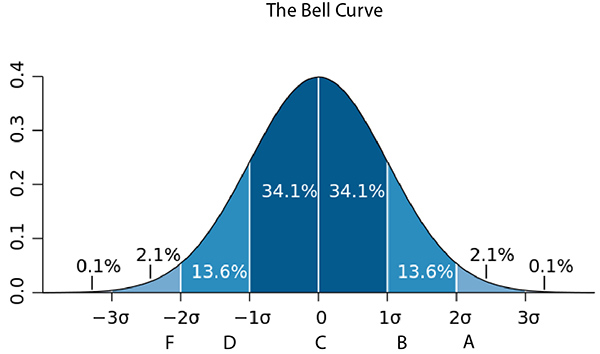
However, you will also note that the percentages for the Holyoke scale are different than many today. Today the difference from one letter grade to the next is usually 10%, and failing is 60% and bellow. Additionally, there was a push in the early to mid-parts of the 20th century to standardize grade distributions to the Normal Distribution/Bell Curve with the C set to the mid or average position.

The Bell Curve modified form Standard Deviation diagram.svg,, Auther M.W. Toews from Own work, based (in concept) on figure by Jeremy Kemp, on 2005-02-09. This file is licensed under the Creative Commons Attribution 2.5 Generic license.

The bell curve added a component of sorting to a system that was supposed to represent mastery.  There is also the question of whether a system (the bell curve/normal distribution) that describes the distribution of physical characteristics (height, weight, strength, etc.) is appropriate to measure learning?

While there is a lot to be said for other grading and assessment methods, the standard grading system is not going to go away anytime soon.  We can’t replace the A – F system quickly because it has many advantages, especially in a mobile society.  As educators, we need to remember that our job is to motivate and encourage learning, the grades will come from knowledge.

When we design our courses, the assignment of points should be for pedagogical reasons.  Just like the clicker in the physics class, we should use points to encourage learning activities.  Points should be assigned based on the activity’s importance to learning, not the need to fill a spreadsheet. Lastly, enough points should be used to allow for a complete and accurate assessment and feedback.

Do you consider the pedagogical impact of your point assignment? Do you think about the effects of grades on your students learning and motivation?  Lastly, why don’t we spend more time discussing something as important as the effects of points and their associated grades on student learning?

Thanks for Listing to My Musings

The Teaching Cyborg

Genetics, Sorry Its Actually Math

“The truth, it is said, is rarely pure or simple, yet genetics can at times seem seductively transparent.”
Iain McGilchrist

Depending on the type of biology degree a student is earning the classes taken can vary. However, in a lot of programs, you will take a basic genetics course as the second or third course of the introductory sequence.

Sometimes I think genetics is a lot like the game of GO simple to learn but challenging to master. Genetics relies on simple rules and principles. These rules and principles can combine to form surprising complexity. There are only five types of genetic mutations and three laws of Mendelian inheritance. A Punnett square (a tool to analyze potential outcomes of a genetic cross) for a cross between to heterozygous (Aa) parents has four boxes. A Punnett square for a five gene heterozygous (AaBbCcDdEe) cross has 1024 boxes.

However, for all the simplicity of basic genetics, many students drop out of biology during or after that first genetics class. So, if the foundation of genetics is simple why do so many students leave or fail genetics. The reason is math, invariably a week or two into a genetics class I always hear students say something like “I choose biology, so I didn’t have to do math.”

Thinking biology does not use math is a funny statement to anyone that has completed any science degree because we all know science always includes some math. Most science degrees require at least some level of calculus graduate. For most biology students’ genetics is the first time where a lot of math is part of the biology.

Beyond the fact that genetics integrates math the bulk of the math is statistics, you could even say that genetics is statistics. Even if the students had statistics, it was probably not embedded into biology. While students might know the basics of statistics, they might have problems with transference, the ability to take preexisting knowledge and apply it to a new situation.

If students are having problems with transference concerning the principles of statistics, or even worse have not had a statistics course, they are not going to be able to focus on biology. Think about a simple piece of information; we tell the students that the probability of a baby being a girl is 50%. Then on a quiz, we ask the students this question (I have seen it used) “In a family with four children how many are girls and how many are boys?” The answer that the instructor is looking for is two girls and two boys. However, I know families that have four girls, or four boys, or three girls and one boy, or 1 girl and three boys. If a student put down one of these other answers, it is technically correct because all these options have happened.

While one problem is the poorly written questions, there is also a problem with understanding what a 50% probability means. One of the most important things that students need to understand is that a 50% probability is a statistic based on population. It is entirely possible for probabilities to vary widely with small sample sizes, as the sample size gets larger the probability of heads to tails to get closer and closer to 50%.

A simple way to think about the sex ration is coin flips. When we flip a coin, we say you have a 50% chance of getting heads. Now suppose I flipped a coin three times and got tails on all three, what is the probability that the fourth flip will be tails? There is two answer I hear most often 6.25% and 50%. The correct answer is 50%. You see every coin flip is an independent event that means each coin flip has a 50% probability of coming up tails.

Coin Toss by ICMA Photos, This file is licensed under the Creative Commons Attribution-Share Alike 2.0 Generic license.

Now if we were to flip a coin 200 times in a row, the total data set would average out to be close to 50% heads to tails. However, even in this larger sample, there are likely to be several relatively long runs of heads or tails in some case more than seven in a row. People can quickly detect fake versus real data directly from the fact that most faked data does not have long enough runs of heads or tails, you can read about it here.

Therefore, one of the most important things we can teach students is the principle of significance. Students need to understand that it is not essential to merely show that probabilities and averages are different but that the difference between them is significant.

What does all this mean for genetics education? First, students should have a basic understanding of statistics before they take genetics. I believe that if statistics are not required to take statistics as a prerequisite for genetics you are not seriously trying to teach genetics to everyone.

However, even if the students have a foundation in statistics genetics lessons should be designed to help the students transfer knowledge from basic statistics into genetics. The transfer of information is also a situation where technology can help. In many math classes especially at calculus and above students often use software like Mathematica to solve the math equations once the student determines the correct approach and writes the equation.

In a genetics’ class students don’t need to derive or prove statistical equations. The students need to know what equations to use and when to use them. There are several statistics analysis software programs available. We should let the students use these tools in their class, a lot of professional scientists do. If we made statistical analysis software available, then students could focus on learning what calculations to apply were and focus on the biology that the statistics are highlighting.

What do you think should we design genetics classes to try and reach all the students? Could statistical analysis tools help the students taking a genetics class? Have you tried helping your students transfer knowledge from their statistics class to their genetics class? How often do we consider transference when we design new courses, should we be doing it more?

Thanks for Listing To my Musings

The Teaching Cyborg