1, 2, 3, 4, 5, and 6? Extinctions

“Extinction is the rule. Survival is the exception.”
Carl Sagan

An article in Scientific America asked an interesting question, Why Don’t We Hear about More Species Going Extinct? There have been a lot of stories about the planet being in the middle of the 6th mass extinction.  Reports are saying that the rate of extinction is as much a 1000 times normal.  If these articles are correct shouldn’t we see articles in the news about species going extinct?  However, I wonder if people even understand the context of mass extinctions?  If asked, what is a mass extinction, could you answer? 

To understand what a mass extinction is, we need to understand life on earth and the fossil record.  All five existing mass extinctions are in the fossil record.  The first life that appeared were microbes around 3.7 billion years ago.  They lived in a world that was quite different from present-day earth.  The atmosphere was almost devoid of O2 (molecular oxygen) and high in things like methane.  Molecular oxygen is highly reactive and will spontaneously react with any oxidizable compounds present.  The early earth was full of oxidizable compounds, any molecular oxygen that did appear was almost instantly removed by chemical reaction.

About 1.3 billion years later the first cyanobacteria evolved, these were the first photo-synthesizers. Over possibly hundreds of millions of years molecular oxygen produced by the cyanobacteria reacted with compounds in the environment until all the oxidizable compounds were used up.  A great example of this is banded iron deposits.  Only when molecular oxygen reacted with all the oxidizable compounds could molecular oxygen begin to accumulate in the environment. 

After another 1.7 billion years the first multicellular organisms, sponges appeared in the fossil record.  Around 65 million years later a group of multicellular organisms called the Ediacaran Biota joined the sponges on the seafloor.  Most of these organisms disappeared around 541 million years ago.  However, the loss of the Ediacaran Biota is not one of the five mass extinction events.  How much of an evolutionary impact the Ediacaran Biota had on modern multicellular organisms is still an open question.  Most of the Ediacaran Biota had body planes quite different from modern organisms.

The next period is especially important; it started about 541 million years ago and lasted for about 56 million years.  The period is known as the Cambrian.  This period is referred to as the Cambrian explosion because all existing types (phyla) of organisms we see in modern life emerged during this period. The Cambrian explosion is also essential because the diverse number and types of organisms that evolved during the Cambrian explosion form the backdrop for mass extinctions.

The first mass extinction occurred 444 million years ago at the end of the Ordovician period.  During this extinction event, 86% of all species disappeared from the fossil record over about 4.4 million years. Global recovery after the extinction event took about 20 Million years

The Second mass extinction occurred at the end of the late Devonian Period.  The Devonian extinction is the extinction that eliminated the Trilobites.  During this extinction event, 75% of all species disappeared from the fossil record over as much as 25 million years

The third and largest mass extinction occurred at the end of the Permian period 251 million years ago.  During this mass extinction, 96% of all species disappeared from the fossil record over 15 million years.  Research suggests that the Permian mass extinction took 30 million years for full global recovery.

The fourth mass extinction occurred 200 million years ago at the end of the Triassic period.  During this mass extinction, 80% of all species disappeared from the fossil record. The Triassic mass extinction appears to have occurred over an incredibly short period, less than 5000 years.

The fifth mass extinction occurred at the end of the Cretaceous period 66 million years ago.  This extinction is by far the most famous of the mass extinctions because it is the meteor strike that killed the dinosaurs.  During this extinction, 76% of all the spices disappeared from the fossil record.  Research suggests this mass extinction only took 32,000 years.

Now that we have looked at mass extinctions what about regular extinctions.  Normal or background extinction rate is the number of extinctions per million species per year (E/MSY).  Current estimates put the background extinction rate at 0.1 E/MSY.  If the the current extinction rate is 1000 times the background extinction rate, then currently the extinction rate is 100 E/MSY.

The current estimate for the total number of species is 8.9 million.  That means that 890 species are going extinct every year or 2.5 species a day.  So why don’t we hear more about spices going extinct if the extinction rate is that high?  First, the current catalog of identified species is 1.9 million, which means there are currently 7 million species (79%) that are undescribed.  That means 700 of the 890 extinctions a year would be in species that scientists haven’t identified.

The second problem is that even with identified species, it is often difficult to know if a species has gone extinct.  The International Union for Conservation of Nature (IUCN) maintains the Red List of critically endangered species.  One of the categories is Possibly Extinct (PE) based on the last time anyone saw an organism.  For example, no one has seen the San Quintin Kangaroo Rat in 33 years, no one has seen the Yangtze River Dolphin in 17 years, and no one has seen the Dwarf Hutia in 82 years.  It is likely that these three spices, along with several others, are extinct.

However, not being seen is not good enough to classify a species extinct.  After all, the Coelacanth was thought to be extinct for 65 million years until a fisherman caught one in 1938.  For a species to be declared extinct, a thorough and focused search must be made for the organism to declare it extinct.  These types of searches require time, personnel, and money.  Therefore, searches don’t often happen.  So with the exceptions of particular cases, like Martha the last Carrier pigeon who died on September 1, 1914, most species go extinct with a whimper, not a bang.

We don’t hear more about species going extinct because even knowing extinctions are occurring, in many cases, we don’t know about them.   Returning to the question of what is a mass extinction, and could there be a 6th happening?

Use the five existing mass extinctions as examples a simple definition of a mass extinction is an event where 75% or more of the existing species become extinct within a short (less than 30 million years) time.  Using the current estimated number of spices, and the current estimated rate of extinction we can calculate how long it will take to reach the 75% mark the answer is 7500 years. Since 7500 years is less than 30 million years, we could be on course for a 6th mass extinction.  However, as Doug Erwin says we are not in the middle of the 6th mass extinction.  If we were in the middle of a mass extinction like Dr. Erwin said cascade failures would already have started in the ecosystem and there would be anything we could do.  However, that is good news we still have time to do something.

What we need is an accurate count of extinct species.  So, do you have a class that could do fieldwork?  There is probably a critically endangered species near you.  Maybe you will even be lucky, and you will find the species then you can help with a plan to save it.

Thanks for Listening to My Musings
The Teaching Cyborg

Writing, Chances Are You Are Doing It Wrong

“You can always edit a bad page. You can’t edit a blank page.”
Jodi Picoult

Writing is a central component of education.  We could argue that writing is the ultimate goal of higher education.  After all, the final project of an academic student is the writing and acceptance of the dissertation.  Even during undergraduate education, there is a lot of focus on writing.  Most undergraduate classes have at least one or two multipage writing assignments.  With all this focus on writing the US should be turning out the greatest writers in the world.

However, there are a lot of essays saying college graduates can’t write.  In $100K, You Would At Least Think That College Grads Could Write from the Forbes website, the author states “They (students) take lots of courses and study lots of stuff (or at least seem to), but don’t even learn how to use the English language well.”  Many others agree that students don’t learn to write.  “I didn’t say the ugly truth: that her bright boy might not graduate as a solid writer, no matter how good the college.” (Maguire)

In the book Academically Adrift Limited Learning on College Campuses the authors state “At least 45 percent of students in our sample did not demonstrate any statistically significant improvement in CLA performance during the first two years of college.” (Arum and Roksa 2011, 204) The CLA uses open-ended questions to test critical thinking, analytic reasoning, problem-solving, and written communication.  According to this study, almost half of all students show no improvement in writing ability after two years.

Outside of higher education, we see similar views.  George Leef starts his post on writing by saying, “One of the loudest complaints about college graduates once they enter the workforce is that they can’t write well.” (Leef, George. “Why So Few College Students Can Write Well.” National Review. retrieved August 24, 2019, from https://www.nationalreview.com/corner/college-students-cant-write-well/) In his essay for education week, Marc Trucker states, “My organization decided a few weeks back that we needed to hire a new professional staff person.  We had close to 500 applicants. Since the task was to help us communicate information related to the work we do, we gave each of the candidates one of the reports we published last year and asked them to produce a one-page summary.  All were college graduates.  Only one could produce a satisfactory summary.  That person got the job.” (Trucker, 2017)

How did we get to this point were college graduates can’t write?  There are multiple issues that impact a student’s ability to write.  I have demonstrated one of the problems in paragraphs 2-4 of this blog post.  Can you identify it?  I will give you a hint.  In her article for Inside Higher Ed, Jennie Young talks about the problems that face the mostly adjunct Instructors (or graduate students) that teach the writing courses.  Based on the course load, these instructors carry, it is almost imposable to address all the problems in all the essays they need to grade. As she says, “Naturally, you begin looking for the easiest way to whittle down your load — some way to count some papers “in” and move others out of the way. And now imagine that just within your reach is the low-hanging fruit of MLA format (or APA, or Chicago or whatever).”  The title of the article is The Weaponization of Academic Citation.

Grading on style is easy, quick, and unambiguous.  The style manuals create the rubric. You can point to the rule or rules and say you didn’t follow the rules, and they are the base requirement.  Well, I followed the rules in paragraphs 2-4 of my blog; what do you think?  Actually, I followed five sets of rules (I will let you figure out which styles I used). 

I have written more than 54,000 words on my blog to this point.  I often conduct research when writing my posts.  However, I don’t follow a rigged citation or writing style. I use what feels right.  I want my readers to be able to find the works I’m referencing if they wish to, but my focus is on the thoughts and arguments I’m writing.  Would it improve my writing and arguments if I rigidly followed a style?  I guess you will have to tell me.  I do know that no style no matter how rigidly followed will correct incoherence.

Another issue with students writing abilities is the field of study.  I have had the opportunity to work with students, faculty, and administrators in many different disciplines.  What I have discovered over the years is how varied fields can be.  After all, a written critique of a new painting in the modernist style is not going to be like a research report describing a new and improved method to synthesize an organic compound.

Even within a single discipline thing can get confusing.  If you are in a field were publication is primarily through Journals articles well it seems each journal has its own rules and style guides.  If your field publishes books, it seems each publishing house has different requirements.

With all these differences between fields, publishers, and even writing styles the truth of the matter is that no matter how you write from someone’s point of view your essay, manuscript, or journal article is miswritten.  It’s a lot like the answer to the question Is hell Exothermic or Endothermic, “Some of these religions state that if you are not a member of their religion, you will go to Hell. Since there are more than one of these religions and since people do not belong to more than one religion, we can project that all people and all souls go to Hell.”  Concerning writing, we could say, since every group or field has a correct way of writing, and the author can only write in one method, all writing is incorrect.

While the previous statement is an exaggeration, it is not entirely incorrect.  But I think it leads to a more critical question. At the undergraduate level, what are we trying to teach the students when it comes to writing?  What’s more important in an introductory writing class learning to construct well thought out and coherent sentences or committing to memory the proper position of every comma and period for your citations in the MLA, APA, and Chicago styles.

To reference Einstein, “why would I waste my time memorizing something I can look up in a book.”   At least for the undergraduates writing should focus on good writing, not styles.  There are tools like Zotero that will format citations and create bibliography correctly in whatever style your publisher wants.  Additionally, citation software can keep your citation style up to date without you having to thoroughly read through each new addition of a style guide looking for changes.

Yes, teaching students to write well is hard.  Much harder than taking the easy way out and quickly grading papers on incorrect styles, page lengths, and formatting.  However, no amount of style and proper formatting will save an essay from incoherent sentences and poorly constructed paragraphs. At the undergraduate level, the bulk of the focus should be on good writing.  Sometimes I think we forget that undergraduate majors don’t follow a single path.  I know students that have earned a BA in Spanish language that have gone on to pursue cares in Law, International Business, Medicine, or Professorships.  I often think the push towards specialization in undergraduate education has come at the cost of general education.

Ask yourself when you are developing an undergraduate writing assignment is that assignment helping the students learn to write? Or is it teaching them structure without substance? In the meantime, I think I will continue “citing” information in my blog based on what feels right.

Thanks for Listing to My Musings
The Teaching Cyborg
Reference

Arum, Richard, and Josipa Roksa. 2011. Academically adrift: limited learning on college campuses. Chicago: University of Chicago Press.

Maguire, John. “Why Many College Students Never Learn How to Write Sentences.” The James G. Martin Center for Academic Renewal, 1 APR 2016, https://www.jamesgmartin.center/2016/04/why-many-college-students-never-learn-how-to-write-sentences/

Trucker, M. (2017). Our Students Can’t Write Very Well—It’s No Mystery Why Retrieved from http://blogs.edweek.org/edweek/top_performers/2017/01/our_students_cant_write_very_wellits_no_mystery_why.html 

If We Want to Discuss Scientific Ethics, We Need to Teach Scientific Literacy

Science literacy is the artery through which the solutions of tomorrow’s problems flow.”
Neil deGrasse Tyson

Late last year a Chinese scientist He Jiankui announced that his team had created two genetically engineered human embryos that lead to the birth of two female siblings.  I wrote an article about why this shouldn’t have surprised anyone (It Might Have Happened, We Don’t Know for Sure, But Now We Freak.) While there may still be some questions, all the technology needed currently exists.

In June 2019 Russian scientist Denis Rebrikov announced that he plans to seek approval from several government agencies to perform a similar experiment to He Jiankui. It is not currently clear that human genetic engineering is legal under Russian law, or that Dr. Rebrikov will receive approval for his trial.

Beyond genetically engineering humans a few days ago (Aug 3, 2019) a report came out about the creation of a Human-Monkey chimera First Human–Monkey Chimeras Developed in China. Professor Juan Carlos Izpisúa Belmonte’s group of the Salk institute conducted the experimented in China.  According to the report, the scientists chose to perform the research in China to avoid legal issues. The same group produced a human-pig chimera in 2017.

On top of questions concerning human experimentation, there are questions about Genetically Modified Organisms (GMOs).  Just like debates about human genetic engineering, the discussions about GMOs are occurring after the fact.  Today more then 90% of the Hawaiian Papaya crop is Genetically modified (How GMO Technology Saved the Papaya).  Other conventional crops like corn, soybeans, and canola oil are also mostly GMO.

I could continue listing procedures that are emerging that have or will have ethical debates associated with them.  However, if we are going to have meaningful discussions, it is essential that individuals have a basic scientific understanding.  Specifically, what are the techniques scientists use and why were they chosen.  What is genetic engineering?  What is a Chimera?  What are stem cells?  Why are we interested in these techniques?  Why should we use them? 

Let’s start with the basics according to Merriam Webster

  • Genetic engineering: the group of applied techniques of genetics and biotechnology used to cut up and join together genetic material and especially DNA from one or more species of organism and to introduce the result into an organism in order to change one or more of its characteristics
  • Chimera: an individual, organ, or part consisting of tissues of diverse genetic constitution
  • Stem cells: an unspecialized cell that gives rise to differentiated cells

While a few of these definitions could lead to additional questions, what does “diverse genetic constitution” mean, I can live with them.  These definitions would be a good starting point for discussions in class.  However, a lot of today’s society is like to go to Wikipedia instead of the dictionary.

  • Genetic engineering: Genetic engineering, also called genetic modification or genetic manipulation, is the direct manipulation of an organism’s genes using biotechnology.
  • Chimera: A genetic chimerism or chimera (/kaɪˈmɪərə/ ky-MEER-ə or /kɪˈmɪərə/ kə-MEER-ə, also chimera (chimæra) is a single organism composed of cells with distinct genotypes.
  • Stem cells: Stem cells are cells that can differentiate into other types of cells, and can also divide in self-renewal to produce more of the same type of stem cells.

Fortunately for society, many of these definitions are excellent; in fact, the Wikipedia definition of Genetic Engineering and Stem cells is probably better than Merriam Webster’s definition.

So that means that GMOs are the product of Genetic Engineering. So why would you want to create GMOs?  There are lots of reasons let’s talk about Golden rice.  Golden rice is a GMO designed to combat vitamin A deficiency.  Due to starch content, white rice is a good source of calories. However, rice lacks several essential nutrients (including vitamin A).

To combat Vitamin A deficiency, scientists engineered rice to produce β-carotene, which the human body turns into vitamin A.  Scientists created Golden rice by the insertion of two genes into the rice genome.  The final product is rice, that is a golden color and provides β-carotene.  So, in the case of golden rice, the reason for genetic engineering was to combat malnutrition. Other researchers are trying to create crops that need less fertilizer or pesticides, that have better yields, or to do less damage to the soil.

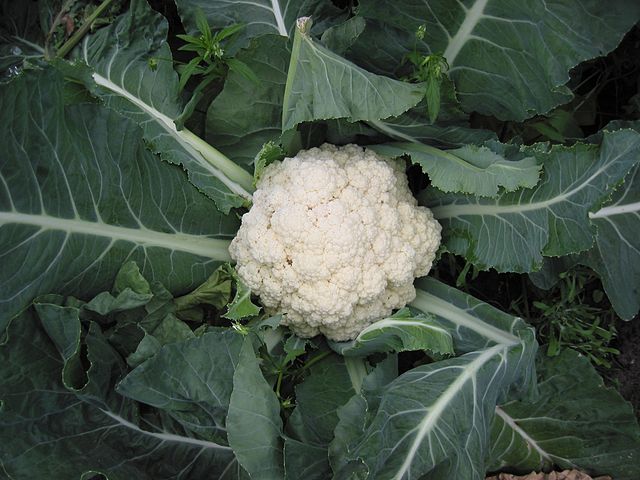
There are people that no matter what the goal is will say GMOs should be outlawed.  The question, of course, is why? After all, we have been modifying our food for thousands of years.  Let’s talk about Cauliflower.  The many types of cabbage, broccoli, kale, kohlrabi, and cauliflower are all descended from the same plant. Brassica oleracea also called wild cabbage (The extraordinary diversity of Brassica oleracea).

Brassica oleracea (wild cabbage) photo by Kurt Kulac,. Licensed under the Creative Commons Attribution-Share Alike 2.5 Generic license.

Over thousands of years farmers selected for traits they found desirable, leading to all the variants, many of which don’t even look like the same plant like cauliflower.

A cauliflower plant photographed by Bloemkool. Licensed under the Creative Commons Attribution-Share Alike 3.0 Unported license.

Research into Arabidopsis thaliana flower development by scientists using a mutagen (a chemical compound that creates changes in DNA) to create mutations.  One of these mutations produced plants that looked like cauliflower (Molecular basis of the cauliflower phenotype in Arabidopsis).  Additional research showed that the gene muted in Arabidopsis to produce the cauliflower phenotype was the same naturally occurring mutation in Brassica oleracea that was selected to produce cauliflower.

The research into plant development means that I could reproduce cauliflower in three different ways.  One, I could selectively breed Brassica oleracea to produce cauliflower.  Two, I could create mutations in Brassica oleracea using chemical mutagens and select for cauliflower.  Three, since we know the gene, I could use genetic engineering to create cauliflower from Brassica oleracea.  Most importantly done correctly, I could produce cauliflower using all three of these methods, and genetically, they would be identical.  However, even though there would be no difference between the three varieties, people would insist that the GMO cauliflower caused all kinds of problems, why?

While GMOs are already out in the wild and because of the spread of pollen, it is unlikely that society will ever put GMOs back in the box.  With several of the recent occurrences, it might also be too late for human genetic engineering, human GMOs.  Now let’s talk about Chimera’s. 

One of the primary goals for human-monkey or human-pig chimeras is the production of organs for transplant.  A common statistic is that 20 people die every day in the US waiting for a transplant. In the case of organ transplants, individuals would donate cells that scientists combine with an early pig embryo. The human cells would then give rise to the lungs, which doctors would transplant.  Currently, scientists have not produced chimeras with enough human cells to create organs that are viable for transplant.  However, it is only a matter of time until this becomes possible.  Will people wait until the first transplant occurs to talk about chimeras?

However, just as significant as the question, “will we discuss something before it happens?” Is the question of whether we are doing enough to teach science so the general society can adequately discuss the issues?  How important do you think science classes for nonmajors are?  Nonmajors class might make all the difference to the future of scientific research and medical improvements.

Thanks for Listing to My Musings
The Teaching Cyborg

Your Student Can Find Supernova

“Look up at the stars and not down at your feet. Try to make sense of what you see, and wonder about what makes the universe exist. Be curious.”
Stephen Hawking

Fifty years ago, humans first set foot on the moon.  In recognition of this, I thought I would discuss how astronomy classes can conduct real astronomy research.  As I have said in many of my posts, most current best practices in STEAM education recommend that students perform real science.

One of the arguments I have repeatedly encountered is that real science requires equipment that is too expensive for student labs.  Nothing could be further from the truth.  While scientific equipment on the cutting edge of science can be costly general improvements in technology, mean that students can use hobby grade instruments for scientific observations.

As an example, digital SLR cameras can be used to find supernova.  As a step up a simple telescope and digital camera like many schools already have can also be used.  Having the equipment fixed in a dedicated spot in a shed or dome that opens is helpful but also not necessary.  Students can also set up the equipment each night to make observations.

The basic technique to find supernova is to take lots of pictures of night sky night after night.  Then compare the images and look for a star (you’re looking at galaxies, not individual stars) that gets brighter or appears where there was not a visible star.  The biggest drawback to the discovery of supernova is simply the amount of data that the students will need.  On the website for BOSS Backyard Observatory Supernova Search under the setting up a search page they list supernova discoveries from several individuals

  • Tim Puckett (one of the largest in the world) ~1 SN every 8000 images (300+ SN)
  • Robert Evens ~ 1 SN every 4000 observations (47 SN)
  • Peter Marples ~ 1 SN per 5000 images (8 SN)
  • Me ~ 1 SN every 2800 images (57 SN)

Using these numbers as a baseline, we would find one supernova on average every 4950 images. If we assume a 15-week semester, the class would have to take 330 pictures per week.  Assuming students take one image every minute, 330 images would take 5.5 hours over one night or 2.75 hours over two nights.   With a class of 25 students, each student would need to examine 198 images or 13-14 images per week.  A better approach would be to have two students review 396 images so that two students separately review each 198-image set. All these numbers seem reasonable for a semester-long class.

Once students capture the images, students analyze the images in one of three methods.  In all methods, you compare the new images you take with a set of reference images.  You can either make your reference images.  Or download reference images from the Digitized Sky Survey (DSS). You then compare your new images to the reference images and look for differences.  The first way to do this is to compare the two images side by side and look for differences.  The second method is to blink the images. The new image is aligned and laid on top of the reference image, and the computer rapidly clicks between them. A free tool to do this is Starblinker.  The third method is automated software, but that can be expensive and is only suitable for projects that collect 1000s or more images a night (there are problems and drawbacks to automated software I will not get into). 

When your students discover a new Supernova (we will assume that if you review enough images, you will be successful.), the students can learn about submitting their discovery to Central Bureau for Astronomical Telegrams. A new supernova report will require the students to take additional images and measurements.

Any scientific research can be used to teach students the basics of research and observation.  The search for and discovery of supernova can be included in everything from a class for nonmajors to a dedicated research seminar.  Additionally, the students that conduct this type of research can be in almost any age group.  When we teach scientific research, it is essential to remember that science is a process and method of looking at the world, not the equipment we use.  So, get out there and find some stars that blew up.

Thanks for Listing to My Musings
The Teaching Cyborg

If a Picture is Worth a Thousand Words, Why Do We Use Words in Education?

“A true photograph need not be explained, nor can it be contained in words.”
Ansel Adams

A picture is worth a thousand words. As someone who has practiced the art of photography for most of his life, this phrase has always rung true.  The phrase seems to have had its origin in US advertising in the early 20th center. (The Phrase Finder, retrieved June 25, 2019, from https://www.phrases.org.uk/meanings/a-picture-is-worth-a-thousand-words.html) While it is certainly possible to learn without images, ask the 63,357 K-12 blind students in the US, (National Federation of the Blind, Blindness Statistics, retrieved June 25, 2019, from https://nfb.org/resources/blindness-statistics) image use is quite prevalent in education.

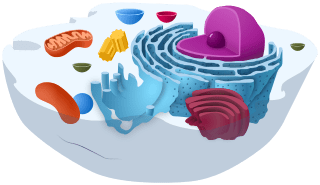
I don’t know many biology teachers that teach the structure of a eukaryotic cell without using a picture like the following one.

Unannotated version of File:Animal_Cell.svg, Author Kelvin Song, https://commons.wikimedia.org/wiki/File:Animal_Cell.svg. This file is made available under the Creative Commons CC0 1.0 Universal Public Domain Dedication.

Not only does this diagram display the components of a cell, but it also helps to establish a relationship between the different parts of the cell. In the textbook Concepts of Biology, the introduction to the structure-function of eukaryotic cells is 14 pages long.  There are 16 images and 4486 words on 14 pages.  That works out to about 320 words and one image per page.

The ratio of text to images in textbooks changes as students’ progress from kindergarten to college. The structure of the college textbook is different from primary school readers.  For example, in the Jack and Jill or Little Dog Spot readers, the whole page is a picture with a maybe seven words (Jack and Jill went up the hill).  While I don’t think a cell biology textbook written like a Jack and Jill book would be a good idea.  Can you imagine how long a college textbook would be if each page were a full-page image with a single sentence like, “eukaryotic cells contain a membrane-bound nucleus?”

While textbooks composed primarily of images will probably not work, I do wonder if we make proper use of images in textbooks.  One of the most common complaints, besides cost, I hear from students is that textbooks are boring, too long, and hard to read.  While the central point of a textbook should be as a teaching tool not merely as a download of facts, we also need to remember that learning to extract information from text is essential.  There are times when books of exclusively just text are necessary, even essential. I don’t see my Shakespearean literature class having worked without reading the plays. That said I do wonder if textbooks should not only include more images but use the images as a central teaching tool rather than just support for text after all image use is a core part of our mental processes.

Images have been with us for longer than written language.  Some of the earliest examples of human-created images are cave paintings, like the paintings found in the Leang Timpuseng cave on the island of Sulawesi, Indonesia.  Scientists have dated the paintings in this cave to at least 35,400 years old.  While they are not as well-known as the paintings in France’s Chauvet Caves, they are older than Chauvet (32,000 – 28,000 years old) making them possibly the earliest cave painting in the world.

Written language was developed around 5200 years ago in the form of the cuneiform script by the Mesopotamians.  The cuneiform script has a direct linkage to images carved in small clay tablets.  The earliest writing was to take these clay tablets and press them into a sheet of clay, “recording the image.”  These images evolved into the symbols of the cuneiform script. In addition to the fact that humans have been using imagery for 10s of thousands of years longer than written language, there is also evidence that images are more effective for learning than text.

One of the ideas behind images being better learning aids, then the text is the theory of dual-coding.  Simply the theory of dual-coding is that images activate two memory centers.  A text-based system and a separate image-based system.  While text by itself only activates a text-based system.  It is also possible that this dual-coding system would work with the other senses, touch, smell, and taste. In education, dual-coding gives the learner twice the number of memory locations for recall.

Beyond cognitive mechanisms like dual-coding, there is also the idea of visual langue. “Visual language is defined as the tight integration of words and visual elements and as having characteristics that distinguish it from natural languages as a separate communication tool as well as a distinctive subject of research.” (Visual Language and Converging Technologies in the Next 10-15 Years (and Beyond)) Infographics are an example of visual language.  Additionally, the paper Visual Language and Converging Technologies in the Next 10-15 Years (and Beyond), says that visual communication increases information transfer. “For example, improvements in human performance from 23 to 89% have been obtained by using integrated visual-verbal “stand-alone” diagrams.”

The ideas of dual-coding, coupled with visual language, suggest that textbooks should include more images.  Additionally, these images should be integrated tightly with the text and viewed as a central component of the learning process. Authors should not consider Images as secondary to the text but as an essential learning component on their own.

However, like so many other aspects of educational research while there is research stating that textbooks are not useful learning tools.  It is not clear if this failure is because textbooks are inherently ineffective learning tools or because of factors other than learning drive textbook design.  As I have said repeatedly, we desperately need more research into what makes an effective textbook.  In the meantime, maybe we should add a couple of pictures.

Thanks for Listing to my Musings
The Teaching Cyborg