My Students Need to Turn Knobs in Labs

“In general, obsolete technology is obsolete for a reason. Monocles are no exception.”
Neil Blumenthal

Many science faculty view laboratory classes as a central component of science education.  Many groups have come out in favor of the laboratory class. According to the America Chemical Society (ACS), “Hands-on laboratory science experiences are critical to the learning process across all areas of study, beginning with kindergarten and continuing through post-secondary education.” (Public Policy Statement 2017-2020) The National Science Teachers Association says “For science to be taught properly and effectively, labs must be an integral part of the science curriculum.” (NSTA Position Statement)

What is the laboratory class? According to America’s Lab Report: Investigations in High School Science “Laboratory experiences provide opportunities for students to interact directly with the material world (or with data drawn from the material world), using the tools, data collection techniques, models, and theories of science.” (NRC 2006 p. 3) while the ACS says, “well-designed laboratory experiences develop problem-solving and critical-thinking skills, as well as gain exposure to reactions, materials, and equipment in a lab setting.” (ACS Public Policy Statement 2017-2020)

While these definitions have some similarities, they also have differences.  I know science faculty that think we should get rid of science labs and faculty that believe we can’t teach science without them.  The thing that surprises me the most is that a many science faculty tell me that one of the most important aspects of laboratory science is learning to use the equipment.

I was involved in a redesign of a physics laboratory course; this course had not been reviewed or updated in, let’s just say “a really long time.”  We were discussing an acceleration due to gravity lab.  The main goal of this lab was to understand that acceleration due to gravity is independent of mass.  This experiment is often run using an air track which is a device that uses air to produces a relatively frictionless surface for a “car” of different masses to run on.  I won’t go into the reasons but setting up the air track to get accurate readings can be difficult.

Several of us proposed some changes to make the set-up easier so that students could collect more significant amounts of data; this would give us more opportunities to build analysis and data testing into the lab report. One of the faculty members argued that he set up his lab so that the students had to spend 80+% of their time setting up the equipment because the most important thing for the students was to “learn” how hard it was to collect accurate data.  Ask yourself what does this have to do with the learning goal?

While developing biology labs, many faculty members have told me “my students have to learn to twist the knobs on a microscope.”  I graduated from graduate school in 2006 even then every microscope I used was connected to a computer and most of them could not be run without a computer.  I rarely twisted knobs.  Additionally, most of these labs had learning goals associated with learning to identify cellular organelles or the differences between different types of muscles.  Even if the students end up using a non-automated microscope what does twisting knobs have to do with the learning goals?

Beyond an incorrect aliment with learning goals in a world where technology is rapidly evolving it is almost impossible for student labs to teach the use of equipment that will not be obsolete by the time they graduate.  As Hofstein and Lunetta said “It is unreasonable to assert that the laboratory is an effective and efficient teaching medium for achieving all goals in science education” (Review of Educational Research Vol. 52, No 2 pp. 201-217) They do suggest that laboratory activities can be used to develop inquiry, problem solving, and observational skills.

Over the last few decades, all this mixed information has allowed laboratory education to come under increased attack.  Several years ago, I worked with an assistant dean of engineering to develop an assessment tool he could use to reinforce the value of lab classes because the college wanted to cut back on lab classes.  Beyond this example lab classes have been subject to a lot of attack over recent years.  From an administrative point of view, there are questions about the cost; laboratory classes are the most expensive classroom on campus. 

Beyond cost laboratory classes are often assigned the same learning goals as the lecture classes.  Some argue if the two classes are doing the something couldn’t the extra time be better used on additional material? Especially since there are countries that don’t have lab courses in their curriculum. (Science Education Vol 88, #3, p. 397-419)

So, what does this mean for faculty members and instructional designers in science?  First when it comes to laboratory classes making sure we have clearly defined learning goals may be even more critical than it is in lecture classes.  Making sure that the activities in the lab support the learning goal are a must.  Lastly, we need to spend more time thinking about why we use labs, what labs can be used for that other forms of education can’t and focus on them.  If we want lab science courses to last, we need to start fighting for them now.

Thanks for Listening to My Musings

The Teaching Cyborg
Tell Me a Story

“A story has no beginning or end: arbitrarily one chooses that moment of experience from which to look back or from which to look ahead.”
Graham Greene

Story it’s an interesting word like so many words in English it has many meanings.  If you look in the Mariam Webster’s Dictionary, the word story has 18 definitions if you include the sub-definitions.  We use story a lot in the sciences.

How do I know when my research is ready for publication?  You’re ready for publication when you can tell a story.  How will I know when I’m prepared to write my dissertation?  You’re prepared to write your dissertation when you can write a complete story. The answer to many a question is when you can tell a story.

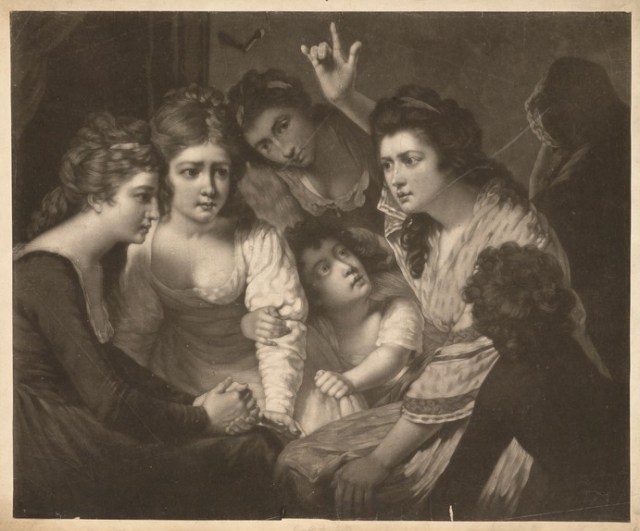
A lady telling a gripping story to young women and children. Mezzotint by V. Green, 1785, after J. Opie. Credit: Wellcome Collection, CC BY

Why a story?  A story is a very efficient way to teach something.  A properly constructed story helps us understand what is going on by logically presenting information and highlighting the links and connections between separate facts and events.  There is even a word for this storification in the paper Storification in History education: A mobile game in and about medieval Amsterdam the authors talk about the advantages of storytelling in History,

“In History education, narrative can be argued to be very useful to overcome fragmentation of the knowledge of historical characters and events, by relating these with meaningful connections of temporality and sequence (storification).” (Computers & Educations Vol 52, Issue 2, February 2009, p449.)

Storification also makes sense in regards to working and short-term memory.  Working memory and short-term memory are transient; permanent information storage takes place in long-term memory.  However, they are both critical to the establishment of long-term memory.  Information enters the memory system through Short-term memory, and processing and connections happen in working memory.

Unlike long-term memory, both short-term and working memory have limits on their capacity.   Recent work suggests that the size of working memory is 3 – 5 items.  For example, I could reasonably be expected to memorize a list of letters; H, C, L, I, and Z. I know some of you were going to say seven items as in the magical number seven, I break down the changes in our understanding of working memory in another blog post, you can read about it here.

However, we can quickly see a problem with 3-5 items; I can also remember a sentence, “All the world’s a stage” this sentence has 18 characters 19 if I count the apostrophe. I can hold this sentence in short-term memory.  I can remember these 18 characters due to a process called chunking coined by George Miller in his paper The Magical Number Seven, Plus or Minus Two Some Limits on Our Capacity for Processing Information.  Miller describes it as “By organizing the stimulus input simultaneously into several dimensions and successively into a sequence of chunks, we manage to break (or at least stretch) this informational bottleneck.” (Psychology Review Vol. 101, No. 2 p351)

In our example’s words are chunks; specifically, each word is a list of letters that have a specific meaning.  If I were to present that list of letters to you in a different way as zilch, it would be much easier to remember. Chunking is the same idea behind storification or storytelling; you are organizing the information into related chunks to make it easier for the mind to remember and digest.

With all the complicated information in a scientific paper, A story is a perfect format to present new scientific knowledge.  A scientific paper starts with an abstract which gives an overview. Then the paper has an introduction which places the new information in context with the old. Then we show the experiments (in the order that explains the information the best. not necessarily chronologically). Lastly, there is a summary that reiterates the new information in context with the old and what directions the research could go next.

A faculty advisor of mine once described writing a science paper as tell them what you are going to tell them, tell it to them, then tell them what you told them.  That might seem a bit excessive, in fact, I once had a non-science faculty member after hearing this triple approach to paper writing say, “what are scientists stupid?”  I think it’s a smart strategy, after all, have you ever had a teacher tell you how many times you need to hear something to commit it to memory? (I always heard it was three)

There is one thing I find quite strange about storytelling in science education.  It seems to me that helping students make connections and tie information together is the most important in the earliest stages of education — for instance, the steps of education that use textbooks.  However, the writing of most current science textbooks presents information as separate chunks.

Like I have said in previous blog posts the reason for writing the modern textbook as independent chunks are so we can use the textbook in any class and any order. However, if we want textbooks to be as useful as possible shouldn’t they be written as a story?  We should write the textbook so that we group information into meaningful chunks, we should write the textbook so that we present information in ways that reinforce the relationships and dependencies between new information and preexisting knowledge.

What do you think is the lack of storytelling harming modern textbooks?  Has our desire to produce textbooks (commercial and open source) that can be used in as many different classes as possible hurting the usability of the modern textbook?  Can we create textbooks that are storified or would they be unusable in current courses?  However, if a storified textbook helps the students learn and if we can’t use them in current courses is the problem with the textbook or the course?

Thanks for Listing to My Musings

The Teaching Cyborg

But I Thought I Knew That!

“We are infected by our own misunderstanding of how our own minds work.”
Kevin Kelly


Over the last several decades we have learned a lot about teaching and learning.  One of the most critical things with regards to education is the addition of new information to memory. The storage of new information in memory and our understanding of that information is dependent on what we already know. According to Jean Piaget’s Cognitive theory, three critical components of learning depend on preexisting knowledge Equilibrium, Assimilation, and Accommodation.

In Piaget’s modal assimilation occurs when the new information matches a learner’s preexisting views and without changing can be incorporated into their view.  Accommodation happens when new knowledge conflicts with the learner’s preexisting view of the world, in this case, the student’s view must change to incorporate the new knowledge.  Equilibrium is the condition where most new knowledge can be dealt with by the students existing view.

In simpler terms, preexisting knowledge can either help or hinder a student’s learning.  If the preexisting knowledge aligns with the existing knowledge, it helps, when the current information does not align with existing knowledge it hinders.

PriorKnowledge_Combined Files-1

Modified From: Exploring Research-based Principles of Learning and Their Connection to Teaching, Dr. Susan Ambrose

Since no student is a blank slate, they will always have a view based on their own life experiences.  When a student learns something that does not fit their view, either their view must change (accommodation), or the new information is altered to fit their view (incorrect assimilation).

In modern education, we call these incorrect views a misconception.  To overcome misconception so that accommodation can occur students must actively acknowledge their misconceptions.  These misconceptions can be especially impactful in science education where many of the ideas taught can’t be touched or physically observed.

In chemistry, we teach students about atoms and molecules, which are too small to see or feel. In astronomy, we teach students that the earth is orbiting around the sun at 67,000 miles per hour.  However, do we feel that speed on the surface of the planet?

Beyond misconceptions derived from observations, students can also acquire misconceptions from language.  In the field of genetics, a common misconception is: A dominant mutation is the most likely one to be found in the population. This misconception likely comes from the word dominant which has six definitions according to the Marian-Webster dictionary.

Dominant

  1. a: commanding, controlling, or prevailing over all others the dominant culture
    b: very important, powerful, or successful a dominant theme a dominant industry the team’s dominant performance
  2. overlooking and commanding from a superior position a dominant hill
  3. of, relating to, or exerting ecological or genetic dominance dominant genes dominant and recessive traits
  4. biology: being the one of a pair of bodily structures that is the more effective or predominant in action dominant eye used her dominant hand
  5. music: the fifth tone of a major or minor scale (see scale entry six sense 2)
  6. a: genetics: a character or factor that exerts genetic dominance (see dominance sense 1b)
    b: ecology: any of one or more kinds of organism (such as a species) in an ecological community that exerts a controlling influence on the environment and thereby largely determines what other kinds of organisms are present dominant conifers
    c: sociology: an individual having a controlling, prevailing, or powerful position in a social hierarchy: a dominant (see dominant entry one sense 1) individual in a social hierarchy

Most of the definitions have to do with importance, power, and control, which is likely why students think a dominant mutation is the most likely one to be found in a population.  However, there is another genetic term for the most common allele in a population, wild-type.  In genetics the term dominant must always be used about something else, for example, the phenotype of the dominant allele B is expressed instead of allele b.

I have always preferred to use the five-terms established by Hermann Muller to classify the specific types of genetic mutations over general terms like dominant and recessive.  Regardless of the words used, the students need to understand that we are discussing mutations that change the function of genes which has nothing to do with a mutation’s frequency in a population.

Another common genetic misconception is that all mutations are harmful.  At the DNA level, a mutation is simply a change to the DNA, a lot of mutations do not affect.  As an example, if a mutation occurred in a coding region, there is a good chance it will not change the final product.  If the mutation occurred in the third position of the alanine codon GCT and became GCC, it would still code for alanine, in fact, all four GCx codons GCT, GCC, GCA, and GCG code for alanine. That means any change in the third position of this triplet will not affect the protein formed. There are a lot of other misconceptions in genetics, but that is a discussion for another day.

When it comes to helping students deal with their misconceptions, it can help to try and understand where the misconceptions came from, and what might be influencing them.  As a faculty member once said, “If you want to understand what a student is thinking, ask them.”  If a student does not comprehend new information, it might be because of previous notions.  Learning what the student’s assumptions are and how the assumptions are interfering with the students learning will only make you a better teacher.


Thanks for Listening To my Musings

The Teaching Cyborg

Abracadabra: Your number is 7 Sort of or is it?

“Science is magic that works.”
Kurt Vonnegut

In 1956 George A Miller’s paper “The Magical Number Seven Plus Or Minus 2 Some Limits On Our Capacity For Processing Information” was published in Psychological Review. This paper would go on to be one of the most cited psychology papers. The article starts with Miller talking about being persecuted by a number.

My problem is that I have been persecuted by an integer. For seven years this number has followed me around, has intruded in my most private data, and has assaulted me from the pages of our most public journals. This number assumes a variety of disguises, being sometimes a little larger and sometimes a little smaller than usual, but never changing so much as to be unrecognizable. The persistence with which this number plagues me is far more than a random accident. There is, to quote a famous senator, a design behind it, some pattern governing its appearances. Either there really is something unusual about the number or else I am suffering from delusions of persecution.

George A. Miller

This paper has to do with the similarity in a person’s performance on one-dimensional judgment tasks and memory span. In one-dimensional judgment tasks, individuals are asked to discriminate between items that differ only by one characteristic. The frequency or loudness of a tone or the saltiness of a solution. While there are some variations in different types of items individuals can distinguish about seven (plus or minus) different objects correctly. Memory span is the maximum number of things a person can recite back correctly immediately after being exposed (hearing, feeling, or seeing) to them. Again, the memory span is about seven. The similarity of these two items led to the obvious question, are they related? Was there something magical about the number seven, especially as Miller says since we see seven everywhere.

What about the magical number seven? What about the seven wonders of the world, the seven seas, the seven deadly sins, the seven daughters of Atlas in the Pleiades, the seven ages of man, the seven levels of hell, the seven primary colors, the seven notes of the musical scale, and the seven days of the week? What about the seven-point rating scale, the seven categories for absolute judgment, the seven objects in the span of attention, and the seven digits in the span of immediate memory? For the present, I propose to withhold judgment. Perhaps there is something deep and profound behind all these sevens, something just calling out for us to discover it. But I suspect that it is only a pernicious, Pythagorean coincidence.

George A. Miller

You may ask “why do we even care”? I first heard about the magic number in a teaching workshop years ago. Where it was being used to define the number of things you could present in a lecture. However, from a practical point of view, we care about memory span because it is a component of short-term memory and working memory. In education to “learn something,” the information needs to move into long-term memory. Information can’t reach long-term memory without passing through short-term memory. Working memory interacts with both short-term and long-term memory since working memory is the place where we do things with information; compute, analyze, and modify information.

The process of conversion to long-term from short-term memory requires reinforcement of the neural pathways, which is accomplished by repetition or reloading of the information into short-term memory. Repetition and reloading of information is where the capacity limit becomes essential. If we are teaching and we keep bumping information out or filling the short-term memory than the new information cannot be reloaded and reinforced.

In Miller’s law capacity is 7 + or -2 or 5 to 9 chunks. So, if we use this as part of a lesson plan do we teach five or seven or nine new things? I would argue the answer should be the lowest number since that gives the best chance for all the students to learn. Some people say we should teach seven or nine because that lets us identify the “best” students. I think this is incorrect because it fails to acknowledge one of the fundamental differences between short-term and long-term memory. Short-term memory has a capacity limit while long-term memory does not. So as long as there’s sufficient reinforcement every student in the class can learn (transfer to long-term memory) all the information regardless of what their memory span is.

Now I’m going to drop the other shoe the magic number seven was published 62 years ago it was a review of the research as it stood at that time. In 2010 Cowan published a new review titled “The magic mystery four: how is working memory capacity limited and why.” In this paper, Cowan goes on to show how research since Miller’s work has demonstrated chunking and multivariable decision-making shows a wide range of capacity limits that seem to be dependent on the type of information. However, working memory does seem to have restrictions, and moreover, these limits can be used to predict mistakes and failures in information processing. This limit on working memory is 3 – 5 or 4 + or -1.

I like this number a lot better, why? Not because of any research. The reason is that of course design. If I use the argument from earlier, I would “teach” three new concepts at a time. It’s that number “three” that makes me like the research better. Instead of saying I’m pursued and persecuted by a number, perhaps I will say three has been my companion.

Man with the number three
Man with the number three.

A story has three parts, the beginning, middle, and the end. When I write a proposal, I include three goals. The three primary colors in the RGB spectrum. I know these are just coincidences there’s no real meaning behind it. I also suspect if I’m aware of it and willing to think logically when the need is there, there is no actual harm in my companionable number three, for the time being at least I have some research to back me up.

How much do “magic” numbers influence course design? How much should they change course design? In the teaching is an art or science debate I’m on the science side, so I like research. What are you? The critical thing about Miller’s review is that he eventually concluded that the capacities of memory span and one-dimensional judgment were, in fact, nothing more than a coincidence, memory span is still essential to course design.


Thanks for listening to my musings

The teaching cyborg

Do You Know If Your References Are Biting You?

“Always…uh…never…forget to check your references.”
Dr. Meredith Real Genius 1985

The scene I’m quoting made just about everyone smile. The bright young student meets Dr. Meredith who says, “a bit of advice.” The student pulls out his notepad and says “Oh, uh, thank you?” eagerly awaiting the information. Dr. Meredith says “Always…uh…never…forget to check your references.” The student smile says “Uh, OK…thank you. I’d better be going.” and wanders off without taking a note (Real Genius). The scene works because everyone knows, even the non-academics, that professional researchers ALWAYS check their references.

Dr. Meredith in the bit of advice scene from the movie Real Genius

When I was an undergraduate, this topic came up all the time. Professors saying reviews are great places to start, However, always go back and check the sources. The PI in whose lab I worked had a quote from Frank Westheimer above his door that said, “A month in the laboratory can often save an hour in the library.” I’ll just let you think about that one.

However, something I have come to realize is that even though we know, we should we don’t “always check our references” nearly as much as we should. I know I have been guilty of it a time or two.  Why is that? As we move through our careers and lives, we have less and less time. So, we know that review went through peer review, so we don’t need to double check it do we? We have a colleague or friend that we respect, and we know they’re not trying to mislead us so sure, we don’t have to double check them, and so on and so on.

The problem is that we’re all human we make mistakes, not intentionally maliciously not even frequently, but it happens. One of the biggest reasons to check your references is to help each other. When we don’t, we let mistakes perpetuate over and over.

I will highlight this with a few examples from my own experience. How long does it take to learn something? Variations of this question come up all the time.  The number of times I have heard someone say 10,000 hours, which would be 1,250 days if you worked a solid 8 hours a day, is more than I can count. However, this is not true the 10,000-hour mark came from work by Anders Ericsson a professor of psychology at Florida State. His work looks explicitly at top-level performers, Olympic caliber athletes, chess grandmasters, etc., people at the very tip-top of fields. He asked how long it took them to reach that level of excellence and that turned out to be 10,000 hours. However, becoming an expert master is different from how long it takes to learn something. If you want to learn something, it only takes about 20 hours. I won’t go into the whole story of how 10,000 hours to become a top expert became 10,000 hours to learn something since Josh Kaufman does a much more entertaining job in his TED talk.

The next one is famous I’ve seen it referenced in books, newspaper articles, and many presentations. The study goes like something like this at Harvard in 1953 (or maybe Yale in 1979) graduates of the business school were asked about their goals and whether they had written them down.  The researchers created three groups from the graduates interviewed; goals and plans written down, goals that were not written down, and without goals. Ten years later these graduates were interviewed, graduates with goals were earning 3X as much as those without goals, while those that had written down their goals were making 10X as much as those without goals. I was going to use this study in a presentation I was giving. For reasons I won’t go into I needed the original reference. I quickly discovered that I couldn’t find it by doing a quick online search. So, I went in search of other sources that used it they all quoted other sources that it turned out quoted it from other sources.  Once I even went in a complete circle going through references and ending up back where I started.  Finding the source became a bit of an obsessive challenge with more in-depth searches and longer searches.

As I searched, I noticed several interesting things.  There were many similar but not identical stories.  The study happened at Harvard; it happened at Yale, it was conducted in 1953 or 1979.  The participants were reinterviewed 10 or maybe 20 years later.  The most telling piece of information I finally found was a post from Laura Sider a librarian and Associate Director of Frontline services at Yale University where she said,

It has been determined that no “goals study” of the Class of 1953 actually occurred. In recent years, we have received a number of requests for information on a reported study based on a survey administered to the Class of 1953 in their senior year and a follow-up study conducted ten years later. This study has been described as how one’s goals at graduation related to success and annual incomes achieved during the period.

That’s right this famous study never happened, you can see her full statement here. The goal setting study has become such a cultural phenomenon that the Yale library felt the need to state that it never happened. Where the story originally came from I don’t know. Mike Morrison has identified “two early reporters” Mark McCormack’s (What They Don’t Teach You in the Harvard Business School) and Brian Tracy’s (Goals!). You can see his full report here. I don’t know if he is correct or not once I convinced myself this study never happened I was able to escape the rabbit hole. However, it’s possible this false study might be causing harm.  Recent research actually out of the Harvard business school suggests that we have been ignoring the potentially harmful side effects of goal setting. The only thing clear to me is that we need more real research on goal setting.

Did any of this surprise you? Do you check your references? Have you ever checked a reference and discovered something you did not expect? I wonder how much we are taking for granted? Should we be checking absolutely everything? Maybe it’s time to work with some librarians and see if we can find out?


Thanks for listening to my musings

The Teaching Cyborg