We Have Always Argued Against Ed Tech

“Classrooms don’t need tech geeks who can teach; we need teaching geeks who can use tech.”
David Guerin

One of the arguments I often hear when it comes to educational technologies is: “we’ve always done it this way.” The idea that we have always done something is such a typical answer about why we use a technique that I once informed a group of academic professionals that I banned that answer from the discussion, and told them if they use it I will ignore everything they said.

Whether or not I would have ignored what they said shall remain a mystery. However, the statement was shocking enough to get the audience to stop and think. Aside from the fact that it is just a lazy answer, it is consummately untrue. What this statement means is in my 10 to 30 years of teaching this is what I’ve always done, or this is what my classes were like when I was a student.

Nothing we do in education has been a part of education since educations inception. Blooms Taxonomy (Taxonomy of Educational Objectives, Handbook 1: Cognitive Domain) was published in 1956, 63 years ago. The Myers-Briggs Type Indicator (1956) and the Kolb Experiential Learning Theory (1984) have both influenced how we teach.  The theory of constructive in education (the late 1800s), the Socratic Method (5th – 4th century BC) and the invention of written language (earliest known 3400 – 3300 BC), in their time all changed education. All these developments fall far short of the 150 – 200 thousand years since modern humans evolved in Africa.

Teaching has occurred from our earliest ancestors take the form of oral histories or skills passed down from elder to youth in small groups likely the family. I would guess this type of education, accounts for more than 90% of human existence. It is not until the advent of modern civilization about 10,000 years ago that some forms of education even became possible.

We always view changes in education with skepticism. Socrates is an excellent example of this. Today we have the Socratic method as a teaching style. However, we do not have any written words directly from Socrates about his beliefs in teaching. In his writing, The Phaedrus Plato writes about an exchange between Socrates and Phaedrus to demonstrate Socrates dislike for the written word because he felt it made the mind weak and would decrease memory.

So, there you have it Socrates someone still admired thousands of years after his death for teaching was opposed to the technology of writing. According to stories he was often found teaching outdoors while sitting on rocks. I would almost be prepared to say the man was a technophobe. But for the fact that he ran his family’s stone masonry business.

Today the value we place on good written communications makes the teaching of writing and its act an essential part of modern education. The benefits of long-term storage of knowledge, the sharing of the thoughts and ideas of a master, makes books valuable to learning. The formation of the modern University was dependent on the rarity of early books. Try and think about what modern education would be like without books.

Technology has defined the shape of the modern classroom. Some because it is just what we do and how we live in our modern world, electric lighting, heating and air-conditioning, and A/V systems. (If you happen to be fortunate enough to live in the developed world.) Other things whiteboards/smart boards the modern descendant of the slate because it solved a problem. The slate (chalkboard) was used in the classroom because the teacher could present to multiple students at once. Is there a real difference for the students if we show material on chalkboards versus whiteboards?

Some people argue, in some cases correctly, society has driven changes in the classroom because of changes in the underlying technology of society. A great example of this is computers and printers. When I was in middle school, I turned in all written assignments in hand-writing. In high school, we had the option to turn it in typed or hand-written. In my undergraduate days, we had to use computer printers on all our assignments. Nowadays I work with people that except writing assignments as digital files or blog posts. These changes have mirrored the changes in how we write in our day-to-day lives. Remember we do things like we always have.

However, the changes from the handwritten to the computer word processor isn’t universally like. For instance, the teaching of handwriting (cursive) has all but disappeared from modern education. The Common Core Standards prefer the keyboard over hand-written words starting in elementary school. Some research, however, suggests that the elimination of hand-writing will affect the development of the brain, especially concerning reading. The effect of handwriting on the development of the mind is an area where more research is needed.

It is essential to be critical about changes in education after all the goal is to provide the best educational experience we can. However, a knee jerk rejection to something, because it is “technology,” is as equally harmful as excepting everything without thought. After all, everything we use and work within the classroom is technology. So, why do we resist change? Part of the reason for this resistance is our psychology as humans; there are psychological effectors that affect our approach to change.  Alternatively, as Ronald Heifetz says, “What people resist is not change per se, but loss.” The Practice of Adaptive Leadership: Tools and Tactics for Changing Your Organization and the World.

Like so many things the truth about resistance to ed tech is more complicated than our expectation. Regardless of which side of the ed tech debate you belong to do you ever think about why the other side is doing what they are doing? If you’re in favor of a new piece of technology have thought about why people might be resisting the change, is there a better way to present your idea? If you are resistant to the idea of new technology, have you thought about why your resisting? It is import that we all engage with new technology so that it can be used thoughtfully instead of being imposed from the outside.

Thanks for Listening to My Musings
The Teaching Cyborg

Genetics, Sorry Its Actually Math

“The truth, it is said, is rarely pure or simple, yet genetics can at times seem seductively transparent.”
Iain McGilchrist

Depending on the type of biology degree a student is earning the classes taken can vary. However, in a lot of programs, you will take a basic genetics course as the second or third course of the introductory sequence.

Sometimes I think genetics is a lot like the game of GO simple to learn but challenging to master. Genetics relies on simple rules and principles. These rules and principles can combine to form surprising complexity. There are only five types of genetic mutations and three laws of Mendelian inheritance. A Punnett square (a tool to analyze potential outcomes of a genetic cross) for a cross between to heterozygous (Aa) parents has four boxes. A Punnett square for a five gene heterozygous (AaBbCcDdEe) cross has 1024 boxes.

However, for all the simplicity of basic genetics, many students drop out of biology during or after that first genetics class. So, if the foundation of genetics is simple why do so many students leave or fail genetics. The reason is math, invariably a week or two into a genetics class I always hear students say something like “I choose biology, so I didn’t have to do math.”

Thinking biology does not use math is a funny statement to anyone that has completed any science degree because we all know science always includes some math. Most science degrees require at least some level of calculus graduate. For most biology students’ genetics is the first time where a lot of math is part of the biology.

Beyond the fact that genetics integrates math the bulk of the math is statistics, you could even say that genetics is statistics. Even if the students had statistics, it was probably not embedded into biology. While students might know the basics of statistics, they might have problems with transference, the ability to take preexisting knowledge and apply it to a new situation.

If students are having problems with transference concerning the principles of statistics, or even worse have not had a statistics course, they are not going to be able to focus on biology. Think about a simple piece of information; we tell the students that the probability of a baby being a girl is 50%. Then on a quiz, we ask the students this question (I have seen it used) “In a family with four children how many are girls and how many are boys?” The answer that the instructor is looking for is two girls and two boys. However, I know families that have four girls, or four boys, or three girls and one boy, or 1 girl and three boys. If a student put down one of these other answers, it is technically correct because all these options have happened.

While one problem is the poorly written questions, there is also a problem with understanding what a 50% probability means. One of the most important things that students need to understand is that a 50% probability is a statistic based on population. It is entirely possible for probabilities to vary widely with small sample sizes, as the sample size gets larger the probability of heads to tails to get closer and closer to 50%.

A simple way to think about the sex ration is coin flips. When we flip a coin, we say you have a 50% chance of getting heads. Now suppose I flipped a coin three times and got tails on all three, what is the probability that the fourth flip will be tails? There is two answer I hear most often 6.25% and 50%. The correct answer is 50%. You see every coin flip is an independent event that means each coin flip has a 50% probability of coming up tails.

Coin Toss by ICMA Photos, This file is licensed under the Creative Commons Attribution-Share Alike 2.0 Generic license.

Now if we were to flip a coin 200 times in a row, the total data set would average out to be close to 50% heads to tails. However, even in this larger sample, there are likely to be several relatively long runs of heads or tails in some case more than seven in a row. People can quickly detect fake versus real data directly from the fact that most faked data does not have long enough runs of heads or tails, you can read about it here.

Therefore, one of the most important things we can teach students is the principle of significance. Students need to understand that it is not essential to merely show that probabilities and averages are different but that the difference between them is significant.

What does all this mean for genetics education? First, students should have a basic understanding of statistics before they take genetics. I believe that if statistics are not required to take statistics as a prerequisite for genetics you are not seriously trying to teach genetics to everyone.

However, even if the students have a foundation in statistics genetics lessons should be designed to help the students transfer knowledge from basic statistics into genetics. The transfer of information is also a situation where technology can help. In many math classes especially at calculus and above students often use software like Mathematica to solve the math equations once the student determines the correct approach and writes the equation.

In a genetics’ class students don’t need to derive or prove statistical equations. The students need to know what equations to use and when to use them. There are several statistics analysis software programs available. We should let the students use these tools in their class, a lot of professional scientists do. If we made statistical analysis software available, then students could focus on learning what calculations to apply were and focus on the biology that the statistics are highlighting.

What do you think should we design genetics classes to try and reach all the students? Could statistical analysis tools help the students taking a genetics class? Have you tried helping your students transfer knowledge from their statistics class to their genetics class? How often do we consider transference when we design new courses, should we be doing it more?

Thanks for Listing To my Musings

The Teaching Cyborg

Making Science

“The advance of technology is based on making it fit in so that you don’t really even notice it,so it’s part of everyday life.”
Bill Gates

There was a time when all biologists were also artists because they had to create drawings of their observations. Even after the invention of the camera, it was still easier to reproduce line art on a print press then photographs for quite some time.

Modern chemists purchase their glassware online or through a catalog. However, there was a time when a lot of chemists were also glass blowers. After all, if you can’t buy what you need, you must make it.  When I was an undergraduate, my university still had a full glass shop.

Early astronomers like Galileo designed and built their telescopes. Early biologists like van Leeuwenhoek, the discoverer of microorganisms, made their microscopes.  The development of optics for both telescopes and microscopes is a fascinating story in and of itself.

In a lot of ways, the progression of science is the progress of technology. The use of new technology in scientific research allows us to ask questions and collect data in ways that we previously could not, leading to advancements in our scientific understanding.

There are still fields like physics and astronomy were building instruments a standard part of the field. However, for many areas, the acquisition of new technology is most often made at conference booths or out of catalogs.

There is a problem with the model of companies providing all the scientific instrumentation. While standard equipment is readily available companies know about it and can make money, companies rarely invest in equipment with a tiny market.  It just happens the rare and nonexistent instrumentation is where innovation can move science forward: Unfortunately, only the scientists working at the cutting edge of their fields know about these needs.

Historically building new equipment has been a costly and challenging process. The equipment used to make a prototype has been expensive and took up a lot of space.Depending on the type of equipment created the electronics and programming might also be complicated.

However, over the last couple of decades, this has changed. There are now desktop versions of laser cutters, vinyl cutters, multi-axis CNC machines;I even recently saw an ad for a desktop water jet cutter. There is also the continuously improving world of 3-D printers. On the electronic side, there is both the Arduino and the Raspberry Pi platforms that allow rapid electronics prototyping using off-the-shelf equipment. Additionally, these tools allow the rapid creation of sophisticated equipment.

This list only represents some of the equipment currently available. The one thing that we can say for sure is that desktop manufacturing tools will become more cost-effective and more precise with future generations.

However, right now I could equip a digital fabrication(desktop style) shop with all the tools I talked about for less than the cost of a single high-end microscope. If access to desktop fabrication tools become standard how will it change science and science education?

There are currently organizations like Open-Labware.net and the PLoS Open Hardware Collection, making open-source lab equipment available. These organizations design and organize open-source science equipment. The idea is that open-source equipment can be cheaply built allowing access to science at lower costs. Joshua Pearce, the Richard Witte Endowed Professor of Materials Science and Engineering at Michigan Tech,has even written a book on the open-source laboratory, Open-Source Lab, 1st Edition, How to Build Your Own Hardware and Reduce Research Costs.

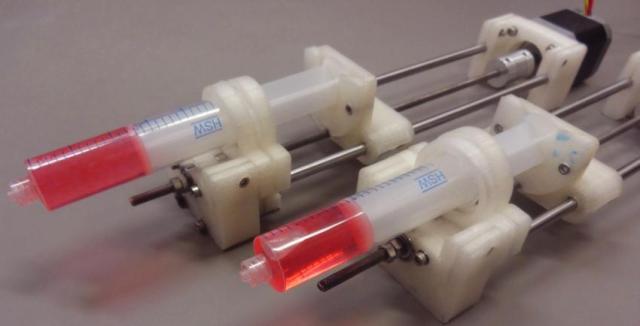
Imagine a lab that could produce equipment when it needs it.It would no longer be necessary to keep something because you might need it someday. Not only would we be reducing costs, but we would also free up limited space. As an example, a project I was involved with used multiple automated syringe pumps to dispense fluid through the internet each pump cost more than$1000.  A paper published in PLOS ONE describes the design and creation of an open-sourceweb controllable syringe pump that costs about $160.

Researchers can now save thousands of dollars and slash the time it takes to complete experiments by printing parts for their own custom-designed syringe pumps. Members of Joshua Pearce's lab made this web-enabled double syringe pump for less than $160. Credit: Emily Hunt
Researchers can now save thousands of dollars and slash the time it takes to complete experiments by printing parts for their own custom-designed syringe pumps. Members of Joshua Pearce’s lab made this web-enabled double syringe pump for less than $160. Credit: Emily Hunt

Let’s take this a step further, why create standard equipment. As a graduate student, I did a lot of standard experiments especially in the areas of gel electrophoresis. However, a lot of the time I had to fit my experiments into the commercially available equipment. If I could’ve customized my equipment to meet my research, I could’ve been more efficient and faster. 

Beyond customization what about rare or unique equipment, the sort of thing that you can’t buy. Instead of trying to find a way to ask a question with equipment that is”financially” viable and therefore available design and builds tools to ask the questions the way you want.

What kind of educational changes would we need to realize this research utopia? Many of the skills are already taught and would only require changes in focus and depth.

In my physical chemistry lab course, we learn Basic programming so that we could model atmospheric chemistry. What if instead of Basic we learned to program C/C++ that Arduino uses. If we design additional labs across multiple courses that use programming to run models, simulations, and control sensors learning to program would be part of the primary curriculum.

In my introductory physics class,I learned basic electronics and circuit design. Introductory physics is a course that most if not all science students need to take.With a little bit of refinement, the electronics and circuit design could take care of the electronics for equipment design. The only real addition would be a computer-aided design (CAD) course so that students/researchers can learn to design parts for 3-D printers and multi-axis CNC’s. Alternatively, all the training to use and run desktop fabrication equipment could be taken care of with a couple of classes.

The design and availability of desktop fabricating equipment can change how we do science by allowing customization and creation of scientific instruments to fit the specific needs of the researcher. What do you think,should we embrace the desktop fabrication (Maker) movement as part of science?Should the creation of equipment stay a specialized field? Is it a good idea but perhaps you think there isn’t space in the curriculum to fit in training?

Thanks for Listening to My Musings

The Teaching Cyborg
We Need a Language to Talk About Ed Tech

“Communication is about what they hear, not what you say.”
Dave Fleet


As our understanding of learning and educational theory has grown how we teach and design educational tools have also developed.  Additionally, changes in society and our daily lives have affected how schools’ function.  We are currently in the middle of vast technological changes in society and our daily lives.  Technology has changed or is poised to change most of the aspects of our lives, communication, travel, entertainment, and shopping to name a few.

It is natural that these technological changes will affect education.  Some of the technologies will affect education because they improve the educational experience, other technologies will change education because they are the way we do things. Guessing how technology will influence education is as Arthur C. Clarke said, “Trying to predict the future is a discouraging, hazardous occupation.”

With my interest in educational technology, I am often involved in educational technology projects, especially concerning the STEM disciplines.  Quite frequently I read an article or hear a talk about a new piece of technology at a school, described many times, as cutting-edge technology.

I often find myself thinking about the term cutting-edge technology, what does it mean?  According to Techopedia cutting-edge technology means:

“Cutting-edge technology refers to technological devices, techniques or achievements that employ the most current and high-level IT developments; in other words, technology at the frontiers of knowledge. Leading and innovative IT industry organizations are often referred to as “cutting edge.””

One of the things I still constantly hear about is cutting-edge mobile phones and apps. I can hear some of you now “Still?” what do you mean by that?  What I mean is that smartphones are not cutting-edge technology. The first smartphone was IBM’s Simon in 1994; the phone came with many features (what we call apps today). Nokia and then Blackberry followed Simon. Finally, we got the iPhone and Android phones. If smartphones and apps have been in existence for about a quarter century are they cutting-edge?

Often, I think what people mean when they say cutting-edge is something new to their school or classroom. I wonder if I’m correct in this thought? If we are going to deal with educational reform and development it deserves clear and critical thinking; for that, we need to be clear in our language.

For a long time, we’ve known that clear communication in education is essential — the publication of a Taxonomy of Educational Objectives, Handbook I: Cognitive Domain in 1956 simplified communication in educational research. In time this book would come to be called Bloom’s Taxonomy. Over the last 62 years, this book has influenced education especially in the area of assessment.  What some people no longer remember was that Bloom’s Taxonomy was developed to help educators communicate with greater precision.

“You are reading about an attempt to build a taxonomy of educational objectives. It is intended to provide for the classification of the goals of our educational system. It is expected to be of general help to all teachers, administrators, professional specialists, and research workers who deal with curricular and evaluation problems. It is especially intended to help them discuss these problems with greater precision.” Bloom, B. H. (1956). Taxonomy of Educational Objectives, Handbook 1: Cognitive Domain. New York: David Mackay Co. pg. 1.

With the creation of a uniform taxonomy educational professionals could communicate clearly and precisely with each other.  Using the taxonomy, everyone knew what the word analysis meant.

Today we need a language to talk about technology in education.  A terminology about educational technology would not only assist in the clarity of communication, but with the types of technology, we use.

As an example, the emerging area of wearable technologies like the new generation of augmented reality (AR) glasses, Microsoft HoloLens, Garmin Varia Vision, or Google Glass Enterprise Edition is on the cutting-edge of technology.  The future of this technology along with Virtual Reality (VR) is so open as to be almost indescribable.  The biggest problem with AR and VR technology as well as most cutting-edge technology is the cost.

Should education invest large amounts of resources into cutting-edge technologies or should we wait until these technologies mature?  To discuss whether we should be working with technologies, we need to be able to agree on the type of technologies we are discussing.

In the case of education, we should not use terms like cutting edge, brand new, or emerging when we mean a technology that is new to teaching or worse new to just my school or program.  A new educational innovation could mean a technology that is in use in business or society but has little or no use in education.  A newly adopted technology could mean something that is used elsewhere in education but is new in a specific school or program.

Even if my suggested terminology is not the best (let’s be honest it’s doubtful it would be), I think we are in desperate need of an agreed upon language for the incorporation of technology in education.  As our world becomes more and more technological, we need to have the ability to discuss not only what technology to integrate into teaching but why we are incorporating it. What do you think, have you gotten confused when talking about technologies in education?  Do we need a language for technology? Would a language for educational technology lead to better and more critical discussion of educational technology?  So, when can we get A Taxonomy of educational terms: Technology.


Thanks for Listing to My Musings

The Teaching Cyborg

We Need CSS for e-books

“The layout of textbooks, I think, has been done with an assumption that students don’t read.”
James W. Loewen


Throughout several decades, I have watched the development of the technology used to build websites. I hand coded my first website using HTML 2 while I was still an undergraduate.

With each additional release of HTML, the addition of features allowed us to add more and more to websites. Additionally, many other technologies have added to websites like JavaScript and cascading style sheets (CSS).

I think CSS was one of the most significant changes to web design. One of the most apparent advantages of CSS is greater control of layout and design. While it would not be the best way to design a website with CSS, you can determine the position of every element on a webpage down to a single pixel.

Modern websites also use CSS to produce different layouts for desktop and mobile viewing. The reason I think CSS was such a significant change is CSS requires a different way of thinking about design and layout.

Proper use of CSS separates the content from the layout. CSS gives us the ability to move, position, and style content any way we want without changing the content. CSS layout is dependent on the use of tags, by giving each element of the website a unique identifier we can use CSS to place that element anywhere we want.

As an example, suppose we wrote three separate paragraphs and gave then CSS tags para1, para2, and para3.

One way to add the tag looks like this:

<p class=”para1”> Lorem ipsum dolor sit amet, consectetur adipiscing elit, sed do eiusmod tempor incididunt ut labore et dolore magna aliqua.</p>

Without the unique tag it would look like this:

<p> Lorem ipsum dolor sit amet, consectetur adipiscing elit, sed do eiusmod tempor incididunt ut labore et dolore magna aliqua.</p>

In and of itself that is not a big deal. However, since the paragraphs are now named elements, I can use CSS to style them independently of each other on the page.

If I do nothing, the three paragraphs will come one after the other. With just a little bit of CSS, I can make paragraph 2 right justified while the other two paragraphs stay left justified.

The code is:

.para2 {  text-align: right;  !important; }

The other paragraphs will stay left aligned because that is the default.

With some other code, I can make one of the paragraphs disappeared.

.para1 { display: none; }

This code would hide the first paragraph.

As the last example, I can change the order of the paragraphs.

p { display: flex; flex-direction: column;}

.para1 {order: 2 }

.para2 {order: 1 }

.para3 {order: 3}

This code would flip the order of the first and second paragraph while leaving the third where it is. These examples show that the code needed to make changes is rather small.

Now, why am I talking about CSS? Not long ago I wrote a blog discussing the problems I had with glossaries in several textbooks (read that blog here). In short, the traditional glossary at the end of a book was broken up and placed at the end of each chapter. For many reasons, I think this makes glossaries harder to use.

The reason for the glossary at the end of chapters is the fact that textbooks, especially open-source ones, are not meant to be used in their entirety but only the parts that fit your course. Since the book designers do not want extra words in the glossary, they split the glossary up.

Now imagine if we took the readability and accessibility of the electronic publication (EPUB) format and coupled that with the layout advantages of CSS. Now instead of copying, pasting, and editing the text of an open-source textbook with a few lines of code you can make a book for your course. Additionally, if something changes in your class, you can easily edit the book by making changes to the CSS. As an example, suppose we tagged all the text in a chapter with a unique name like chp#. If we added the same tag to the words in the glossary the words would behave the same as the chapter when formatted with CSS.

Now if we hide chp# not only will the chapter text disappear but so will the glossary words. However, you might ask “What if we wanted to move chp#? That will also move the glossary entries.” If the glossary entries moved, we would have the same problem with a glossary that I talked about before.

However, CSS has another little trick I skipped over; you can add tags together. As an example, your chapter text is a paragraph which has the default tag p. The glossary is a list, so each word is a list item which has the default tag li.

If I only wanted to move the chapter text, I would use the tag chp#.p this tag will leave the glossary words alone. To make a change to just the glossary words, I would use the tag chp#.li.

The makers of modern electronic books have done their best to re-create books just like their paper versions. While that is fine even desirable in some cases, we should not limit ourselves to it. After all, it should be comparatively easy to add functionality to electronic books.

We already have the code to make use of CSS it is in every web browser currently in use. This code can be added to e-reader software to give e-readers the ability to handle CSS. As for the creation of the books, we could start with any of the website creation tools and add the ability to export and save the documents (sites) as an EPUB document with CSS.

Having electronic books with expanded capabilities would give us tremendous advantages in addition to just CSS we can imagine being able to embed all kinds of additional content; media, live video, tests, and chat/discussions now books aren’t merely repositories for knowledge but a tool for learning.

We currently have all the tools we need to expand the functionality of the EPUBs format all we need to do is bring them together. Having this new EPUB format as a new tool would give us tremendous abilities as we design new and improved books for the use in the classroom.


Thanks for Listening to My Musings

The Teaching Cyborg