The Use of Technology Requires Flexibility

“Any sufficiently advanced technology is equivalent to magic.”
Arthur C. Clarke


At one time Best Buy was the largest reseller of CDs, this year Best Buy announced it was going to stop selling CDs.  I’m a little sad about that, I rather like CDs I own hundreds of them.  Don’t get me wrong I like the convenience of MP3’s, I still own an iPod and have a flash drive with over 3000 songs plugged into my car radio.  However, I still buy CD’s it looks like I am going to have given that up.

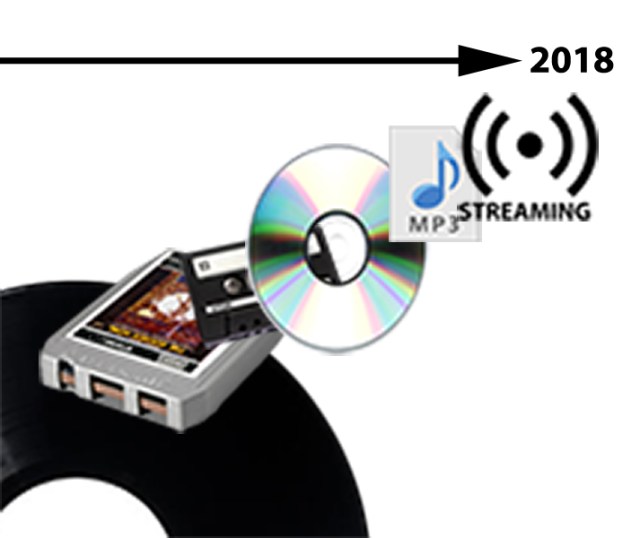
This decision from Best Buy got me thinking about audio technology in general.  Have you ever thought about how audio technology has changed in the last half-century?  Imagine telling someone they could have a device that let them listen to thousands of songs that was smaller than a deck of cards in 1968.  Think about all the different types of audio technology that was available over the last 50 or so years

  • Vinyl Albums – early 1900’s to the 1980s (peak usage)
  • 8 Track Tapes – 1964 to 1988
  • Cassette Tapes – 1962 to early 2000s (Still made on a minimal amount)
  • Compact Disks – 1982 to Present (phasing out)
  • MP3s – 1993 to Present
  • Streaming Services – 2005 to Present
Image showing vinyl records, 8-track Taps, cassette tapes, CDs, MP3s, and Streaming musics technologies. Image from PJ Bennett
Types of Audio Technologies

Over the last 50 years, several different types of audio technology have been developed and mostly discarded. Additionally, audio technology covers the development of technology in just one area. Add to that phones, movies, computers, cameras, and on and on and the development of technology has been astounding.

Something else I find interesting is the tendency to forget about technology as it develops.  I have had an interest in photography for most of my life. In that time, I have seen a lot of changes.  The most prominent being the conversion to digital over film.  Somewhere between 3 to 5 years after digital pictures became the predominant form of photography I started noticing ads for new photo editing tools.  When I first saw these tools my thought was “why would you want that?”  The purpose of these tools was to add grain to give your photos the traditional film look.

You might ask why does this surprise you? Well for many years (maybe even decades) each month I would receive photography magazines in the mail.  In each of these magazines, there was always a review of the newest film, one of the questions asked about each type of film was “how big you could enlarge a picture before the grain became evident?”  That is right for decades the goal of film development was to reduce and eliminate visible grain.  Now that digital cameras have finally given us that dream people want to put the grain back.  People have forgotten that in the days of film grain was the enemy.

In addition to all the new technologies, we live with the rate at which devices and technology get replaced by new ones has increased.  There is even a term for the rate of change Velocity of Obsolescence, the speed at which a newer/different technology replaces an older technology.  In a Forbs article from several years ago, one of the things they talked about was the time to obsolesce of web-enabled services, in 1998 the lifetime was 3-5 years while in 2013 the lifetime was 14-18 months.  New smartphones come out every 12 months.  With the subscriptions plans the update cycle on software has drastically changed.  As an example, Adobe software used to update every 18 months with a new version every three years.  Now they seem to add new features every couple of months. With this rate of change, there is no way to say what technology, our daily lives, and by extant society will look like in 20 or 30 years.

What does this increasing speed of technological development mean for schools? The most important thing is flexibility, schools need to develop a mindset that does not focus on specific technologies but the teaching and operational needs of the school.  Schools also need to realize we are entering a time where they can’t take years examining, testing, and adopting new technology and expect it to stay current.  While it is essential to think critically about educational technology we need to shorten the selection and implementation process so that we can get the most out of the life expectancy of the technology.

With the increasing impact of Bring Your Own Device (BYOD) schools are also going to need to develop technologies that are device agnostic.  As an example, many schools have adopted the use of clickers (student response systems). While the stand-alone devices work just fine to reduce the number of things students need to purchase schools have started using smartphone apps.  The cost savings side is always a good idea, the problem with apps is the upkeep.  As I said earlier new phones, come out every year, and operating systems upgrade multiple times a year, the maintenance could amount to 2 or more version of each app a year.

Why 2 or more versions a year? The mobile release cycle means you or the company you purchase your app from will need to have at least two apps one for iOS and one for Android.  In case you are one of the people that think you only need iOS the current US market share is 53.7% iOS and 45.96% Android (there are a few smaller ones).  With updates and end of support cycles on operating systems, you will need a new version of the app for each operating system at least once a year.

However, even if you go with mobile apps, this is still limiting.  All the apps give you is access to smartphones, you can probably get tablets out of the same app, but laptops and netbooks/Chromebooks are perhaps out of the question.

There is another option that schools could be using.  That option is web apps, which is an app that lives and runs on a web page.  The app is accessible through a web browser which means it is available through any web-enabled device.  The web app gives you access to phones, tablets, laptops, desktops (labs, distance education), netbooks/Chromebooks, and many emerging smart devices.  Also, since the app is a web page, you only need to maintain a single app, and operating system updates have little effect on the app.

Additionally, schools have turned to apps so that they could add functionality to the clickers.  Schools now want to add the ability to have students type out long answers, do complicated math, and so on.  The schools have forgotten that the use and reason for clickers were to collect quick short feedback. That feedback was then used to motivate peer to peer discussions or the direction of lectures.

With the current rapid speed of technological development, schools need to develop a streamlined method of assessing and choosing technology.  Schools also need to think about multiple platforms, so they don’t exclude students.  Because of the rate of development and the diversity of devices, it is entirely possible that schools will need to do more and more of their maintenance and development.  After all the rules and design considerations that were used to make that new killer app might not be usable in an app developed for education.


Thanks for Listening to My Musings

The Teaching Cyborg

Shh I’m hunting (for) Digital Natives

“Technology has become as ubiquitous as the air we breathe, so we are no longer conscious of its presence.”
Godfrey Reggio

Elmer Fudd holding finger to lips while hunting

Anyone that has worked in educational technology knows that there is often a lot of pushback when you try and introduce new technology to the classroom.  In some cases, pushback and questioning are good. It is always beneficial to think critically about all aspects of education after all the goal is to provide the best educational experience we can.

However, I have repeatedly encountered pushback from faculty that is not about whether a piece of technology is beneficial to teaching.  In these cases, the faculty says things like “I don’t want to use this (technology) because my students understand it better than I do.” This attitude comes directly out of the idea of the Digital Native.

Marc Prensky coined the term Digital Natives in Digital Natives, Digital Immigrants in 2001. Since then the idea of the Digital Native has been an almost a central theme in education spawning terms like Homo zappiëns and iGeneration and the notion that we need to redesign education because of the new abilities and skills these “new” humans have.

This belief in “new” humans has directly led to the fear that students know more about technology than their teachers.  I’m a biologist, and I have some questions about Digital Natives and their new skills and abilities.  Where did these new abilities come from are they magical?  I’ve even had people tell me it is the processes of evolution.

The idea of evolution and Digital Natives generates a teachable moment.  First, evolution is a slow process substantial changes are the result of many small changes over lots of generations.  Two, evolution is selective it is a process that plays on the parents.  For the appearance of Digital Natives to have been evolution, the parents would have to be Digital Natives, and being a Digital Natives would have had to confer an advantage in reproduction. There are several other points I can make, but I think it is safe to say that these new skills are not the product of evolution.

There is another possibility for the creation of Digital Natives the development of the brain.  A lot of neural development occurs in young children and according to some physiological studies continues at a high degree until around 25.  So maybe exposure to lots of technology from a young age leads to a difference in how the brain learns to work.  Fortunately for us, researchers have started looking at Digital Natives and their skills.

The research into Digital Natives is uncovering the same thing that I have experienced in my work.  The research results and my experience show that as far as having lots of computer/technologies skills and the ability to multi-task Digital Natives don’t exist.  One of my favorite comments about digital natives comes from a review paper The myths of the digital natives and the multitasker by Paul Kirschner and Pedro De Bruyckere “Many teachers, educational administrators, and politicians/policymakers believe in the existence of yeti-like creatures populating present-day schools namely digital natives and human multitaskers.”

A yeti holding a smartphone

In addition to a catchy phrase, the editorials section of Nature references it as “The digital native is a myth, it claims: a yeti with a smartphone,” Kirschner and Bruyckere make some crucial points.  First, when Prensky first coined the term Digital Natives, this was not based on any controlled research merely an observation about children born after the widespread adoption of mobile devices and how they interacted with them.  Because of these observations, he proposed several skills and abilities that these individuals would have as they grew up.

We are now collecting information about the Digital Natives, and the research is showing that while these students use a lot of mobile technology for communication and socializing, they don’t have a deep understanding of the technology.  I have often served as escalated tech support (especially for things I have built or helped to develop), many of the students I have worked with are from the generation of Digital Natives. Since so many people talked about the Digital Natives I think to some degree I even believed in the Digital Native.

When helping students, I quickly discovered that many of these students could not do any form of troubleshooting on their own.  If the button didn’t seem to do what they wanted, the students didn’t know what to do next. In one of the programs which involved fully online students, I would always start my troubleshooting with the question “What operating system are you using?”  Some of the answers I got were “I don’t know the computer says Toshiba.”, “I think I’m using Firefox.”, “how would I tell?” and these were not one-offs I got these answers a lot.

Beyond in-depth technical knowledge, Kirschner and Bruyckere also discuss the student’s ability to utilize the internet.  Looking at the papers Information behavior of the researcher of the future: Work Package II and The Google generation: The information behavior of the researcher of the future the researchers conclude that students of the Digital Native generation have pore information retrieval skills.  Specifically, the students have limited ability to deeply dive into information and often fail in critical thinking and evaluation of the information they do retrieve.

One of the most significant points of the internet and Web 2.0 and beyond was that we had reached a point where we were not just consumers of information but creators as well.  While there still needs to be more research, it also appears that Digital Natives are mostly passive consumers of information and not the general creators we assumed they would be.

All this information suggests that the idea that we should be scared to incorporate technology into our classrooms because the students know tech better than we do is a fallacy.  Closely related to this, the idea that we need to redefine and redesign the classroom because it is no longer suited to the skills and abilities of our students is also a fallacy.

As I have said, technology can be a huge benefit to the classroom.  Technology can be a massive equalizer in education.  However, we need to incorporate technology into the classroom based on educational pedagogy and as the solution to actual, not yeti-like, problems.  I do think we need to make some changes to education based on our modern technological world.  We should be teaching our students how to determine the value and validity of information sources on the internet.  If they are going to live in a technological world, we should teach them problem-solving skills, so they know what to do when the button does not do what they want.  We should be teaching communication skills, so they can make sure their thoughts and ideas get communicated.  Specifically, we should use good educational practices when we design our courses and programs, not yeti footprints.


Thanks for Listing to my Musings

The teaching Cyborg

My Silver Bullet Failed Me!

“There is no silver bullet. There is always options, and the options have consequences.”
Ben Horowitz

I can’t count the number of times I’ve read an article or heard from a colleague about some new piece of technology that is going to change everything. This new technology was the “The silver bullet!” that was going to solve all our problems. Then I either never hear about it again or get told how it didn’t work. I’ve even had some people wonder why their silver bullet didn’t work while looking for something to blame.

To start with your silver bullet didn’t work because you are not Bass Reeves.

Bass Reeves first African-American Deputy US Marshal west of the Mississippi.

If you’ve never heard of him, Bass Reeves was born a slave and after the civil war became the first African-American Deputy US Marshal west of the Mississippi. He worked extensively in what was then called the Indian territories in Arkansas and the Oklahoma territories; he arrested more than 3000 felons. Lastly, he gave out silver dollars as his calling card; many people believe he is the real-life inspiration for the Lone Ranger. Look him up his life is a fascinating story.

Okay enough Lone Ranger references, why did so many technologies fail to fundamentally change education when so many, often talented and intelligent individuals thought they would. In 1922 Thomas Edison said, “The motion picture is destined to revolutionize our educational system, and in a few years, it will supplant largely, if not entirely, the use of textbooks.” Perhaps, we should start by looking at some of these technologies that were supposed to change education but didn’t.

  • The motion picture
    • How many of you fill every class period with movies and assign movies instead of textbooks?
  • Radio
    • I usually find myself asking students to take out their earphones and turn off the music.
  • Videodisc
    • Do any of you even remember this one?
  • MOOCs
    • When I first heard of MOOCs, they were going to replace everything and put schools out of business.
  • Pokémon Go
    • This bandwagon started even before the app came out. I read multiple articles about how Pokémon Go was the future of apps and technology in the classroom. Perhaps we’re still too early, and we should wait and see, but I’m thinking not.

As a comparison let’s look at some technologies that have worked and changed learning.

  • Textbooks
    • Before the internet, the book was the greatest democratization of knowledge the world had ever seen.
  • The Magic Lantern
    • The Magic Lantern and its descendants all the way to the modern Digital projector gave teachers the ability to show complex materials, notes, and images to whole classes. The information limit wasn’t the instructor’s ability to draw with chalk.
  • Student Response systems
    • Have allowed real-time feedback during lessons between instructors and their class. Giving the teacher the ability to adjust their teaching on the fly.
  • Learning Management Systems
    • Has created a simple single point of interaction for students and teachers to share information about all their classes.

There must be a difference between the technologies on these two lists.  What is that difference? The difference is the purpose, what purpose do these technologies serve. Look at laser disks finding individuals that have used these is a very difficult even in their prime they were costly. Yes, the image quality was superb especially in the days before HD, but that was all there was to them. If movies didn’t take over education why would movies with a better-quality image change everything? The real question to ask is, what was the problem laser disks solved or created? The answer, there wasn’t one they were just cool if you liked movies.

Now let’s look at one from the second list, the student response system (SRS). When you’re teaching a class one of the hardest things to do is figure out if your students are “getting it.” Asking the class “Was that clear?”, Or “Do you understand?” usually leads to a lot of head shaking when it’s time to grade the exams. Several faculty started adopting a practice where they would post multiple-choice questions during these lessons and have students raise their hands or colored cards to indicate their answer. However, since the students could see what response their fellows were giving the answers were often biased. The SRS gave the faculty the ability to ask these questions privately and then adjust their lectures based on what the student needs were.

We can tell similar stories about other items on the list. These items were adopted not because they were cool technologies but because they solved an educational problem. The technologies in the first list were technologies looking for a problem. That is why your silver bullet failed.

Don’t get me wrong I’m a tech geek I built my desktop computer, I travel with top-end phones, tablets, readers, and laptops. I have a smart house with phone controllable lights the whole 9 yards. While I deeply believe in the ability of technology to improve education, when dealing with the education I always start with the pedagogy. What are your educational goals? What are your learning outcomes? What are you trying to achieve? What problems are you having reaching your learning goals? Once the issues are known, do a little research and see if someone has already come up with an intervention for it. Is there a solution that already exists? Don’t reinvent the wheel; there’s plenty of other problems. Once you have finished all these steps, now it is time to consider what technology might do for you.

Think about some of the technologies that you know that have been successes and failures do they follow the pattern I listed above? What are the best Ed tech successes you know? Can these successes help you solve other problems?


Thanks for listening to my musings

The Teaching Cyborg