It’s All in the Primes

“The greatest single achievement of nature to date was surely the invention of the molecule DNA.”
Lewis Thomas


When you’re an undergraduate student, two words mean a lot to you prerequisite and corequisite.  These two words let you know whether you must take courses one after the other or at the same time.  Ever since my undergraduate days, I have found these terms to be fascinating.  As a student, I often thought of the words differently.  Prerequisite meant we believe you need this information to understand our class, while corequisite indicated this information might be useful, but we don’t care.

That may seem a bit harsh, but that is the way it seemed to me when I was an undergraduate, and to be honest, it still seems that way to me. My experience for the first couple of years as a biology major was a little different than several of my classmates.  As a high school student, I had been fortunate enough to attend a school with a robust Advanced Placement (AP) and International Baccalaureate (IB) program, because of this I tested out of first-year biology and chemistry.  Then in a fit of madness, I took a full years’ worth of organic chemistry with labs over the summer.

Biology students would take organic chemistry the same time the would take the second year introductory biology courses, i.e., corequisite.  The first biology class I took was Molecular Biology, one day we were sitting in class, and the professor was talking about DNA replication.  If you know anything about DNA you know, the terms 5’ and 3’ (also written 5 prime and 3 prime) get used a lot.  DNA is composed of two directional strands if one strand is 5’ to 3’ left to right the other strand will be 3’ to 5’ left to right.  DNA replication is carried out by DNA Polymerase III which synthesizes new DNA from 5’ to 3’.  I could go on, but that should make the idea clear enough.
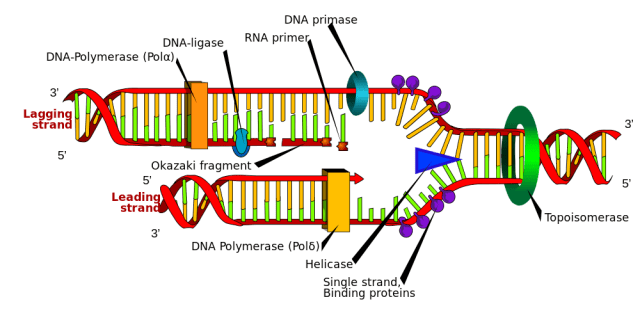
DNA replication or DNA synthesis is the process of copying a double-stranded DNA molecule. This process is paramount to all life as we know it.
DNA Replication Image by Mariana Ruiz

One day my classmate turned to me and said, “I don’t understand anything he’s talking about what the hell does all this 5’ and 3’ stuff mean.” It took me a second to figure out what my classmate was saying the terms had been obvious to me.  I told him the names came from organic chemistry; they are referencing the 3rd and 5th carbon on the deoxyribose ring. Specifically, the 5’ carbon on one nucleic acid binds to the 3’ carbon on another forming the DNA backbone. Didn’t they cover numbering carbons in your organic chemistry course I asked, it turns out they had not gotten to that yet?

Many times during my undergraduate education corequisite courses did not cover material before it was needed.  It was this tendency of separate classes not to line up that lead me to start thinking of corequisite courses as “we really don’t care.”  As a student, I usually assumed corequisite courses would be no help in a class I was taking.

As a professional, I understand the constraints that impact educational choices.  Ideally, we are trying to fit all the courses needed for a degree in four years, that is four years minus summers.  I suspect if we made every corequisite a prerequisite we would not fit all the courses into a four-year program.  Interestingly according to the Marian Webster’s dictionary, the first known use of corequisite as we use it in education was circa 1948.  The fact that corequisite didn’t exist until 1948 suggests to me that we used to fit all the courses into a four-year degree without corequisites, I wonder what changed? I would assume this has to do with the growth in the amount of material covered in a Bachler’s program while maintaining the time to degree.

The other impact on the usability of corequisite courses is that they are taught by different faculty sometimes in other departments.  We hire faculty because of their experts in a field, to take full advantage of this expertise faculty are given the freedom to design and teach subject matter in the method they determine is best.  I wonder if schools are doing enough to promote communication between faculty members that teach courses related by corequisites.

Then again is a corequisite essential enough for a faculty member to change how they teach their course?  When thinking about curriculum design and degrees, I often think where is the line between the needs of the degree and the design freedom of a faculty member, is there a line? With the constant changes in many if not most fields and the growing amount of knowledge we must teach, we must rely on the experts in the field to keep the content of individual courses relevant.  With the continual work to keep course content relevant is it even possible to create a completely unified curriculum?

It may be that corequisite is the best we can do with respects to a degree’s curriculum.  However, I do know that anytime I deal with the curriculum of either a single course or a whole degree, I always remember “about what the hell does all this 5’ and 3’ stuff mean.”


Thanks for Listing To my Musings

The Teaching Cyborg

The Language of the Field

“All I know is what I have words for.”
Ludwig Wittgenstein

There are many components to a bachelor’s degree, part of the goal of the degree is to give students a wide range of skills and knowledge.  The single largest component of the degree is the disciplinary component.  While there is often overlap in basic skills in addition to the content knowledge of the field students learn how to think, analyze information, and communicate in and outside their field.

Throughout four (sometimes more) years that a bachelor’s degree takes students to build their skills.  Over the last decade or two, there has been a significant focus on the teaching of higher order thinking skills. Whether or not this focus on higher order thinking skills has been successful, I think, like many things we have embraced higher order thinking skills without a lot of thought, this focus on higher order thinking skills above everything is causing damage to our educational process.

While I agree that the introduction of higher order thinking skills can and should as early as possible, it is critical to realize that higher order skills don’t work independently of the so-called lower order thinking skills.  I remember consulting with an instructor that was having trouble with his student’s test performance; his students were performing significantly lower than students in other classes.  He brought in a couple of tests for me to look at, one of my first questions was what are your goals.  He said he was focusing on higher order thinking skills.

His tests had some of the most thoughtfully written questions I had seen.  It was composed almost exclusively of open-ended and long answer word problems.  Even though the questions were excellent, I immediately had an idea of what the problem was.  Most of the questions relied heavily on discipline-specific language.  Since he was teaching a lower division course, I asked if he is sure that his students understood the meaning of the words he was using, after a little discussion he realized he was assuming information about his students that he didn’t know.

After making some changes and including some content about language his student’s scores improved, which shows its essential to keep all skills in mind.  I have never liked the idea of defining skills as lower level and higher level. I think these skills are more of a gradient than levels.  Additionally, characterizing them as lower level and higher level suggests a hierarchy of importance that is not true. The skills we are teaching in a course should be dependent on the goals of that course not some external evaluation about the “best” skills.  However, that is probably a discussion for another day.

Continuing with the devaluation of “lower order thinking skills” I have been thinking about how this might be affecting textbooks.  In many fields, textbooks are used extensively in the introductory courses.  One of the most important things that take place in these introductory courses is teaching the students the language of their field. Since learning the language of a field is the main component of introductory classes textbooks should support learning the discipline language.

I have been looking at several textbooks lately especially open source textbooks, and I think I have started to see a problem.  Imagine you are a student working on a homework assignment, and you come across a word you don’t know or remember.  Yes, today I know it is likely that a student will Google it.  Let’s suppose instead they go to their textbook; how do they look up the word.  The student could look it up in the glossary.

Surprisingly this could be a problem; if you go to the back of many textbooks, you will find there isn’t a glossary in the back.  It turns out that many of the new books both open source and some commercial are designed to be customized.  You only choose the parts of the book that fit your course if, and I do mean if, the textbook has a glossary it has probably been divided into small sections and placed at the end of every chapter.

So how are you our student supposed to find the word you are trying to look up.  Since you can’t remember what the word means, in which section do you look?  You probably start with the most recent section you read if it’s not there well then, I guess you look through the entire book till you find the definition.

While we are currently trying to solve many problems with textbooks, cost, compatibility with curriculum, and accessibility we need to be sure we don’t introduce new problems by not paying attention to what we are doing. Students are not going to want to use textbooks that are difficult to use.  While many of the problems go away with the use of digital textbooks, isn’t the search function simply fantastic, we need to design textbooks for both digital and print.

While I understand the idea of designing textbooks so that you can pick and choose which parts you want to use splitting up the glossary confuses me.  It should be relatively apparent that separating the glossary into a lot of separate section through the whole book makes the glossary harder to use.  I wonder if this glossary design is because book designers think lower order thinking skills like memorizing definitions is unimportant.

Independent of the reason for this separate glossary model what is wrong with having a single glossary in the back of the book?  Why does it matter if the glossary has words in it that don’t appear in the text?  A single glossary in one place (I don’t care if it’s in the back) is much more usable than a scattered one.

I suppose if you think have extra words in a glossary is a problem the glossary could be laid out in a separate section like in an appendix.  We could label glossary sections by chapter and page, and each would be a separate section.  For example, G.12.2 would be the glossary for the 12th chapter second page.  Then you could leave out the unused parts of the glossary.

While a glossary organized by chapters might still require some searching by a student (if they don’t know what chapter a word they are looking for comes from), they would at least know where in the book to look.  Of course, I suppose if we are talking about Open Source textbooks we could edit the glossary and remove the extra words.

Lastly, if you think that a divided glossary is the best thing to do there is one other potential solution.  That solution would be to include all the words in the glossaries in the index.  Listing the glossary words in the index would give the students a single place they could look to find the definitions.

As we design the next generation of textbooks and learning materials we always need to remember that the most critical design consideration needs to be usability.


Thanks for Listening to My Musings

The Teaching Cyborg

Shh I’m hunting (for) Digital Natives

“Technology has become as ubiquitous as the air we breathe, so we are no longer conscious of its presence.”
Godfrey Reggio

Elmer Fudd holding finger to lips while hunting

Anyone that has worked in educational technology knows that there is often a lot of pushback when you try and introduce new technology to the classroom.  In some cases, pushback and questioning are good. It is always beneficial to think critically about all aspects of education after all the goal is to provide the best educational experience we can.

However, I have repeatedly encountered pushback from faculty that is not about whether a piece of technology is beneficial to teaching.  In these cases, the faculty says things like “I don’t want to use this (technology) because my students understand it better than I do.” This attitude comes directly out of the idea of the Digital Native.

Marc Prensky coined the term Digital Natives in Digital Natives, Digital Immigrants in 2001. Since then the idea of the Digital Native has been an almost a central theme in education spawning terms like Homo zappiëns and iGeneration and the notion that we need to redesign education because of the new abilities and skills these “new” humans have.

This belief in “new” humans has directly led to the fear that students know more about technology than their teachers.  I’m a biologist, and I have some questions about Digital Natives and their new skills and abilities.  Where did these new abilities come from are they magical?  I’ve even had people tell me it is the processes of evolution.

The idea of evolution and Digital Natives generates a teachable moment.  First, evolution is a slow process substantial changes are the result of many small changes over lots of generations.  Two, evolution is selective it is a process that plays on the parents.  For the appearance of Digital Natives to have been evolution, the parents would have to be Digital Natives, and being a Digital Natives would have had to confer an advantage in reproduction. There are several other points I can make, but I think it is safe to say that these new skills are not the product of evolution.

There is another possibility for the creation of Digital Natives the development of the brain.  A lot of neural development occurs in young children and according to some physiological studies continues at a high degree until around 25.  So maybe exposure to lots of technology from a young age leads to a difference in how the brain learns to work.  Fortunately for us, researchers have started looking at Digital Natives and their skills.

The research into Digital Natives is uncovering the same thing that I have experienced in my work.  The research results and my experience show that as far as having lots of computer/technologies skills and the ability to multi-task Digital Natives don’t exist.  One of my favorite comments about digital natives comes from a review paper The myths of the digital natives and the multitasker by Paul Kirschner and Pedro De Bruyckere “Many teachers, educational administrators, and politicians/policymakers believe in the existence of yeti-like creatures populating present-day schools namely digital natives and human multitaskers.”

A yeti holding a smartphone

In addition to a catchy phrase, the editorials section of Nature references it as “The digital native is a myth, it claims: a yeti with a smartphone,” Kirschner and Bruyckere make some crucial points.  First, when Prensky first coined the term Digital Natives, this was not based on any controlled research merely an observation about children born after the widespread adoption of mobile devices and how they interacted with them.  Because of these observations, he proposed several skills and abilities that these individuals would have as they grew up.

We are now collecting information about the Digital Natives, and the research is showing that while these students use a lot of mobile technology for communication and socializing, they don’t have a deep understanding of the technology.  I have often served as escalated tech support (especially for things I have built or helped to develop), many of the students I have worked with are from the generation of Digital Natives. Since so many people talked about the Digital Natives I think to some degree I even believed in the Digital Native.

When helping students, I quickly discovered that many of these students could not do any form of troubleshooting on their own.  If the button didn’t seem to do what they wanted, the students didn’t know what to do next. In one of the programs which involved fully online students, I would always start my troubleshooting with the question “What operating system are you using?”  Some of the answers I got were “I don’t know the computer says Toshiba.”, “I think I’m using Firefox.”, “how would I tell?” and these were not one-offs I got these answers a lot.

Beyond in-depth technical knowledge, Kirschner and Bruyckere also discuss the student’s ability to utilize the internet.  Looking at the papers Information behavior of the researcher of the future: Work Package II and The Google generation: The information behavior of the researcher of the future the researchers conclude that students of the Digital Native generation have pore information retrieval skills.  Specifically, the students have limited ability to deeply dive into information and often fail in critical thinking and evaluation of the information they do retrieve.

One of the most significant points of the internet and Web 2.0 and beyond was that we had reached a point where we were not just consumers of information but creators as well.  While there still needs to be more research, it also appears that Digital Natives are mostly passive consumers of information and not the general creators we assumed they would be.

All this information suggests that the idea that we should be scared to incorporate technology into our classrooms because the students know tech better than we do is a fallacy.  Closely related to this, the idea that we need to redefine and redesign the classroom because it is no longer suited to the skills and abilities of our students is also a fallacy.

As I have said, technology can be a huge benefit to the classroom.  Technology can be a massive equalizer in education.  However, we need to incorporate technology into the classroom based on educational pedagogy and as the solution to actual, not yeti-like, problems.  I do think we need to make some changes to education based on our modern technological world.  We should be teaching our students how to determine the value and validity of information sources on the internet.  If they are going to live in a technological world, we should teach them problem-solving skills, so they know what to do when the button does not do what they want.  We should be teaching communication skills, so they can make sure their thoughts and ideas get communicated.  Specifically, we should use good educational practices when we design our courses and programs, not yeti footprints.


Thanks for Listing to my Musings

The teaching Cyborg

The Gardeners Keep Changing My Tree of Life

“You’ll be tempted to grouse about the instability of taxonomy: but stability occurs only where people stop thinking and stop working.”

Donald P. Abbott


My Ph.D. is in biology regardless of everything else I’ve learned or what my current job is I generally think of myself as a biologist. A lot of what biologists do involve using model systems or organisms. A model organism is an organism that has some trait or benefit that makes it particularly useful to answer certain types of scientific questions. For instance, the fruit fly Drosophila melanogaster produces large numbers of offspring and can easily be stored in small spaces making it an excellent system for genetics.  The Zebrafish Danio rerio is a vertebrate that develops from eggs and has transparent embryos making it an excellent model system for vertebrate organ development.  The information learned from model systems improves understanding of other organisms and biology in general.

The application of knowledge from one organism to another works because of the relatedness of all living things. Taxonomies are used to understand the relatedness of organisms. Taxonomies name “scientific name,” organize, and define an organism’s relationship to everything else. The full scientific name of an organism contains 8 or 9 names depending on whether you are using a Domain (Bactria, Archaea, and Eukaryotic) hierarchy. When using taxonomies to determine relatedness the more names, two organisms share, the closer they are on the tree.

I must admit as a student I found taxonomies rather dull. I’ve never really enjoyed topics that seem to be taught exclusively by memorization and regurgitation. One of the most exciting experiences I’ve ever had with taxonomies occurred in the research lab, not in the classroom.

As an undergraduate, I researched the zebrafish, a small freshwater fish that is used extensively in developmental and toxicology research.

Zebrafish Image source Wikimedia Commons Author Azul

When I first started to start working on zebrafish their scientific name was Brachydanio rerio.  Shortly after I started working with them, it was proposed and approved that the name change from Brachydanio rerio to Danio rerio, or to list their full name

  • Kingdom: Animalia
    • Phylum: Chordata
      • Class: Actinopterygii
        • Order: Cypriniformes
          • Family: Cyprinidae
            • Subfamily: Danioninae
              • Genus: Danio
                • Species: rerio

Changing things like scientific names can confuse people, how can scientific information change? There are lots of different types of scientific knowledge, and generally, only scientific facts and laws are immune to change.

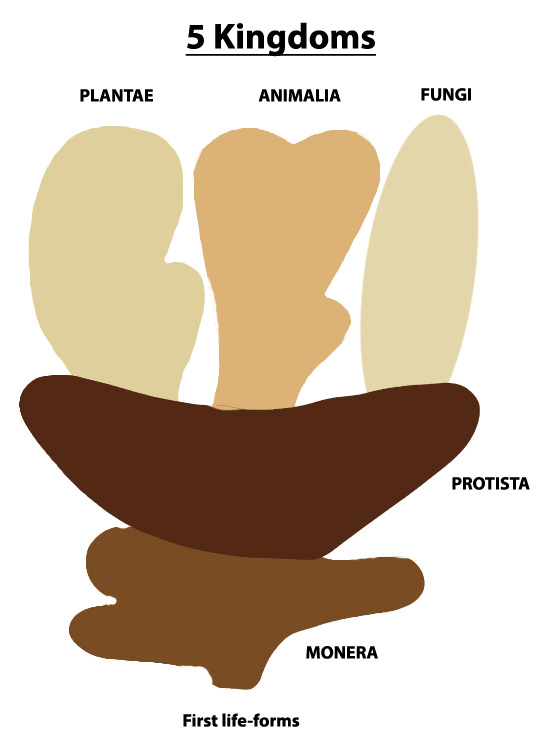
In science, as we learn new information, we change our interpretations to account for that new information, just ask Pluto. One of the things that have changed a lot in Biology is the tree of life (taxonomies) or how we understand the relatedness of life. When I was in high school, we learned that all life fit into five kingdoms; monera, protista, fungi, plantae, and animalia. Then the tree of life looked like this.

Tree of life showing the 5 Kingdoms Model. Image is based on Biology The science of life volume 3.

At this time almost all the classifications were based on physical traits. By the time I was in my undergraduate education, this began to change thanks to the work done by Carl Woese, who used DNA sequences to organize life, his tree looks like this.

Tree of life based on Carl Woese's genetic Analysis. Image source Wikimedia commons By Eric Gaba
Tree of life based on Carl Woese’s genetic Analysis. Image source Wikimedia commons By Eric Gaba

This process continues to change with additional trees and models put forth regularly.

The problem I currently have is on the educational side. I was reading a current intro biology textbook, the tree used in the book looks a lot like Carl Woese’s tree.  However, in the layout of their book they use a word, it’s all over the textbook. The word is prokaryote it is used to classify all single-cell organisms that don’t have membrane-bound nucleus Pro = “before” Kary = “nucleus.”

I hate the word prokaryote as a means of classification from my point of view it is less than useless. I think it can be damaging. In the current textbook, bacteria and archaea are grouped as prokaryotes, because they are both single-cell organisms that lack membrane-bound nuclei. However, that is about where the similarities end. Bacteria and archaea use different chemistries for their cell walls and plasma membranes. They package their DNA differently some archaea even having histones like eukaryotes. Currently, we believe archaea are more closely related to eukaryotes than bacteria. Categorizing bacteria and archaea together under a single term suggests an evolutionary closeness that is not there.

After all, if we look at the full names of several single-celled organisms

Table show the full scientific name of three single celled organisms.

the word prokaryote does not appear anywhere in the scientific names.

When we are teaching students, it is essential that we don’t unintentionally introduce miss-conceptions.  We should be teaching bacteria and archaea as the distinct groups they are. They should have independent sections in textbooks.  The terms we use in education must have real meaning, and it turns out for a process of taxonomic relatedness lacking a membrane-bound nucleus should not mean things are classified together. When we teach science, when we write about science (textbooks), we need to make sure our language has meaning. We need to stop using groupings and classifications because they are convenient, it gives false impressions about relatedness.  Let’s all get together and kill the term prokaryote and make it easier for students to understand how organisms are related.


Thanks for Listening to My Musings

The Teaching Cyborg


What Is A Textbook?

“Science is cool! But it’s easy for that to get lost in textbooks sometimes.”
Philippe Cousteau, Jr.

In many ways, the history of education is the history of books. Currently, people frequently quote “I have more computer power in my pocket (smartphone) then all of NASA during the Apollo moon missions.” Today when we talk about technology in the classroom we tend to think about computers, phones, tablets, apps, and the internet. However, a book is also technology we tend to take books for granted nowadays. Before Johaness Gutenberg invented his printing press around 1440, books were produced by hand.

An image of the printing press in the Gutenberg Workshop, curtsy of Cuneo Press. Inc Exhibit.
The_Cuneo_Press,_Inc.,_Exhibit,_Gutenberg_Workshop,_Printing_Press_(NBY_416882)

Before the printing press, books were scarce and expensive. During the medieval age books in a library or lectern were often chained to desks. The word Lecture derives from the French word lecture meaning reading since in early medieval universities the Faculty member “Lecturer” would stand at the front of the class and read from the primary book. After all the University only had one of these books. Mass production of books changed all this and allowed “the spread of learning to the masses.”

In recent years there has been a lot of discussions about textbooks. Many of these discussions revolve around problems with the mass mark textbook, high cost, the rigidity of the curriculum, and the relatively long time to update. The most commonly offered solution to these complaints is the opensource textbooks. The various open source projects provide books that are free, editable, and adaptable. There has also been a lot of work looking at digital and multimedia textbooks.

The one thing that is clear we are currently involved in an in-depth and involved discussion about the future of the textbook. What will a textbook look like and what will its source be in a few years or a decade? I don’t know, but maybe we are remembering that the textbook is technology deserving of thought and work.

In my mind, one of the exciting things about all the textbook discussion is perhaps the unstated implicit point. All these arguments suggest that the textbook is still an essential component of the educational process. Very few of these discussions suggest we eliminate the textbook. Which I think is probably a very sound and vital point.

A while ago I was asked to review a couple of open-source textbooks (No, I am not going to tell you which ones, many have changed). What struck me was that many of these books were over a 1000 pages. The reason for this was to allow instructors to pick and choose the parts that best suit their class. While this seems like a good idea, the individual topics all seemed to be incredibly shallow. My guess is this was done, due to the amount of time available to create the book and the number of topics covered. While this list of books was not extensive, the books reviewed did not meet our needs, and the school ended up going with a customized book from a publisher.

The other problem I noticed with some of these books was a lack or limited amount of layout. The content of a book is only part of what makes a book. Layout and white space enhance readability and make sure the location of graphics make sense. I suspect a lot of this was left out for practical reasons. It’s hard to edit text that has already been typeset. If any of you have published a book or article, you probably remember how much it cost to make a change to a galley proof (the galley proof is typesetting). This type of typesetting would make it hard to customize open-source texts. I suspect layout is going to be the place were HTML versions of open-source textbooks will shine since we already have a well-established means of separating content from style with CSS.

Beyond layout future updates to open-source projects worries me. While a lot of nonprofits and government agencies have invested a lot of money creating open-source textbooks, what is the likelihood that the same organizations will dump massive amounts of money into updating these books? However, I’m not going into the costs of publishing an open-source textbook. Tony Bates did a great job in his post about his open-source textbook, you can read it here.

Beyond the talks concerning costs, I want to add to this revitalization of the technology called the textbook. I want to expand the discussion, what is a textbook? The textbook has been around a long time. Over that time, we have learned a lot about pedagogy, the nature of learning, and instructional design. If we apply the information, we know about learning how would that change the textbook? What do we want for the textbook to do? What would be the best textbook today and into the immediate future? Truthfully, the variations in people, subjects, and schools make it all but impossible to create the best textbook, so I guess the best means a textbook that is the most useful to the largest group of people.

Or maybe we must limit ourselves further perhaps the best textbook helps the most students in a single class.

What do you want from a textbook? Is the purpose of the book to prep students for class, help them review after class, or both? I come back to this question a lot because of the second question, does it matter? Is there a difference in how we write a book if it was meant to prep students or help them a review? I think the answer might be yes but I’m not entirely sure.

The next question that hits me is how long the textbook should be? I think there’s a lot of validity about having open-source textbooks in which the instructor can modify the book to their needs. It seems to me that the shorter the book, the easier the instructor editing. Also, when it comes to reviewing and updating the more concise the book is, the faster and easier reviewing and updating is going to be. I’m also a believer in short and concise, so the textbook should be as short as possible.

Albeet Einstein with the Quote "Everything should be made as simple as possible but not simpler."
Albert Einstein with Quote, Derived form a Photograph by Orren Jack Turner, Princeton, N.J.

The total length will be governed by two issues the number of topics covered and the length of text in each topic. Here is where I would differ from many of the existing projects. To keep the textbook as short as possible, we should write a textbook for a single class. Writing the textbook for a single course will also help us with something that has always bothered me about textbooks. Most textbooks are composed of stand allow units because publishers write them to be used by multiple classes at multiple schools. I have always wished textbooks told a coherent story that built on itself. If we write a textbook for a specific course, we could do this.

If we choose a single semester length course what limitations does this give us? A standard one-hour course meets three times a week for 15 weeks or 45 class periods. However, the first day of class is usually taken up with administration details; there are traditionally two midterms and two or three days off for holidays. That means we lose 5 to 6 days. Let’s say five, so we are left with 40 days. If we assume the purpose is to prep the students for a lecture, the entire book should read in 40 units (chapters?) one before each class. The other size limit is the number of words in each chapter. The chapter lengths I suspect will vary from concept to concept and will have to be determined by actual practice.

Besides the purpose and length of a textbook we need to ask, what does modern technology get us? In theory, if done correctly current tech should give us improved accessibility (compatibility with readers), distribution, and availability. It should also give us the ability to add in multimedia and other content to enhance the learning abilities.

There are probably other questions that I have not thought of or considered. However, if we’re going to spend all this time talking about textbooks let’s not limit our conversation just to cost. Let’s take some time to talk about what a textbook really should be. When do you think of the best textbook possible what is the first thing that comes to your mind? What was the best textbook you ever encountered as a student? Can you learn from your favorite textbook when it comes to picking textbooks?

Thanks for listing to my musings

The Teaching Cyborg