To Be Digital or Not to Be Digital

“Real knowledge is to know the extent of one’s ignorance.”
Confucius

The debate about textbooks and the cost of textbooks has become so large that governments are getting involved. In 2009 California passed SB 48 An act to add Section 66410 to the Education Code, relating to college textbooks. This bill requires publishers of College textbooks to make the books sold to the State schools (Diversities of California, the California State universities, and the California Community College system) available in digital format by 2020.

In 2011 Florida passed SB 2120 which added similar legislation for Florida schools. Several other states have passed bills relaxing regulations on the money assigned to textbooks to allow digital content to be purchased instead of traditional printed material.

Of course, even with these rules, there are still questions concerning digital books. One question is what do the students think about Digital textbooks? Several surveys have shown that e-textbooks (e-texts) have had slow sales, in 2010 e-texts accounted for only 2-3% of textbook sales, in 2012 e-text sales had grown to only 11%. The slow growth in e-texts sales is different than other types of e-books, as Amazon announced in 2010 that it was selling more digital than print books.

With the growth in sales of fiction and nonfiction e-books coupled with advantages like lower cost, more comfortable transport (weight), and the addition of multimedia and connected content it seems like e-texts should be growing exponentially. So why aren’t they? One reason might be the availability of the reader. While I read all my entertainment books in a digital format, I rarely read them on my laptop or desktop computer. I read them on my tablet or dedicated e-ink reader. According to the 2017 Educause study ECAR Study of Undergraduate Students and Information Technology, 2017 While smartphones have reached near-saturation only about 50% of the students surveyed own a tablet. The presence of pictures, multimedia and formatting make e-texts challenging to use on smartphones; therefore another reading device is needed which 50% of the students don’t have.

If the availability of “reading” devices is the primary reason for the slow adoption of e-texts by students, there is an easy solution for governments and schools wishing to encourage the transition. The schools need to provide “readers” like they provide other educational tools. However, before we run out and change regulations we should ask is the lack of “readers” is the primary reason students are not adopting e-texts?

There is plenty of evidence that suggests there are other reasons students are not adopting e-texts. The current generation of undergraduate students is digital natives. Which means they are familiar and comfortable around technology. We might expect them to flock to e-texts. However, we need to remember that schools are historically slow to change how they do things in the classroom, even if they have the money to make changes. Authors Win Shih and Martha Allen in their article Working with Generation‐D: adopting and adapting to cultural learning and change point out that while the current students are digital natives. The students have not grown up with digital technology in their educational environment. Therefore the slow adoption of e-texts could be the students wish to stick with what they know.

Another interesting thing is that students confidence in their ability to use e-texts effectively has decreased over time. In 2012 60% of surveyed students felt they could effectively use e-texts while in 2016 only 44% said they could effectively use e-texts. (deNoyelles, A. and Raible, J. Exploring the Use of E-Textbooks in Higher Education: A Multiyear Study, EDUCAUSE Review, Monday, October 9, 2017) This decrease in comfort is unusual since students comfort with technology should be increasing as students grow up surrounded by more and more technology.

Where this decrease in comfort is coming from is an interesting question. A possible explanation could be the increased interactive and multimedia content in e-texts. In addition to searching, highlighting, and bookmarking features, e-texts have started to include features to ask questions, annotations, and chat with fellow students and faculty. All of these connected functions are in addition to the multimedia and linked content.

As I have written about previously (Shh I’m hunting (for) Digital Natives) Digital Natives while comfortable with technology do not have a deep understanding of how it works. Many faculty don’t understand this and fearful of looking foolish in front of their students don’t use, demonstrate, and model the educational technology used in their class. Because of this lack of training student might feel like they don’t understand how they should be using the e-texts.

Alternatively, since the use of e-texts has increased 24% over the same period as the students’ comfort has decreased
(deNoyelles, A. and Raible, J.Exploring the Use of E-Textbooks in Higher Education: A Multiyear Study, EDUCAUSE Review, Monday, October 9, 2017) , we might be seeing the Dunning-Kruger Effect . Early on in the adoption of e-texts, the students had so little self-knowledge about the use of e-texts they had no ability to judge their lack of skill and knowledge accurately. As time passed and the students gained experience with the e-texts they began to understand how much they didn’t know about the use of the e-text. More research is needed here.

While schools and governments have been quick to support e-texts for all there advantages, lowers cost, ease of portability, interactive and multimedia tools, and several (often incompletely implemented) accessibility features. Most of these groups have failed to look at the user population, the students. Recent studies from groups like Educause has shown that the ownership of dedicated reader devices like tablets has plateaued and may even be decreasing among college students. Additionally, while students are comfortable with technology the limited use of e-texts in K-12 means that students are more comfortable with regular print texts.

If we wish to continue with the increased adoption of e-texts we need to focus on working collaboratively across the whole of K-16. Students need to be comfortable and familiar with e-texts before they start college if we want e-texts to be used generally throughout college. To increase the successes of e-texts in education faculty also need to use and model e-texts in their classrooms so that students understand how to use them. Lastly, schools need to develop strategies to help students select and acquirer devices that will let the students get the most out of the e-text. Most importantly we need to remember e-texts will only work if the end user, the student, finds them helpful, compelling, and affordable.

Thanks for Listing to My Musings
The Teaching Cyborg
Why Do You Teach?

“I never teach my pupils, I only attempt to provide the conditions in which they can learn.”
Albert Einstein

I have been interested in the improvement of education throughout my life. During my late Graduate student and early professional years, I attended many workshops on Discipline-Based Educational Research (DBER). In these early days, the workshops and associated discussions were not well organized and would often range far and wide. The birth of organizations like the Khan Academy, Massive Open Online Courses (MOOCs), and other internet-based educational tools around the same time lead to a plethora of articles announcing that the Face-to-Face university was on its last leg and would soon die.

One of our discussions revolved around why the loss of face-to-face classes would be a tragedy. All the professors started by saying face-to-face classes were always superior to online (something I am not sure I agree with, but that is a different discussion) because of all the advantages the students got. Then for the next hour, the faculty discussed how they always get great ideas from their students, how the students think of things the professors did not, and how they taught so much better when interacting with the students. I remember asking “everything you just talked about are benefits to you what about the students? Shouldn’t we be talking about what they get?” I never got an answer.

Just recently I read an article The Subtle Erosion of Academic Freedom from Inside Higher Ed. The paper starts by saying that President Trump’s executive order about free speech while problematic is also distracting from the real loss of academic freedom. The author Professor Johann N. Neem argues that three things are undermining academic freedom. The first is the decline of tenure and shared governance; the next two surprised me. The second point undermining academic freedom is schools that offer degrees but don’t require “professors” to teach the courses specifically schools like Western Governors University or Southern New Hampshire University’s College for America. The third issue undermining academic freedom is the growing number of students that earn college credit through things like Advanced Placement.

Why does Professor Neem feel AP credit is undermining Academic freedom? Neem states “Yet a moment’s thought makes it clear that AP courses are nothing like college classes. They may be rigorous, but that does not make a course worthy of college credit. A college course is defined by the presence of a professor who is an expert in their subject and the freedom of that professor to pursue truth in the classroom and scholarship. … however, what defines a college course is freedom to seek truth far more than how hard a class is”

This argument that the essential thing in a college course is that the Professors can seek the “truth” drives the remainder of the paper. According to Webster’s dictionary, Truth means


  1. (a)
      i. : the body of real things, events, and facts: ACTUALITY
      ii. : the state of being the case: FACT
      iii. : often capitalized: a transcendent fundamental or spiritual reality

    (b): a judgment, proposition, or idea that is true or accepted as true
    (c): the body of true statements and propositions

So how does truth affect AP courses “ … AP courses, even if more rigorous, are less like college courses than even traditional high school courses because AP teachers must teach to a predesigned test …” lets think about this idea a little if a course can’t be “college worthy” because the teachers don’t have the ability to seek real things, events, and facts what about American Chemical Society (ACS) certified programs. Since ACS certified programs have curricular requirements, does that mean an ACS certified Bachelors degree is not a college education?

One of the arguments as to why schools like Western Governors is not worth a “college” degree as Neem states is “Students themselves do not interact directly with professors but with standardized online modules and learning “coaches” and “mentors” hired to implement a pre-existing curriculum.” While I do not personally know every coach and mentor at Western Governors University the ones, I do know care a lot about education. Many “professors” don’t really care about education. I have lost count of the number of professors at high-end universities that have told me “I do as little teaching as possible,” “teaching is the lest import thing I do,” and “I put as little effort into teaching as I can.” Additionally, graduate students taught 25% -33% of my classes which is not uncommon.

So if High School teachers teaching AP classes are not worthy of college credit because as Professor Neem said “ … high school teachers, who lack the expertise and autonomy to offer college-level instruction, teach such courses.” Then do we need to invalidate all the bachelor’s degrees where graduate students have taught courses?

Just like the discussion I had years ago everything in Professor Neem’s article is about what the professors get not what the students get. Everything presented is opinion with little or no fact backing it up. Where is the evidence that shows students that graduate from schools like Western Governors or students that have AP credit do not do as well or have a “weaker” education than other students? I suspect there is no evidence presented because there is none. After all, when it comes to online education it has already been shown there is No Significant Difference.

If you want to argue that Universities and academic freedom are central to the quality of a students education, explain why with examples and evidence. After all, everything changes over time, just because something is new does not mean its wrong. If seeking the truth is the most important thing in education then instead of just complaining about differences put some real thought into the issue and conduct research to prove it (if you can).

Thanks for Listing to My Mussing
The Teaching Cyborg

Should You be Replaced By A Computer?

“Any teacher that can be replaced by a computer, deserves to be.”
David Thornburg

Whether as part of a talk, training session, or some other event everyone that has worked in educational technology has probably been asked the question “Are you trying to replace teachers with a computer?” Or heard the statement “You are trying to replace teachers with computers!”

Educational technologists are not trying to replace teachers. Educational technology is meant to enhance the teaching and learning experience. The goal of ed tech is to help the teacher and student so they can focus on learning efficiently. Ed tech is meant to solve problems in the learning environment so that teachers can get back to the job of guiding and interacting with the student. One of the uses of educational technology is to help with basic tasks so the teacher can focus on the things only they can do.

The core idea behind David Thornburg statement “Any teacher that can be replaced by a computer, deserves to be.” Is there are things that only a live teacher can do. Therefore, if a computer can do the things a teacher is doing, there is no point in having the teacher. Teachers should focus on the tasks that only they can do. However, like all types of technology in the classroom, we should discuss the idea of computer run education before it happens.

As a starting point for a discussion of computer run education, we should start with the questions; “what can technology do right now?” The reason for this discussion is that at some point technology is going to reach a point that from at least a financial standpoint people will consider replacing teachers with computers.

There are two places where computers can replace teachers in the face-to-face classroom and the online classroom. Let’s start with the online class. Most online classrooms are asynchronous. That means the students do not have a lot of real-time interactions with their teachers. Most of the communication is through email, text messages, and hopefully phone calls or audio conferences. While it is possible it is difficult to make connections and have real personal interactions with students in this environment.

Starting with communication can computers answer email, text, and voice chats/calls? Historically, automated computer response systems suffer from the inability to understand common spoken or written language what is called natural language. However, in 2011 IBM’s unveiled an Artificial Intelligence (AI) questions answering system (Q&A) named Watson. The systems competed on the game show Jeopardy and won, you can read about it here. Watson showed that natural language understanding in a computer had arrived. Since then Watson has only improved and is now used in many industries including finance, healthcare, and education.

Two of Watson’s tools are especially useful to education. A one-to-one tutoring tool that gives real-time tutoring to students when its covenant for them. The other is a natural language chatbot. These AI tools allows the students to ask questions and get feedback in real-time. Additionally, both tools can respond to typed and spoken language.

So a natural language Q&A system like Watson can cover the basic communication needs, usually done through email, text messaging, and voice. What about assignments and tests? All current generation learning management systems can already handle multiple choice, true/false, matching, and single word answer questions.

That leaves the short answer, discussion boards, essays, and reports. There is a software tool called General Architecture for Text Engineering (GATE) a natural language text analysis tool that uses both rule-based analysis and neural net learning. Using this tool students would be able to get feedback on written assignments as well as automated grading on final drafts.

The tools discussed here are only some of the options developed in the last 10 to 15 years. However, looking at just the tools discussed in this blog and based on the modern structure of most online classes we already have the means to replace teachers. Again our research and discussions are lagging what we can do.

Concerning face-to-face classes, the national language AI’s are not quite at the point where they can run multiple participant discussions and give lectures — assuming we except lectures out of thin air. However, natural language AI systems will probably have the ability to run multi-person discussions or give lectures within the next 5-10 years. Augmented reality, virtual reality, and projection systems will also provide natural language AI systems the ability to have a physical presence in the next 10 to 20 years.

Contrary to previous times AI systems with natural language understanding are reaching a point where at least in theory they could replace teachers. We are desperately in need of research that shows what impact AI “teachers” have on learning and the classroom. Additionally, now is the time to have real thoughtful discussions about AI tools in education not in a couple of years when government/administration starts adding them to classrooms. We need to decide not merely what we are willing to let the AI system do in education but why we are making these decisions.

Thanks for Listening To My Musings
The Teaching Cyborg

Tell Me a Story

“A story has no beginning or end: arbitrarily one chooses that moment of experience from which to look back or from which to look ahead.”
Graham Greene

Story it’s an interesting word like so many words in English it has many meanings.  If you look in the Mariam Webster’s Dictionary, the word story has 18 definitions if you include the sub-definitions.  We use story a lot in the sciences.

How do I know when my research is ready for publication?  You’re ready for publication when you can tell a story.  How will I know when I’m prepared to write my dissertation?  You’re prepared to write your dissertation when you can write a complete story. The answer to many a question is when you can tell a story.

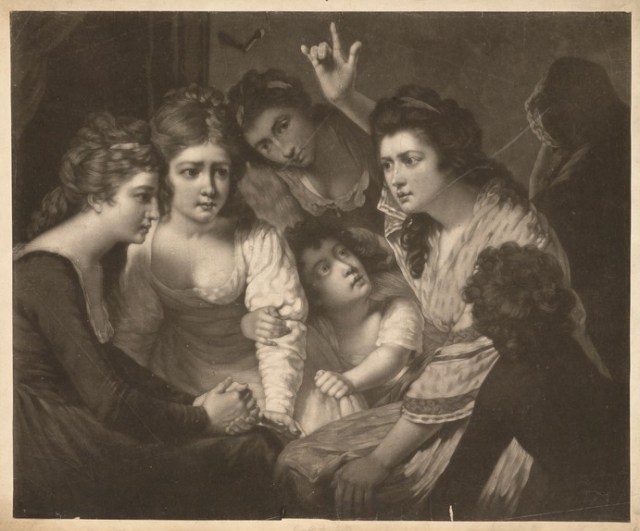
A lady telling a gripping story to young women and children. Mezzotint by V. Green, 1785, after J. Opie. Credit: Wellcome Collection, CC BY

Why a story?  A story is a very efficient way to teach something.  A properly constructed story helps us understand what is going on by logically presenting information and highlighting the links and connections between separate facts and events.  There is even a word for this storification in the paper Storification in History education: A mobile game in and about medieval Amsterdam the authors talk about the advantages of storytelling in History,

“In History education, narrative can be argued to be very useful to overcome fragmentation of the knowledge of historical characters and events, by relating these with meaningful connections of temporality and sequence (storification).” (Computers & Educations Vol 52, Issue 2, February 2009, p449.)

Storification also makes sense in regards to working and short-term memory.  Working memory and short-term memory are transient; permanent information storage takes place in long-term memory.  However, they are both critical to the establishment of long-term memory.  Information enters the memory system through Short-term memory, and processing and connections happen in working memory.

Unlike long-term memory, both short-term and working memory have limits on their capacity.   Recent work suggests that the size of working memory is 3 – 5 items.  For example, I could reasonably be expected to memorize a list of letters; H, C, L, I, and Z. I know some of you were going to say seven items as in the magical number seven, I break down the changes in our understanding of working memory in another blog post, you can read about it here.

However, we can quickly see a problem with 3-5 items; I can also remember a sentence, “All the world’s a stage” this sentence has 18 characters 19 if I count the apostrophe. I can hold this sentence in short-term memory.  I can remember these 18 characters due to a process called chunking coined by George Miller in his paper The Magical Number Seven, Plus or Minus Two Some Limits on Our Capacity for Processing Information.  Miller describes it as “By organizing the stimulus input simultaneously into several dimensions and successively into a sequence of chunks, we manage to break (or at least stretch) this informational bottleneck.” (Psychology Review Vol. 101, No. 2 p351)

In our example’s words are chunks; specifically, each word is a list of letters that have a specific meaning.  If I were to present that list of letters to you in a different way as zilch, it would be much easier to remember. Chunking is the same idea behind storification or storytelling; you are organizing the information into related chunks to make it easier for the mind to remember and digest.

With all the complicated information in a scientific paper, A story is a perfect format to present new scientific knowledge.  A scientific paper starts with an abstract which gives an overview. Then the paper has an introduction which places the new information in context with the old. Then we show the experiments (in the order that explains the information the best. not necessarily chronologically). Lastly, there is a summary that reiterates the new information in context with the old and what directions the research could go next.

A faculty advisor of mine once described writing a science paper as tell them what you are going to tell them, tell it to them, then tell them what you told them.  That might seem a bit excessive, in fact, I once had a non-science faculty member after hearing this triple approach to paper writing say, “what are scientists stupid?”  I think it’s a smart strategy, after all, have you ever had a teacher tell you how many times you need to hear something to commit it to memory? (I always heard it was three)

There is one thing I find quite strange about storytelling in science education.  It seems to me that helping students make connections and tie information together is the most important in the earliest stages of education — for instance, the steps of education that use textbooks.  However, the writing of most current science textbooks presents information as separate chunks.

Like I have said in previous blog posts the reason for writing the modern textbook as independent chunks are so we can use the textbook in any class and any order. However, if we want textbooks to be as useful as possible shouldn’t they be written as a story?  We should write the textbook so that we group information into meaningful chunks, we should write the textbook so that we present information in ways that reinforce the relationships and dependencies between new information and preexisting knowledge.

What do you think is the lack of storytelling harming modern textbooks?  Has our desire to produce textbooks (commercial and open source) that can be used in as many different classes as possible hurting the usability of the modern textbook?  Can we create textbooks that are storified or would they be unusable in current courses?  However, if a storified textbook helps the students learn and if we can’t use them in current courses is the problem with the textbook or the course?

Thanks for Listing to My Musings

The Teaching Cyborg
Let Them Run Their Own Labs

“Research is creating new knowledge.”
Neil Armstrong

I suspect that people have been arguing about teaching science since we started teaching science. There are multiple groups that each have their models and best practices. In recent years we have even seen the progression of specialized undergraduate majors. Which suggests that some schools think content that used to be part of a foundational bachelor’s degree is no longer necessary.

One of the things that most of the groups interested in science education agree on is the more like real science we can make the learning experience the better the learning and understanding of science will be. There are even some schools like Reed College that requires all their students to complete a senior thesis and oral defense, under a faculty members supervision, to earn a bachelor’s degree.

Imagine if every bachelor’s student could spend a year studying and writing about a topic in their field that interested them. Not only would students get to “geek out” about a topic that interested them, think about how much we would learn.

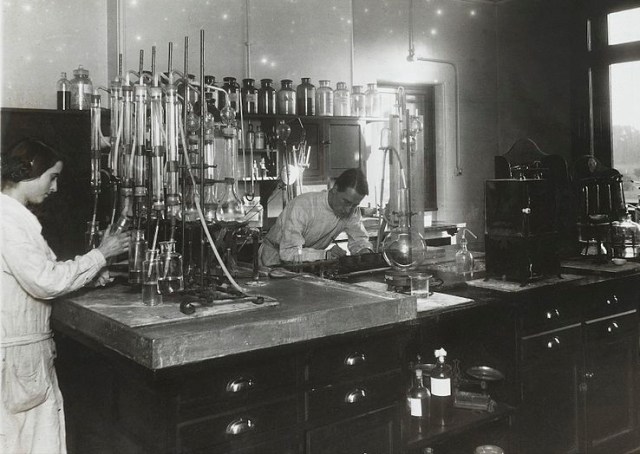
Chemical research lab, Beckenham. Two chemists at work, surrounded by equipment and apparatus. Archives & Manuscripts, This file comes from Wellcome Images, license CC BY 4.0

The problem with Reed’s model is that it does not scale. Reed College has an enrollment of 1400 students and a 9 to 1 student to faculty ratio. It’s not feasible to scale this to a Tier 1 research institution that has 25 – 40 thousand students and nowhere near a 9 to 1 student to faculty ratio. Faculty don’t have space in their research labs to support student populations in the 10s of thousands.

There have also been a lot of programs developed and tested to provide students with research experiences. Most of these programs are small only 20 – 30 students. Also, a lot of these programs are short 8 – 12 weeks during summer. Additionally, since most are small, they have become highly competitive leading to access to only the top students.

While these programs have their heart in the right place, they are not going to provide research experiences to all students with program sizes of 20 – 30 students. If we are going to have a goal of providing research experiences for all bachelor’s students, we need another approach.

I have put a lot of thought into the idea of incorporation research into required laboratory science classes. If we incorporated a year-long research project in required laboratory courses all students would get research experiences. Additionally, the class would be more coherent because experiments would flow one to the other based on the results from previous work. However, research as a lab course is an idea for another day.

I recently came across an article that potentially presents another way to give students real research experiences. Before I get to the article, I want to show some of the background ideas that make this idea possible.
One of the most significant problems with scaling research experiences in a large university is the availability of space in faculty research labs and the availability of research mentors. It might be possible to reduce the burden on faculty by using the knowledge of the crowd.

We already use per – per instruction in large lecture classes, why not use it in research. After all, in professional research, you can’t look up the answer to your research question. In professional research, we talk to our colleagues and try out experiments until we get a direction or answer the question. Additionally, many of the groups that are interested in science education suggest having students work in groups.

The idea for undergraduate research comes from an article Pushing Boundaries: Undergrad launches student-driven particle astrophysics research group published in CU Boulder today on November 16, 2018. The article describes a research group formed by Jamie Principato that was established and run by undergraduates. The group is composed of 30 undergraduates who are designing and building an instrument to measure cosmic radiation. The group’s detector has already flown on high altitude balloons. You can read the full article here.

From my point of view, one of the most interesting things is that the 30 members of the group had little or no previous research experience. While Jamie Principato is an exceptional student, I can’t help but think undergraduate formed research groups could be the solution or at least part of the solution to undergraduate research experiences.

Depending on the question some of these groups could run for years with new undergraduates joining each year. If we think of undergraduate research groups having about 30 students than a departmental graduating class of 250 students would need nine groups a class of 500 would require 17 groups. With some proper planning and organizing this seems a reasonable number of groups for a department.

What do you think could student-run, and organized research groups be the solution to undergraduate research experiences for all students? Do you think undergraduate research experiences for all students are something we should be trying to develop? I think student-run and organized research groups could be the solution to undergraduate research experiences for all students, especially at large universities.

Thanks for Listing to My Musings
The Teaching Cyborg