In Research We Trust

“Facts are stubborn things, but statistics are pliable.”
Mark Twain

Anyone that knows me knows I believe in research and data backed decisions in education.  Successful research is a balancing act between skepticism and an openness to new sometimes radical ideas.  To avoid the possibility of bias, we have developed methodologies and techniques to determine the validity of an experiment.  Experimental validity falls into two categories: internal, experimental design, data collection, and data analysis. The second is external, the progression from hypothesis to theory, and finally to the fact.  Research drives the progression from hypothesis to fact with supporting evidence and replication.

Considering how vital replication is to research, there appears to be very little direct replication.  Makel and Plucker showed that only 0.13% of educational research is replicated (Facts Are More Important Than Novelty: Replication in the Education Sciences).  Compared to a rate of 1.07% in psychology and 1.2% for marketing research.  However, the rate of replication does not tell the whole story.  After all, to publish research, you need to conduct an experiment, submit it for peer review, make changes, and then have your article published.  Perhaps we can accept published results.

Looking at actual replication studies suggests that publication is not enough.  One study in psychology, Estimating the reproducibility of psychological science, was only able to replicate 63% of the studies they examined.  Replications of clinical research are even worse.  A group from Amgen attempted to replicate 53 research studies in cancer research they only replicated 6 of them.  Additionally, a group with Bayer Health could only replicate 25% of the preclinical studies they tested (Drug development: Raise standards for preclinical cancer research). 

So how do we resolve the replication crisis?  We need to reproduce previous research and publish the results.  The problem is that professors, postdocs, and graduate students don’t benefit from replication studies.  Even if researchers get the articles published, they don’t carry the same weight as original research.  One possibility would be to have graduate students replicate experiments at the beginning of their graduate study as part of their training.  However, this is probably not a workable solution as it would likely lengthen the time to degree. 

So, who would benefit from reproducing research?  The answer is undergraduates.  Conducting replication studies would more effectively train students in research methodologies than any amount of reading.  Why would conducting replication studies help students with research design?  The reason is that if you replicate a study perfectly (exactly as undertaken previously), you might have the same problems the original researchers had.  After all, most of the issues in research are not intentional but unintentional and probably unidentifiable problems with data collection or analysis.

Statistical analysis of most data involves a null hypothesis.  When the data is analyzed, the null hypothesis is either accepted or rejected.  Errors analyzing a null hypothesis, are classified as Type I (rejecting a correct null hypothesis) or Type II (accepting a false null hypothesis).  The critical thing to keep in mind is that it is impossible to eliminate Type I and II errors.  Why can’t researchers eliminate Type I and II errors? Think about a P value, P < 0.001, what does the number mean.  Written in sentence form as P value < 0.001 means: the likely hood that these results are the product of random chance is less than 1 in 1000.  While this is a small number, it is not zero, so there is still a tiny chance that the results are due to random chance. Since P values never become P < 0, there is always a chance (sometimes ridiculously small) that results are due to random chance.

In addition to Type I and II errors, there could be problems with sample selection or size. Especially early in the research were influencing and masking factors might not be known.  Alternatively, limited availability of subjects could lead to sample size or selection bias.  All these factors mean that a useful replication study looks at the same hypothesis and null hypotheses but uses similar but not identical research methods.

Beyond the benefits students would gain in experimental design, they would also learn from hands-on research something that many groups say is important for proper education.  Additionally, replication research is not limited to biology, chemistry, and physics.  Any field that publishes research (i.e., most areas of study) can take part in undergraduate replication research.

Of course, these replication studies will only benefit research if they are published.  We need journals to publish replication studies, how do we do that.  Should a portion of all journals be devoted to replication studies?  The Journal Nature says it wants to publish replication studies; “We welcome, and will be glad to help disseminate, results that explore the validity of key publications, including our own.” (Go forth and replicate!).  Hay Nature how about really getting behind replication studies! How about adding a new Journal to your stable, Nature: Replication?

However, if we want to disseminate undergraduate replication studies, it may be necessary to create a new Journal, The Journal of Replication Studies?  With all the tools for web publishing and e-Magazines, it should be straight forward (I didn’t say free or cheap) to create a fully online peer-reviewed journal devoted to replication.  Like so many issues, the replication crisis is not a problem but an opportunity.  Investing in a framework that allows undergraduate to conduct and publish replication research will help everyone.

Thanks for Listing to My Musings
The Teaching Cyborg

Researching Prototyping and STEM Education

“The visionary starts with a clean sheet of paper, and re-imagines the world.”
Malcolm Gladwell

Microscopes are an essential piece of scientific equipment they gave us the ability to view parts of the world that we can’t see otherwise.  The invention of the microscope lead directly to germ theory which revolutionized healthcare. Throughout my career I’ve done a lot with microscopes; research, teach, maintenance, and I’ve even worked with a group to make them remote controlled.

Microscopes can also be extremely expensive, I worked with a microscope that cost a million dollars, and some microscopes cost more than that. Microscopes are particularly crucial in pathology and medical diagnostics. Which in some cases can be a problem; the cost of microscopes can be limiting in some areas of the world.

Take for instance sub-Saharan Africa; malaria is one of the most common causes of death due to illness in this region. According to the CDC 90% of all the worlds malaria-related deaths are in sub-Saharan Africa. Which is sad because malaria is completely treatable especially if identified early. The problem is malaria can present like the flu. Without going to it all the reasons the only way to conclusively diagnose an active malaria infection is by a stained blood smear observed under a microscope.

In the United States, this is not a problem if your local medical office doesn’t have a diagnostic lab; one is available within a few hours by medical courier. However, in places like sub-Saharan Africa diagnostics labs can be prohibitively expensive and far out of reach. A basic diagnostic microscope is going to cost several thousand dollars; a clinical centrifuge will also cost a couple of thousand dollars. In addition to the cost, this equipment can be difficult to transport and set-up.  The diagnostic equipment also requires electricity something that is not commonly available. So, you also need a generator and fuel.

In addition to malaria, poverty severely impacts sub-Saharan Africa. According to the World Bank in 2015, 66.3% of the population live on $3.20 a day or less $1160 a year, 84.5% lived on $2007.50 or less a year.  One of the effects of poverty is a lack of infrastructure which makes it difficult to access many areas. 

A potential solution to this problem came from Dr. Manu Prakash an associate professor of bioengineering at Stanford. In 2014 his group developed the Foldscope a small microscope built from paper, an LED, watch battery, and spherical lens, it has magnification from 140X to 2000X. The Foldscope cost less than a dollar to make.

In 2017 his group developed the Paperfuge a hand-powered centrifuge with speeds of 125,000 RPM it costs about $0.20.

The Foldscope and Paperfuge don’t require power they’re small and easy to transport and we can easily replace them because of their low-cost. These pieces of paper can change diagnostics in remote regions drastically.

So, what do the Foldscope and Paperfuge have to do with STEM education?  Historically building, prototyping, and testing a new device was a long and expensive process. The cost limited the development of products to a few high-end research institution and large companies.  In today’s world of desktop manufacturing and prototyping, the cost to prototype has come down and is readily accessible to most schools and institutions.

With desktop tools available you can imagine building research/teaching programs around social and educational problems. On the educational side tools like the Foldscope and Paperfuge can be used by groups of students to do fieldwork.  Imagine taking groups of students out to a field site and giving all of them a microscope and centrifuge to do examinations.

Alternatively, we could use the Foldscope and Paperfuge as a model.  Schools and classes could partner with a community organization to develop tools to deal with problems and issues these organizations are facing. Students will start by learning the science behind the issues and the existing solution if there is one. Then as a laboratory component, students would use modern desktop manufacturing tools to design, prototype, and test solutions. We could adapt this type of program to any level of school. Additionally, they would combine science, engineering, and community service in one class.

Thanks for Listing to My Musings
The Teaching Cyborg

What the Moon Can Teach Us About Science

“I still say, ‘Shoot for the moon; you might get there.’”
Buzz Aldrin

Last month on January 21, 2019, I stood in the snow in below freezing temperature to photograph the lunar eclipse. 

January 2019 Lunar eclipse, photography by PJ Bennett

Almost as much as the lunar eclipse itself, I enjoy the discussion leading up to the eclipse.  The news seemed to focus on the name of the eclipse, the super blood wolf moon eclipse.  I will admit it’s a great name and each part of it means something.  However, what if I told you that all total lunar eclipses have names.

A total lunar eclipse can only occur when there is a full moon.  The full moon is essential because every month’s full moon has a name.  February’s full moon (Feb 19, 2019) is the full snow moon.  February is also a super moon the second of three super moons in a row March will also be a super moon.  So, using the pattern from January Februaries full moon is a full super snow moon.

February 2019 Full Super Snow Moon, photograph By PJ Bennett.

Our fascination with eclipses is interesting.  After all its not like they surprise us anymore, for instance, there will be a total Lunar eclipse in Denver on Feb 13, 2101, with its maximum at 7:46:33 pm.  The precision of this prediction is, of course, dependent on the model of the solar system and our observations of the positions of the plants. I suspect our fascination with eclipses has to do with the fact that there are very few things that let us observe the workings of the solar system.

Regardless of why its fascinating astronomy is an excellent way to both increase interest in the STEM fields and teach research methodologies.  Using astronomy to promote an interest in STEM is rather simple.  Anytime there is an astronomical event it gets covered in all the media.  Schools and organizations that promote STEM education should hold viewing parties.  In addition to helping people get a good view of the celestial event having experts present to talk about the event and science, in general, helps stir interest in STEM fields.

While I have seen some schools, observatories, and planetariums hold viewing parties it has defiantly not been all or most schools.  Additionally, these viewing parties would make a great cornerstone for a larger event that involved multiple STEM fields.  Helping participants understand that all the STEM fields are related and accessible will only help improve interest in the STEM disciplines.

Beyond promoting general interest in STEM, the history of astronomy makes a great teaching tool for the scientific method.  Anytime there is an eclipse especially a total solar eclipse someone always talks about how terrified this event must have been for early peoples.  We take for granted that we can predict eclipses.

In the media, we tie our ability to predict eclipses to our understanding of the plant’s motion around the sun which was first formally proposed by Copernicus in the 1543 publication of On the Revolutions of the Heavenly Spheres.  The only significant flaw with Copernicus’s model is that he thought the orbits had to be perfect circles.

Before Copernicus, the astronomic model of the solar system was dominated by the Ptolemaic model which had the earth at the center of the solar system (the center of the Universe).  This model lasted for about 1400 years.  However, even with incorrect or incomplete models of the solar system, the ability to predict eclipses has existed for at least 2000 years probably longer.  For instance, the Dresden Codex is a Mayan book written sometime in the 13th or 14th century; the authors based the codex on a Mayan book several centuries older.  The codex contains calculations on astronomy including accurate predictions of eclipses for both the sun and the moon. 

Six sheets of the Dresden Codex (pp. 55-59, 74) depicting eclipses, multiplication tables and the flood. Auther is unknown, This work is in the US public domain.
Six sheets of the Dresden Codex (pp. 55-59, 74) depicting eclipses, multiplication tables and the flood. Author is unknown, This work is in the US public domain.

Using the information in the Dresden codex anthropologists Harvey and Victoria Bricker were able to predict the Central American solar eclipse of July 11, 1991, to within a day in 1983 (If you’re interested the full paper is here.) Considering that we must convert the Mayan calendar to match our calendar that is amazingly accurate for something written hundreds of years before Copernicus published his model of the solar system.

We also know that the Mesopotamians and ancient Greeks predicted eclipses perhaps as far back as 2000 years. (Griggs, M.B. (2017, August 18). We’ve been predicting eclipses for over 2000 years. Here’s how. Retrieved from https://www.popsci.com/people-have-been-able-to-predict-eclipses-for-really-long-time-heres-how) If the correct understanding of the motion of the plants in the solar system is a relatively new thing how did older cultures predict eclipses and how does this help explain why the scientific method is essential?

Older cultures were able to predict eclipses because they follow a repeating cycle called the Saros Cycle, which is approximately 223 months long.  If a civilization lived long enough and its records were accurate enough deriving the Saros cycle is possible. Information on the periodicity of celestial events and observations of the night sky let individuals like Aristotle and Ptolemy developed the first models of the solar system with the earth at its center, also known as a geocentric model.

The Solar System according to the geocentric model of Claudius Ptolemaeus. By Andreas Cellarius. This work is in the US Public domain.

So how did this Ptolemaic model and its decedents last for almost one and a half millennia? The biggest reason is that the model fits all the relevant data and for most of this period the scientific method as we know it didn’t exist.

If the modern scientific method had been present at the time of Ptolemy, his geocentric model would have been a hypothesis, a prediction based on observation.  Again, using the scientific method astronomers would have tested the model by either trying to disprove it or by trying to disprove an alternative hypothesis.  Nowadays we understand that the best experiments are the ones designed to either disprove a hypothesis or distinguish between competing hypothesis. At the time of Ptolemy, astronomers did not challenge the model because it matched the observations and social beliefs.

Using the models of planetary motion from Ptolemy to Kepler makes an excellent background for discussions of the scientific method.  For the average person, all three models appeared to work and could predict celestial events.  Because they lacked our modern approach to science, several of these models persisted much longer then they could have.  Linking education to current events that capture people’s attention and excite them is one of the best ways to motivate a student. Next time a science-related story catches peoples attention think about how you might use it for education or motivation.

Thanks for Listing to My Musings
The Teaching Cyborg

The Raven Paradox and Science

“Anything that thinks logically can be fooled by something else that thinks at least as logically as it does.”
Douglas Adams, Mostly Harmless

The democratization of knowledge is a tremendous and empowering idea. The internet plays a huge role in this democratization. The growth and expansion of the Internet are almost unfathomable. The growth of online video is an example of this. In the early stages of the Internet, one small picture could slow your website to a crawl. Now we’re watching 4K YouTube videos at 60 frames per second.

You can find almost anything on YouTube. Need to paint a room in your house there’s a video for that. Want to listen to your favorite band they probably have a channel. Want to know how to build an electric guitar there is a playlist for that. There are even channels focused primarily on teaching science. Some of my favorites are Dianna Cowern’s Physics Girl, Derek Muller’s Veritasium, Michael Stevens’s Vsauce, and Brady Haran’s Numberphile.

However, there are also other channels on YouTube presenting pseudoscience or even outright falsehoods. Did you know that the Flat Earth Society has its own YouTube channel? (No, I’m not linking to it!) As much as we might like the idea of deleting them if we support an open and free Internet and the democratization of knowledge we can’t.

Fortunately, a lot of them are easy to spot. However, what about videos that make a mistake or fall into a logic trap. What about videos recommended by YouTube? Does a YouTube recommendation increase the validity of a video?

The other day a video popped up in my YouTube recommendation feed the title intrigued me “The Raven Paradox (An Issue with the Scientific Method)” the video is by a channel TritoxHD which is a channel about “science, theory, and history!” The video concludes that scientists shouldn’t make overly broad generalizations.

The video centers around the Raven Paradox, which is an argument in inductive reasoning first presented by Carl Gustav Hempel and how it impacts on the scientific method. The raven paradox is interesting from a logical standpoint. The paradox is dependent on logical equivalents from a logical point of view; all A’s are B’s is equal to if not B then not A.

The paradox uses these two statements.

  1. All ravens are black.
  2. Something is not black; then it is not a raven.

Since these two statements are logically equivalent observing one is support for the other. As an example, the flower in my front yard is pink, this flower is not black, and it is not Raven, so this pink flower supports all ravens are black. If you are like most people, your response was just “WHAT!” The idea that dissimilar things can be used to prove each other is where the paradox comes from how can an observation of a flower have anything to do with ravens. Fred Leavitt does an excellent job of explaining how this works in his article Resolving Hempel’s Raven Paradox in Philosophy Now; my interest is in the description of the scientific method.

How does The Raven Paradox relate to the scientific method? Our YouTuber and others have suggested that many if not most hypotheses are of the format all A’s are B’s. In this case, the YouTuber makes his first mistake when he takes All ravens are black as a hypothesis.  The video states that the hypothesis is the first step in the scientific method, this is not true.

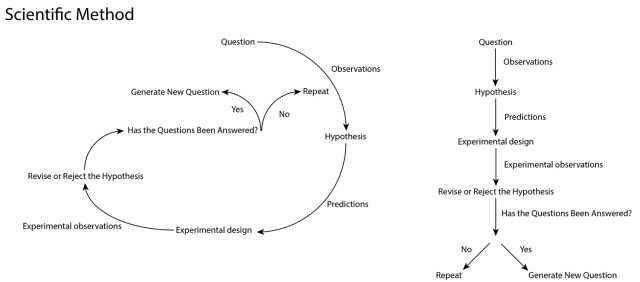
I like to think of the scientific method is a cycle that we can enter from any point, so there isn’t a first step. However, if you think of the scientific method linearly the first step is to ask a question.

Two representations of the Scientific Method one circular the other liner.

Following in the raven example the question would be “Is there a trait that all ravens share?” Then you’d go out and observe ravens. This step is necessary because a hypothesis is a prediction based on observation. So, if you need observations to make a hypothesis, the hypothesis can’t be the first step. Our YouTube author even states that a hypothesis is a prediction based on observation.

An important thing to know about the hypothesis all ravens are black is that while very rare there are white (albino) or cream (leucistic) colored ravens.

Modified from Raven by Marcin Klapczynski, licensed under the Creative Commons Attribution-Share Alike 3.0 Unported license.

The argument concerning the paradox is twofold one, to “prove” the hypothesis you must observe every single raven, I’ll come back to this latter. Two, you can observe hundreds even thousands of ravens and never see a white raven and therefore conclude that all ravens are black incorrectly.

Let’s suppose you examine 50 ravens and they were all blacks you come up with the hypothesis all ravens are black. You then go out and examined 5000 ravens, and they are all black. What is the problem, while we don’t know the exact numbers there are 4 or fewer albino ravens worldwide out of a total population of 16 million. That means that your probability of seeing an albino raven is 0.000025%. 

Beyond the small chance of seeing a white raven, there is another problem with the approach. Observing Ravens to see if they are black is an experiment that is designed to prove the hypothesis.  Specifically observing 5000 black Ravens is a result that is consistent with the hypothesis, this type of research doesn’t provide any information on alternative hypotheses.

With science, supporting or consistent data is of a lower value. Experiments that focus on disproving a hypothesis always have a higher value. They have a higher value because they eliminate alternative ideas which strengthen the validity of the remaining hypothesis. Additionally, a hypothesis is only scientific if it can be disproven.  Which means if you try to disprove a hypothesis and can’t the likely hood that the hypothesis is pointing at something real is stronger.

Let’s briefly get back to the issue of testability, since all ravens are black requires an examination of all ravens something that is impossible the hypothesis is untestable and is therefore not a scientific hypothesis. 

In the end, this the video uses the Raven Paradox to say that scientists can overreach and should be careful of generalizations. However, this argument is problematic because it is dependent on the definition of a hypothesis which is not complete.  The hypothesis all ravens are black is not a valid hypothesis. The author states a hypothesis is a prediction based on observations. I would say a prediction that is consistent with observations. Additionally, a hypothesis must be testable. Lastly, a hypothesis must be falsable or able to be proven incorrect to be a scientific hypothesis.

While I would like to see the YouTube logarithm not suggest things that are incomplete or oversimplified beyond usefulness, I suspect that will not happen.  Like I have stated before we need to focus on teaching students how to evaluate information.  I suspect most of the problems with the video come from things being oversimplified. As Einstein said, “Simplify everything as much as possible but no further.” Concerning basic education, I think we’ve taken the scientific method further. We tend towards being very simplistic in how we present the scientific method. We need to do a better job of teaching the basics if our students don’t know the foundation how can we hope to teach them the specifics.

Thanks for Listening to My Musings
The Teaching Cyborg

It Might Have Happened, We Don’t Know for Sure, But Now We Freak

“We wait until Pandora’s box is opened before we say,”Wow, maybe we should understand what’s in that box.” This is the story of humans on every problem.”
Peter Singer

Louis Brown was born July 25, 1978, for some people she was surprising maybe even scary, you see Louise Brown was the first in vitro fertilized (IVF) baby ever born. Today IVF is a technique that barely causes people to bat an eye. In fact, according to the Society of Assistant Reproductive Technologies (SART) from 1987 – 2005 in the US one million babies have been born through IVF and other reproductive technologies.

We have two more names Lulu and Nana born November 2018. Lulu and Nana might not be their real names, we don’t know their last name, and the public has not seen them. However,according to Dr. He Jiankui of the Southern University of Sciences and Technology in Shenzhen China, they are the first human beings to be genetically engineered. The announcement of the first genetically engineered human beings raises a lot of questions.  Including do these children even have genetically engineered genes?

However, before we get into the issues with Dr. Jiankui’s work,I want to cover a little history to show that it might be possible to engineer humans genetically. Two techniques have been hanging over human reproduction for decades. They are cloning and genetic engineering.

The reason cloning is important is that it makes genetic engineering easier,more on that later.  Most people have heard of Dolly the sheep the first mammal cloned by nuclear transfer from an adult somatic cell she was born July 5, 1996. With Dolly the critical words are adult somatic cells, scientists cloned a sheep from an embryonic cell in 1984.

Dolly was all over the news when she was born. However, who has heard of Polly and Molly? Who is that you say? While Polly and Molly are cloned female sheep like Dolly, however, Polly and Molly were genetically engineered to produce human factor IX in their milk. Factor IX is the clotting factor missing in people with hemophilia B, Polly and Molly were born in 1997.

Here is where cloning helps with producing genetically engineered organisms. Growing cells in culture make it easier to create genetic changes lots of different techniques are available.  Then you can select for cells that have the change — scientists then use the changed cells for somatic cell cloning.  This technique using cultured cells is what produced Polly and Molly.

The critical point is that with regards to humans, theoretically, all the tools needed to produce genetically engineered humans was in place in the late 1990s.  That was the time to start discussing the laws and ethics in the late 1990s or early 2000snot 20 years later. I know some of you are going to say, but that was only sheep (also I didn’t know about factor IX). Well, sheep are mammals just like human beings.

However, there is something that Dolly (perhaps the media’s fixation on Dolly) distract us from, a week after Dolly was born Neti and Ditto were born they are a pair of Rhesus macaque monkeys produced by nuclear transfer cloning in this case the nuclei were from embryos. Then on October 2, 2000, ANDi, a genetically engineered Rhesusmonkey was born.

The genetic engineering of a Rhesus monkey means that everything needed to do human genetic engineering has been done in a primate and was technically feasible in humans by 2000. The only real technical problem remaining was the methods used to introduce DNA at the time they were random and inexact potentially producing unintended effects.

Then from 2005 – 2011 we identified the function of Clustered Regular Interspersed Short Palindromic Repeats (CRISPR)and the CRISPR associated (Cas) genes. The CRISPR DNA sequences and associated genes are a mechanism of adaptive immunity in bacteria and archaea they help these organisms defend themselves against viruses. The important thing about the CRISPR/Cas complex is that it is highly sequence specific. In2012 it was shown that the CRISPR/Cas complex could be targeted to a sequence of the researchers choosing. In 2013the CRISPR/Cas9 system was used to create site-specific gene editing.

While the CRISPR editing process is tremendously useful in basic research it also potentially gives us the ability to make specific gene edits in humans (this point still up for debate). However, again in 2013, it was the time for discussion, not 2018.

In 2015 a group of researchers tried to use CRISPR/Cas9to edit tripronuclear zygotes (human)they got gene edits. However, there were mistakes in the edits and off-target changes.  The scientists recommend further refinement of the CRISPR/Cas9 system before clinical applications.

Which brings us back to Dr. Jiankui and little Lulu and Nana, the most significant technical argument from the scientific community is that Dr.Jiankui shouldn’t have done this because he can’t guarantee the unintentional production of changes.

Beyond the question of whether the procedure produces unanticipated changes, there are other issues. According to Dr. Jiankui, the purpose of the trial was to create children resistant to HIV infection. Couples in which the man was HIV positive, had their embryos treated with the CRISPR/Cas9 system at the single cell stage during in vitro fertilization. They created defects in the CCR5 gene which is the gene used by HIV to enter cells.

Let’s look at some more issues with Dr. Jiankui’s procedure to mutate CCR5.  First, few if any over sight organizations would give genetic engineering of CCR5 approval as a clinical trial since there are already treatments which prevent embryos from contracting HIV. We don’t introduce new and potentially dangerous techniques when we already have a functioning therapy in place.

Second, the embryos were not already HIV-positive so is this a medical treatment or is it something else like genetic enhancement?  Genetic enhancement is something that most organizations oppose.  There is a big difference between treating a disease and make a change without a need.

Third, Dr. Jiankui says he explained the consequences to the parents. Without being able to talk to the parents is impossible to know if they understood the consequences as Dr.Jiankui explained them. Additionally, how can Dr. Jiankui explain the consequences of a procedure when the best scientific studies say we don’t know the consequences.

We now find ourselves scrambling to catch up as a society because some self-centered researcher was more interested in getting himself into the history books that he was in doing his actual job.  Simply put Pandora has opened her box and we all know once something escapes Pandora’s box it’s not going back.

As we try and deal with the appearance of human genetic engineering,we also need to do a better job at looking to the future and dealing with issues before they happen.  As I showed, human genetic engineering has been a possibility for 20 years. Having the ability to talk about the future is why a basic understanding of science is vital to modern society. While science communication needs to be better,it is also reasonable to expect that individuals pay attention to what is happening in the world around them.

We now find ourselves in a situation where something has already happened. There will be a tendency to call everything associated with it wrong and evil.  However, we need to remember that techniques and knowledge are not inherently good or bad how we use them that is good or bad. The atomic bomb is bad; nuclear medicine helps cure cancer that’s good they both come from the same foundational research. The techniques that Dr. Jiankui abused are tremendously useful to science and may someday solve problems that we currently can’t even begin to understand.

Lastly, as we discuss what we want to use genetic engineering for let’s remember that Lulu and Nana are children none of this is their fault.They have every right to live their lives, to grow up, to be happy, and free of abuse and prejudices. Don’t call them monsters, don’t say they are a threat to all of us, and most certainly don’t suggest that they are not human.  In the end,society is measured by how it treats its most vulnerable.

Thanks for Listening to My Musings

The Teaching Cyborg