The Gardeners Keep Changing My Tree of Life

“You’ll be tempted to grouse about the instability of taxonomy: but stability occurs only where people stop thinking and stop working.”

Donald P. Abbott


My Ph.D. is in biology regardless of everything else I’ve learned or what my current job is I generally think of myself as a biologist. A lot of what biologists do involve using model systems or organisms. A model organism is an organism that has some trait or benefit that makes it particularly useful to answer certain types of scientific questions. For instance, the fruit fly Drosophila melanogaster produces large numbers of offspring and can easily be stored in small spaces making it an excellent system for genetics.  The Zebrafish Danio rerio is a vertebrate that develops from eggs and has transparent embryos making it an excellent model system for vertebrate organ development.  The information learned from model systems improves understanding of other organisms and biology in general.

The application of knowledge from one organism to another works because of the relatedness of all living things. Taxonomies are used to understand the relatedness of organisms. Taxonomies name “scientific name,” organize, and define an organism’s relationship to everything else. The full scientific name of an organism contains 8 or 9 names depending on whether you are using a Domain (Bactria, Archaea, and Eukaryotic) hierarchy. When using taxonomies to determine relatedness the more names, two organisms share, the closer they are on the tree.

I must admit as a student I found taxonomies rather dull. I’ve never really enjoyed topics that seem to be taught exclusively by memorization and regurgitation. One of the most exciting experiences I’ve ever had with taxonomies occurred in the research lab, not in the classroom.

As an undergraduate, I researched the zebrafish, a small freshwater fish that is used extensively in developmental and toxicology research.
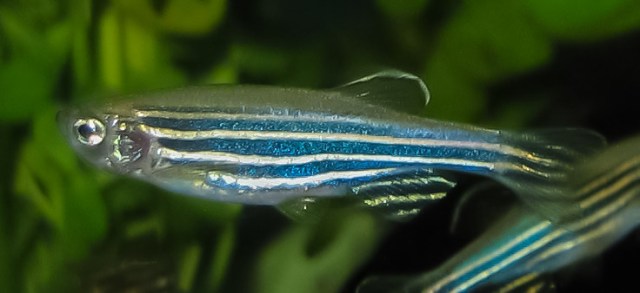
Zebrafish Image source Wikimedia Commons Author Azul

When I first started to start working on zebrafish their scientific name was Brachydanio rerio.  Shortly after I started working with them, it was proposed and approved that the name change from Brachydanio rerio to Danio rerio, or to list their full name

  • Kingdom: Animalia
    • Phylum: Chordata
      • Class: Actinopterygii
        • Order: Cypriniformes
          • Family: Cyprinidae
            • Subfamily: Danioninae
              • Genus: Danio
                • Species: rerio

Changing things like scientific names can confuse people, how can scientific information change? There are lots of different types of scientific knowledge, and generally, only scientific facts and laws are immune to change.

In science, as we learn new information, we change our interpretations to account for that new information, just ask Pluto. One of the things that have changed a lot in Biology is the tree of life (taxonomies) or how we understand the relatedness of life. When I was in high school, we learned that all life fit into five kingdoms; monera, protista, fungi, plantae, and animalia. Then the tree of life looked like this.
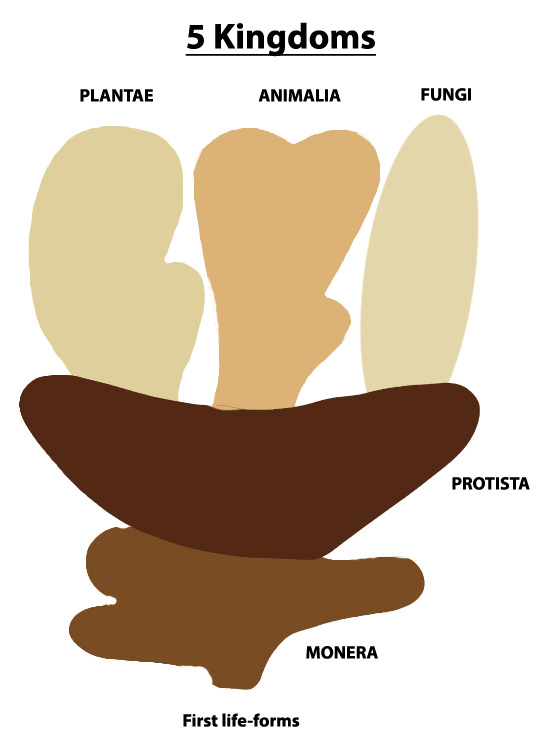
Tree of life showing the 5 Kingdoms Model. Image is based on Biology The science of life volume 3.

At this time almost all the classifications were based on physical traits. By the time I was in my undergraduate education, this began to change thanks to the work done by Carl Woese, who used DNA sequences to organize life, his tree looks like this.

Tree of life based on Carl Woese's genetic Analysis. Image source Wikimedia commons By Eric Gaba
Tree of life based on Carl Woese’s genetic Analysis. Image source Wikimedia commons By Eric Gaba

This process continues to change with additional trees and models put forth regularly.

The problem I currently have is on the educational side. I was reading a current intro biology textbook, the tree used in the book looks a lot like Carl Woese’s tree.  However, in the layout of their book they use a word, it’s all over the textbook. The word is prokaryote it is used to classify all single-cell organisms that don’t have membrane-bound nucleus Pro = “before” Kary = “nucleus.”

I hate the word prokaryote as a means of classification from my point of view it is less than useless. I think it can be damaging. In the current textbook, bacteria and archaea are grouped as prokaryotes, because they are both single-cell organisms that lack membrane-bound nuclei. However, that is about where the similarities end. Bacteria and archaea use different chemistries for their cell walls and plasma membranes. They package their DNA differently some archaea even having histones like eukaryotes. Currently, we believe archaea are more closely related to eukaryotes than bacteria. Categorizing bacteria and archaea together under a single term suggests an evolutionary closeness that is not there.

After all, if we look at the full names of several single-celled organisms

Table show the full scientific name of three single celled organisms.

the word prokaryote does not appear anywhere in the scientific names.

When we are teaching students, it is essential that we don’t unintentionally introduce miss-conceptions.  We should be teaching bacteria and archaea as the distinct groups they are. They should have independent sections in textbooks.  The terms we use in education must have real meaning, and it turns out for a process of taxonomic relatedness lacking a membrane-bound nucleus should not mean things are classified together. When we teach science, when we write about science (textbooks), we need to make sure our language has meaning. We need to stop using groupings and classifications because they are convenient, it gives false impressions about relatedness.  Let’s all get together and kill the term prokaryote and make it easier for students to understand how organisms are related.


Thanks for Listening to My Musings

The Teaching Cyborg


What Is A Textbook?

“Science is cool! But it’s easy for that to get lost in textbooks sometimes.”
Philippe Cousteau, Jr.

In many ways, the history of education is the history of books. Currently, people frequently quote “I have more computer power in my pocket (smartphone) then all of NASA during the Apollo moon missions.” Today when we talk about technology in the classroom we tend to think about computers, phones, tablets, apps, and the internet. However, a book is also technology we tend to take books for granted nowadays. Before Johaness Gutenberg invented his printing press around 1440, books were produced by hand.

An image of the printing press in the Gutenberg Workshop, curtsy of Cuneo Press. Inc Exhibit.
The_Cuneo_Press,_Inc.,_Exhibit,_Gutenberg_Workshop,_Printing_Press_(NBY_416882)

Before the printing press, books were scarce and expensive. During the medieval age books in a library or lectern were often chained to desks. The word Lecture derives from the French word lecture meaning reading since in early medieval universities the Faculty member “Lecturer” would stand at the front of the class and read from the primary book. After all the University only had one of these books. Mass production of books changed all this and allowed “the spread of learning to the masses.”

In recent years there has been a lot of discussions about textbooks. Many of these discussions revolve around problems with the mass mark textbook, high cost, the rigidity of the curriculum, and the relatively long time to update. The most commonly offered solution to these complaints is the opensource textbooks. The various open source projects provide books that are free, editable, and adaptable. There has also been a lot of work looking at digital and multimedia textbooks.

The one thing that is clear we are currently involved in an in-depth and involved discussion about the future of the textbook. What will a textbook look like and what will its source be in a few years or a decade? I don’t know, but maybe we are remembering that the textbook is technology deserving of thought and work.

In my mind, one of the exciting things about all the textbook discussion is perhaps the unstated implicit point. All these arguments suggest that the textbook is still an essential component of the educational process. Very few of these discussions suggest we eliminate the textbook. Which I think is probably a very sound and vital point.

A while ago I was asked to review a couple of open-source textbooks (No, I am not going to tell you which ones, many have changed). What struck me was that many of these books were over a 1000 pages. The reason for this was to allow instructors to pick and choose the parts that best suit their class. While this seems like a good idea, the individual topics all seemed to be incredibly shallow. My guess is this was done, due to the amount of time available to create the book and the number of topics covered. While this list of books was not extensive, the books reviewed did not meet our needs, and the school ended up going with a customized book from a publisher.

The other problem I noticed with some of these books was a lack or limited amount of layout. The content of a book is only part of what makes a book. Layout and white space enhance readability and make sure the location of graphics make sense. I suspect a lot of this was left out for practical reasons. It’s hard to edit text that has already been typeset. If any of you have published a book or article, you probably remember how much it cost to make a change to a galley proof (the galley proof is typesetting). This type of typesetting would make it hard to customize open-source texts. I suspect layout is going to be the place were HTML versions of open-source textbooks will shine since we already have a well-established means of separating content from style with CSS.

Beyond layout future updates to open-source projects worries me. While a lot of nonprofits and government agencies have invested a lot of money creating open-source textbooks, what is the likelihood that the same organizations will dump massive amounts of money into updating these books? However, I’m not going into the costs of publishing an open-source textbook. Tony Bates did a great job in his post about his open-source textbook, you can read it here.

Beyond the talks concerning costs, I want to add to this revitalization of the technology called the textbook. I want to expand the discussion, what is a textbook? The textbook has been around a long time. Over that time, we have learned a lot about pedagogy, the nature of learning, and instructional design. If we apply the information, we know about learning how would that change the textbook? What do we want for the textbook to do? What would be the best textbook today and into the immediate future? Truthfully, the variations in people, subjects, and schools make it all but impossible to create the best textbook, so I guess the best means a textbook that is the most useful to the largest group of people.

Or maybe we must limit ourselves further perhaps the best textbook helps the most students in a single class.

What do you want from a textbook? Is the purpose of the book to prep students for class, help them review after class, or both? I come back to this question a lot because of the second question, does it matter? Is there a difference in how we write a book if it was meant to prep students or help them a review? I think the answer might be yes but I’m not entirely sure.

The next question that hits me is how long the textbook should be? I think there’s a lot of validity about having open-source textbooks in which the instructor can modify the book to their needs. It seems to me that the shorter the book, the easier the instructor editing. Also, when it comes to reviewing and updating the more concise the book is, the faster and easier reviewing and updating is going to be. I’m also a believer in short and concise, so the textbook should be as short as possible.

Albeet Einstein with the Quote "Everything should be made as simple as possible but not simpler."
Albert Einstein with Quote, Derived form a Photograph by Orren Jack Turner, Princeton, N.J.

The total length will be governed by two issues the number of topics covered and the length of text in each topic. Here is where I would differ from many of the existing projects. To keep the textbook as short as possible, we should write a textbook for a single class. Writing the textbook for a single course will also help us with something that has always bothered me about textbooks. Most textbooks are composed of stand allow units because publishers write them to be used by multiple classes at multiple schools. I have always wished textbooks told a coherent story that built on itself. If we write a textbook for a specific course, we could do this.

If we choose a single semester length course what limitations does this give us? A standard one-hour course meets three times a week for 15 weeks or 45 class periods. However, the first day of class is usually taken up with administration details; there are traditionally two midterms and two or three days off for holidays. That means we lose 5 to 6 days. Let’s say five, so we are left with 40 days. If we assume the purpose is to prep the students for a lecture, the entire book should read in 40 units (chapters?) one before each class. The other size limit is the number of words in each chapter. The chapter lengths I suspect will vary from concept to concept and will have to be determined by actual practice.

Besides the purpose and length of a textbook we need to ask, what does modern technology get us? In theory, if done correctly current tech should give us improved accessibility (compatibility with readers), distribution, and availability. It should also give us the ability to add in multimedia and other content to enhance the learning abilities.

There are probably other questions that I have not thought of or considered. However, if we’re going to spend all this time talking about textbooks let’s not limit our conversation just to cost. Let’s take some time to talk about what a textbook really should be. When do you think of the best textbook possible what is the first thing that comes to your mind? What was the best textbook you ever encountered as a student? Can you learn from your favorite textbook when it comes to picking textbooks?

Thanks for listing to my musings

The Teaching Cyborg

Abracadabra: Your number is 7 Sort of or is it?

“Science is magic that works.”
Kurt Vonnegut

In 1956 George A Miller’s paper “The Magical Number Seven Plus Or Minus 2 Some Limits On Our Capacity For Processing Information” was published in Psychological Review. This paper would go on to be one of the most cited psychology papers. The article starts with Miller talking about being persecuted by a number.

My problem is that I have been persecuted by an integer. For seven years this number has followed me around, has intruded in my most private data, and has assaulted me from the pages of our most public journals. This number assumes a variety of disguises, being sometimes a little larger and sometimes a little smaller than usual, but never changing so much as to be unrecognizable. The persistence with which this number plagues me is far more than a random accident. There is, to quote a famous senator, a design behind it, some pattern governing its appearances. Either there really is something unusual about the number or else I am suffering from delusions of persecution.

George A. Miller

This paper has to do with the similarity in a person’s performance on one-dimensional judgment tasks and memory span. In one-dimensional judgment tasks, individuals are asked to discriminate between items that differ only by one characteristic. The frequency or loudness of a tone or the saltiness of a solution. While there are some variations in different types of items individuals can distinguish about seven (plus or minus) different objects correctly. Memory span is the maximum number of things a person can recite back correctly immediately after being exposed (hearing, feeling, or seeing) to them. Again, the memory span is about seven. The similarity of these two items led to the obvious question, are they related? Was there something magical about the number seven, especially as Miller says since we see seven everywhere.

What about the magical number seven? What about the seven wonders of the world, the seven seas, the seven deadly sins, the seven daughters of Atlas in the Pleiades, the seven ages of man, the seven levels of hell, the seven primary colors, the seven notes of the musical scale, and the seven days of the week? What about the seven-point rating scale, the seven categories for absolute judgment, the seven objects in the span of attention, and the seven digits in the span of immediate memory? For the present, I propose to withhold judgment. Perhaps there is something deep and profound behind all these sevens, something just calling out for us to discover it. But I suspect that it is only a pernicious, Pythagorean coincidence.

George A. Miller

You may ask “why do we even care”? I first heard about the magic number in a teaching workshop years ago. Where it was being used to define the number of things you could present in a lecture. However, from a practical point of view, we care about memory span because it is a component of short-term memory and working memory. In education to “learn something,” the information needs to move into long-term memory. Information can’t reach long-term memory without passing through short-term memory. Working memory interacts with both short-term and long-term memory since working memory is the place where we do things with information; compute, analyze, and modify information.

The process of conversion to long-term from short-term memory requires reinforcement of the neural pathways, which is accomplished by repetition or reloading of the information into short-term memory. Repetition and reloading of information is where the capacity limit becomes essential. If we are teaching and we keep bumping information out or filling the short-term memory than the new information cannot be reloaded and reinforced.

In Miller’s law capacity is 7 + or -2 or 5 to 9 chunks. So, if we use this as part of a lesson plan do we teach five or seven or nine new things? I would argue the answer should be the lowest number since that gives the best chance for all the students to learn. Some people say we should teach seven or nine because that lets us identify the “best” students. I think this is incorrect because it fails to acknowledge one of the fundamental differences between short-term and long-term memory. Short-term memory has a capacity limit while long-term memory does not. So as long as there’s sufficient reinforcement every student in the class can learn (transfer to long-term memory) all the information regardless of what their memory span is.

Now I’m going to drop the other shoe the magic number seven was published 62 years ago it was a review of the research as it stood at that time. In 2010 Cowan published a new review titled “The magic mystery four: how is working memory capacity limited and why.” In this paper, Cowan goes on to show how research since Miller’s work has demonstrated chunking and multivariable decision-making shows a wide range of capacity limits that seem to be dependent on the type of information. However, working memory does seem to have restrictions, and moreover, these limits can be used to predict mistakes and failures in information processing. This limit on working memory is 3 – 5 or 4 + or -1.

I like this number a lot better, why? Not because of any research. The reason is that of course design. If I use the argument from earlier, I would “teach” three new concepts at a time. It’s that number “three” that makes me like the research better. Instead of saying I’m pursued and persecuted by a number, perhaps I will say three has been my companion.

Man with the number three
Man with the number three.

A story has three parts, the beginning, middle, and the end. When I write a proposal, I include three goals. The three primary colors in the RGB spectrum. I know these are just coincidences there’s no real meaning behind it. I also suspect if I’m aware of it and willing to think logically when the need is there, there is no actual harm in my companionable number three, for the time being at least I have some research to back me up.

How much do “magic” numbers influence course design? How much should they change course design? In the teaching is an art or science debate I’m on the science side, so I like research. What are you? The critical thing about Miller’s review is that he eventually concluded that the capacities of memory span and one-dimensional judgment were, in fact, nothing more than a coincidence, memory span is still essential to course design.


Thanks for listening to my musings

The teaching cyborg

Is It in the Syllabus?

Directions are instructions given to explain how.
Direction is a vision offered to explain why.
Simon Sinek

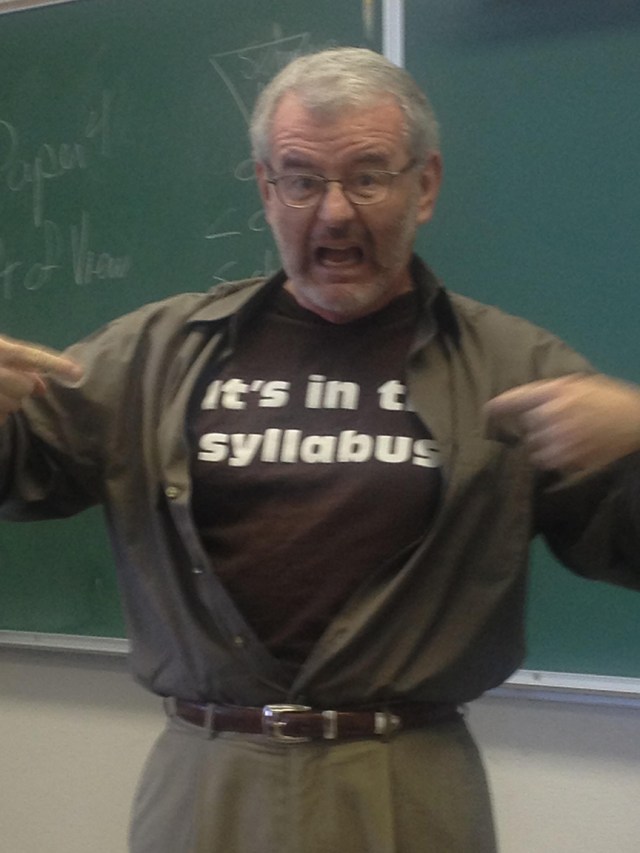
The course syllabus is the backbone of many courses; the syllabus is the means by which the teachers deliver their expectations and policies to students. However, getting students to read the syllabus has become such a common problem that it has entered popular culture. A quick search of the international net turned up over 50 memes, mugs, T-shirts, and posters all was some variation of the phrase “it’s in the syllabus.” My favorite being “It was in the syllabus it’s still in the syllabus it’s always in the syllabus” There are a lot of web pages written about the topic of the syllabus Amy Baldwin’s website is called “it’s in the syllabus.”  Austin Community College professor David Lydic has a unique approach to students asking him questions that are in the syllabus.

David Lydic using his t shirt, that reads it's in the syllabus, to answer a student question that is in the syllabus.
David Lydic showing his It’s in the syllabus t shirt. Image source Imgur

The funny thing is I had not planned on writing about the syllabus. However, I recently collected course syllabi for another project. I collected 20 syllabi for first-year majors biology courses and ten each from chemistry and physics. When I started looking at the syllabi and noticed something interesting, the only thing that was in all of them was the course name.

Five of the 40 syllabi did not list the course instructor, only 12 of them listed learning goals, ten didn’t even list course schedules. With all this emphasis on it’s in the syllabus, I was quite surprised to find that when you go and look at syllabus well, it’s not in the syllabus. Since a lot of schools or at least departments require course syllabi coupled with the fact that syllabi are generally regarded as legal contracts why is so much missing?

My guess is a lack of training and models. I’ve previously talked about out why I use models in my work and so I won’t go into it. If you want to read about it, you can review my earlier blog post here. For this blog, I’m going to use the recommended checklist from “the course syllabi: a learning-centered approach” second edition. When I used this checklist to examine all 40 syllabi, this is what I found.

Syllabi Checklist Table

Biology (n=20)
Chemistry (n=10)
Physics (n=10)
Total
(n=40)
table of contents

0

0 0 0
instructor information 17 8 10 35
student information form (not needed anymore) 0 0 0 0
letters to the student or teaching philosophy statement 0 0 0 0
purpose of the course 0 0 0 0
course description 8 8 6 22
course objectives (learning goals) 4 4 4 12
readings 17 8 5 30
resources 16 9 8 33
course calendar 17 8 5 30
course requirements 0 0 0 0
policies and expectations (Instructor/Course):
attendance 0 0 0 0
late papers 0 0 0 0
missed tests 1 1 0 2
class behaviors 1 2 2 5
civility 0 0 0 0
policies and expectations (University/College):
academic honesty 9 4 7 20
disability access 7 5 7 19
safety 0 1 0 1
evaluation 0 0 0 0
grading procedures 13 7 9 29
how to succeed in this course: tools for study and work 0 0 1 1

There are a few things on this list that are not relevant anymore; student information systems replaced student information forms.  I generally include the purpose of the course with the course description.  So, what do you think of this list?  Is it too much, not enough, should it just be different? There are two things that each appeared only once in a syllabus that I think I would add; one is a list of FAQs and other while I don’t necessarily like what it suggests. I understand its presence, and that is an escape plan.  Though in all honesty, it should be the responsibility of the school to have escape plans for all its buildings.

Course syllabi are the perfect example of where schools could and should help their teachers. With today’s learning management systems school should be able to create a page template for the syllabus. The advantages a lot of the information could be auto-populated, for example when the course is assigned the syllabus page auto-populates the course title, description, room and meeting times from the course catalog. Appointing the professor can automatically populate contact information. Additionally, programs could automatically fill school policies like; disability policy, honor code, harassment, and safety. A form that could be used to add all the additional information that faculty added themselves. Imagine having a form that auto-populates with a schedule of dates that you could add readings and assignments without figuring out the calendar.  Not only would this help save time, but it would also lead to consistency and support both new and experienced faculty include all the necessary components of a syllabus. Since schools write many of these components, the school should be responsible for their upkeep and consistency among syllabi.

Is there anything else you think should be in a syllabus? Anything you would leave out? Would a syllabus creation tool be something you would like to see? What do you think about the syllabus? Whatever you think about the syllabus as a group I think we need to think a little bit before we go into “It’s in the syllabus.”

Thanks for listening to my musings

The Teaching Cyborg

Clear and Obvious Facts

“There is nothing more deceptive than an obvious fact.”
Arthur Conan Doyle, The Boscombe Valley Mystery


I have watched or been a student in a lot of biology classes over the years.  I sometimes think we take a lot for granted when we teach students. Not only in biology but in many of the STEM fields. We have the advantage of teaching science on the shoulders of all the greats that came before us.  Sometimes I think we forget how long it took to answer questions and just how smart the people that figure them out were. Also, we forget how fast things change, in biology we have something called The Central Dogma. Simply it states that DNA goes to RNA goes to protein. It’s as simple as that; we know proteins are not made directly from DNA and RNA is not made from proteins.

The funny thing about The Central Dogma’s place in modern biology is that it’s relatively new. We’ve been studying biology for a long time; Van Leeuwenhoek discovered single-cell organisms in 1670,  Hooke coined the term cell in 1665.  Macromolecules came later; Proteins in 1838, DNA in 1869, and RNA between 1890 and 1950, RNA was initially thought to be the same as DNA. However, we didn’t know whether DNA or proteins were the sources of genetic inheritance until 1952. We didn’t know the structure of DNA until 1953. Meselson and Stahl published the proof of semi-conservative replication of DNA in 1958.

In 2018 most of The Central Dogma is less than 70 years old. There are a substantial number of people alive that are older than The Central Dogma. This information is only old because of the speed at which biology has been progressing over the last century.

When teaching facts In STEM education we often run into a severe problem, students can often give us the “correct” answer on a test.  However, if you dig a little deeper, they don’t understand what that answer means.

I have often thought that teaching biology (or any STEM field) through an understanding of the foundational experiments would help students understand the facts. Imagine going through these experiments; What was the question?, Why did they do this?, Why didn’t they do that?, What do the results show?, and What do they do next?. Teaching these experiments to students would explain not only what we know but why we know it.

Let’s look at a couple of examples. We know that DNA is the molecule responsible for genetic inheritance. How do we know? For many years scientists thought proteins had to be the source of genetic inheritance because DNA was just too simple.  In 1952 Alfred Hershey and Martha Chase conducted an experiment that provided some of the most persuasive evidence that DNA was the source of genetic inheritance.

Hershey and Chase use T2 bacteriophage for their experiment, T2 phage reproduced by infecting a bacterial cell. The bacterial cell produces new phage that would be released when the cell lysed. While the mechanism of T2 phage reproductions was not known, the process required the transfer of “genetic material” from the phage to the bacteria. The T2 phage is composed of two components a protein shell and DNA core. The researchers needed to determine what part of the T2 phage entered the bacterial cell.

The researchers needed a way to label proteins and DNA independently of each other.  Two atoms helped sulfur and phosphorus. Proteins use sulfur while DNA does not. DNA uses phosphorus while proteins do not. They grew phage with radioactive sulfur or radioactive phosphorus. These radioactive phages infected cells, after infection, the phage and cells were separated, and the location of the radioactivity was determined.

They found the radioactive DNA was always with the bacteria (Figure 1B) while none of the radioactive protein was with the bacteria (Figure 1A). They also showed that radioactive DNA could get incorporated into the bacterial DNA. While other scientists conducted additional experiments, this experiment showed it was the DNA, which carried the genetic information.

Cartoon depiction of the Hershey Chase Experiment
Hershey Chase Experiment, Derived from Hershey Chase experiment.png by Thomasione from Wikimedia Commons

Your students can probably (we hope) tell you that DNA replicates semiconservatively.  However, if you asked them to prove semiconservative replication of DNA, could they do it? Without looking up the Meselson and Stahl experiment. In the late 1950s when Matthew Meselson and Franklin Stahl conducted their research, we already knew the structure of DNA. It was immediately clear from the structure that DNA could serve as a template for its replication.

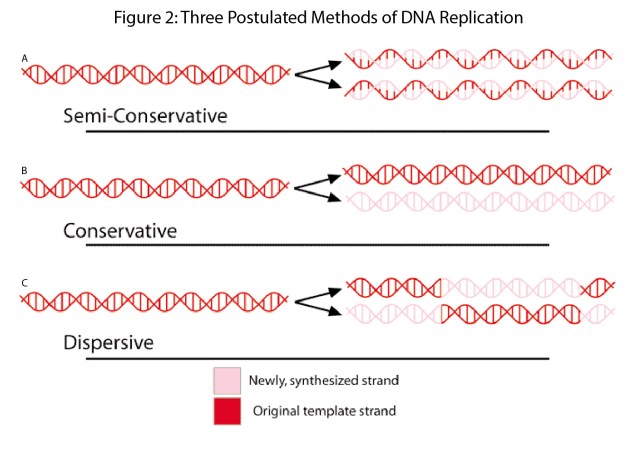
Early on there were three competing models for DNA replication; conservative replication (Figure 2A), semiconservative replication (Figure 2B), and dispersive replication (Figure 2C). The differences in these models can be described based on where the new and old DNA strands are after replication. In conservative replication after one round, you end up with one DNA molecule composed entirely of new DNA and one molecule composed entirely of old DNA. After two rounds of replication, you now have three new DNA molecules and one old DNA molecule. In semiconservative replication after the first round, you get two molecules that both contain one new and one old strand of DNA. After two rounds you get two molecules composed entirely of new DNA and two molecules composed of one new and one old strand. In disrupted replication, the DNA molecule was cut every ten base pairs on alternating strands, and then new DNA would fill in the gaps. After one round you get molecules that are 50-50 old versus new DNA. After two rounds of replication, you get four strands that would have somewhere between 50-50 and 75-25 new versus old DNA.

Cartoon representation of 3 different modes of DNA replication tested in the Meselson and Stahl Experiment.
3 different modes of DNA replication, Dertived from DNAreplicationModes.png by Adenosine from Wikimedia Commons.

The beauty of these models is that if you can follow the new and the old DNA you can distinguish between all models. Meselson and Stahl marked new and old DNA with nitrogen isotopes specifically N14 and N15 these isotopes differ by one neutron. Which turns out is enough to separate DNA by density in a cesium chloride gradient.

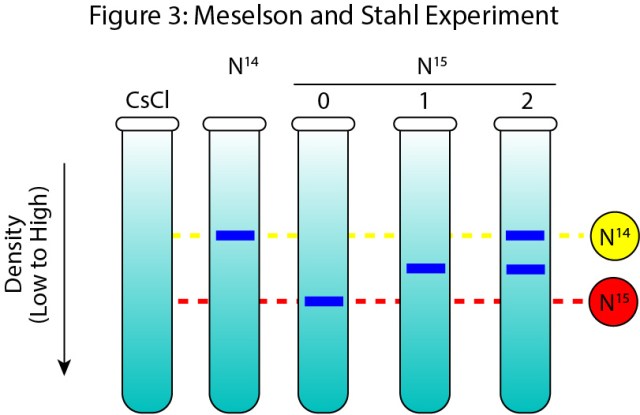
They grew bacteria on media which contained N15 then allowed the cells to grow on media containing N14 for 0, 1, or 2 cycles of replication. The DNA was then isolated from the cells and density was used to separate the DNA molecules.  After zero rounds of replication, there was a single band lower than cells grown only on N14 (Figure 3 N15 0). After one round of DNA replication, there was a single band between the N15 and N14 bands (Figure 3 N15 1). This result ruled out conservative replication since conservative replication should have produced one heavy (N15) and one light (N14) band. However, both semiconservative and disrupted replication should produce 50-50 molecules at round one. After two rounds of replication, we get two band’s one at the 50-50 spot the second at the light (N14) position (Figure 3 N15 3). This position of bands is what you’d expect from semiconservative replication but not dispersive replication. Dispersive replication would have produced a band between the 50-50 and the N14 band. Therefore, DNA replicated semiconservative.

Cartoon representation of the Results from the Meselson Stahl Experiment.
Meselson Stahl Experiment, Derived from Meselson-stahl_experiment_diagram_en.svg: LadyofHats, Wikimedia Commons

Even if you don’t need this experiment to teach your students how semiconservative replication works, the Meselson and Stahl experiment is often referred to as one of the most elegant experiments ever conducted in biology and is worth studying to learning experimental design.

Up until these experiments were conducted the information that we teach as clear and obvious facts was up for debate. While we probably can’t go over every single fundamental experiment in enough details, so our students understand them, because of the total amount of material we need to cover, foundational experiments can be useful. If there’s a topic that your students are having trouble grasping maybe take the students through the experiments that demonstrated the facts. Perhaps the solution is a one-credit recitation that covers the experiments in conjunction with the lector.  That might solve all our problems (shakes head ruefully).  One last thought, if students are having trouble grasping that clear and obvious fact maybe stop and ask if it is clear and obvious?


Thanks for listening to my musings

The teaching cyborg