The Gardeners Keep Changing My Tree of Life

“You’ll be tempted to grouse about the instability of taxonomy: but stability occurs only where people stop thinking and stop working.”

Donald P. Abbott


My Ph.D. is in biology regardless of everything else I’ve learned or what my current job is I generally think of myself as a biologist. A lot of what biologists do involve using model systems or organisms. A model organism is an organism that has some trait or benefit that makes it particularly useful to answer certain types of scientific questions. For instance, the fruit fly Drosophila melanogaster produces large numbers of offspring and can easily be stored in small spaces making it an excellent system for genetics.  The Zebrafish Danio rerio is a vertebrate that develops from eggs and has transparent embryos making it an excellent model system for vertebrate organ development.  The information learned from model systems improves understanding of other organisms and biology in general.

The application of knowledge from one organism to another works because of the relatedness of all living things. Taxonomies are used to understand the relatedness of organisms. Taxonomies name “scientific name,” organize, and define an organism’s relationship to everything else. The full scientific name of an organism contains 8 or 9 names depending on whether you are using a Domain (Bactria, Archaea, and Eukaryotic) hierarchy. When using taxonomies to determine relatedness the more names, two organisms share, the closer they are on the tree.

I must admit as a student I found taxonomies rather dull. I’ve never really enjoyed topics that seem to be taught exclusively by memorization and regurgitation. One of the most exciting experiences I’ve ever had with taxonomies occurred in the research lab, not in the classroom.

As an undergraduate, I researched the zebrafish, a small freshwater fish that is used extensively in developmental and toxicology research.
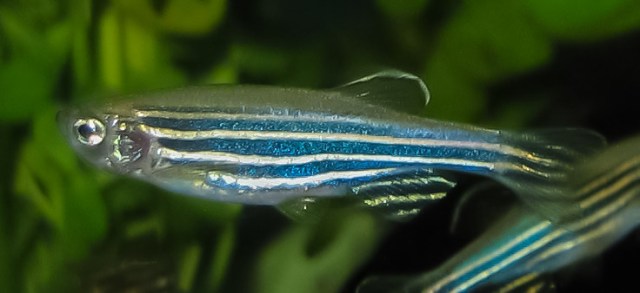
Zebrafish Image source Wikimedia Commons Author Azul

When I first started to start working on zebrafish their scientific name was Brachydanio rerio.  Shortly after I started working with them, it was proposed and approved that the name change from Brachydanio rerio to Danio rerio, or to list their full name

  • Kingdom: Animalia
    • Phylum: Chordata
      • Class: Actinopterygii
        • Order: Cypriniformes
          • Family: Cyprinidae
            • Subfamily: Danioninae
              • Genus: Danio
                • Species: rerio

Changing things like scientific names can confuse people, how can scientific information change? There are lots of different types of scientific knowledge, and generally, only scientific facts and laws are immune to change.

In science, as we learn new information, we change our interpretations to account for that new information, just ask Pluto. One of the things that have changed a lot in Biology is the tree of life (taxonomies) or how we understand the relatedness of life. When I was in high school, we learned that all life fit into five kingdoms; monera, protista, fungi, plantae, and animalia. Then the tree of life looked like this.
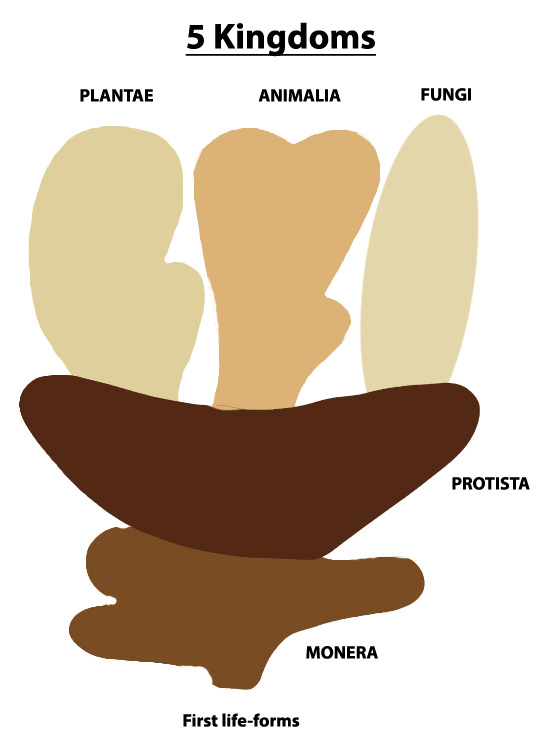
Tree of life showing the 5 Kingdoms Model. Image is based on Biology The science of life volume 3.

At this time almost all the classifications were based on physical traits. By the time I was in my undergraduate education, this began to change thanks to the work done by Carl Woese, who used DNA sequences to organize life, his tree looks like this.

Tree of life based on Carl Woese's genetic Analysis. Image source Wikimedia commons By Eric Gaba
Tree of life based on Carl Woese’s genetic Analysis. Image source Wikimedia commons By Eric Gaba

This process continues to change with additional trees and models put forth regularly.

The problem I currently have is on the educational side. I was reading a current intro biology textbook, the tree used in the book looks a lot like Carl Woese’s tree.  However, in the layout of their book they use a word, it’s all over the textbook. The word is prokaryote it is used to classify all single-cell organisms that don’t have membrane-bound nucleus Pro = “before” Kary = “nucleus.”

I hate the word prokaryote as a means of classification from my point of view it is less than useless. I think it can be damaging. In the current textbook, bacteria and archaea are grouped as prokaryotes, because they are both single-cell organisms that lack membrane-bound nuclei. However, that is about where the similarities end. Bacteria and archaea use different chemistries for their cell walls and plasma membranes. They package their DNA differently some archaea even having histones like eukaryotes. Currently, we believe archaea are more closely related to eukaryotes than bacteria. Categorizing bacteria and archaea together under a single term suggests an evolutionary closeness that is not there.

After all, if we look at the full names of several single-celled organisms

Table show the full scientific name of three single celled organisms.

the word prokaryote does not appear anywhere in the scientific names.

When we are teaching students, it is essential that we don’t unintentionally introduce miss-conceptions.  We should be teaching bacteria and archaea as the distinct groups they are. They should have independent sections in textbooks.  The terms we use in education must have real meaning, and it turns out for a process of taxonomic relatedness lacking a membrane-bound nucleus should not mean things are classified together. When we teach science, when we write about science (textbooks), we need to make sure our language has meaning. We need to stop using groupings and classifications because they are convenient, it gives false impressions about relatedness.  Let’s all get together and kill the term prokaryote and make it easier for students to understand how organisms are related.


Thanks for Listening to My Musings

The Teaching Cyborg


Is It in the Syllabus?

Directions are instructions given to explain how.
Direction is a vision offered to explain why.
Simon Sinek

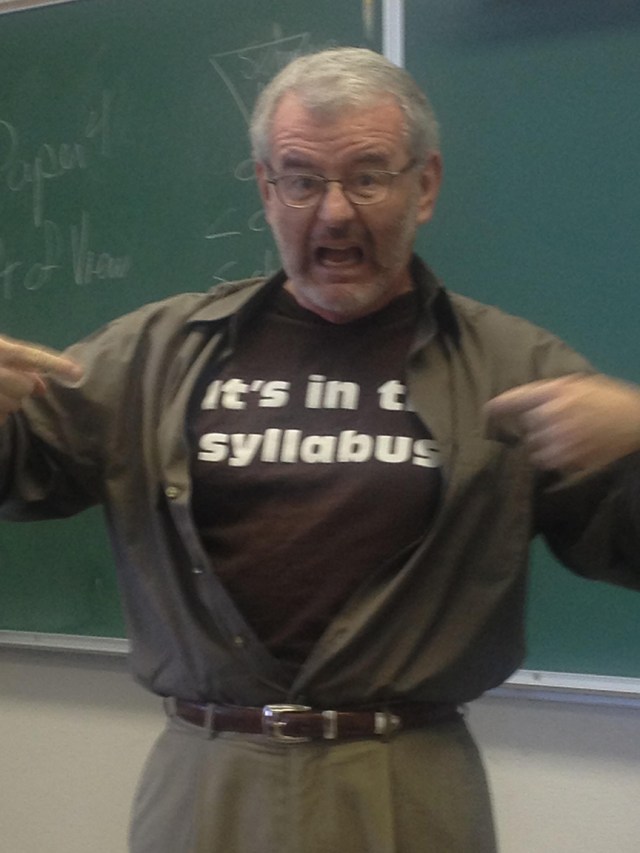
The course syllabus is the backbone of many courses; the syllabus is the means by which the teachers deliver their expectations and policies to students. However, getting students to read the syllabus has become such a common problem that it has entered popular culture. A quick search of the international net turned up over 50 memes, mugs, T-shirts, and posters all was some variation of the phrase “it’s in the syllabus.” My favorite being “It was in the syllabus it’s still in the syllabus it’s always in the syllabus” There are a lot of web pages written about the topic of the syllabus Amy Baldwin’s website is called “it’s in the syllabus.”  Austin Community College professor David Lydic has a unique approach to students asking him questions that are in the syllabus.

David Lydic using his t shirt, that reads it's in the syllabus, to answer a student question that is in the syllabus.
David Lydic showing his It’s in the syllabus t shirt. Image source Imgur

The funny thing is I had not planned on writing about the syllabus. However, I recently collected course syllabi for another project. I collected 20 syllabi for first-year majors biology courses and ten each from chemistry and physics. When I started looking at the syllabi and noticed something interesting, the only thing that was in all of them was the course name.

Five of the 40 syllabi did not list the course instructor, only 12 of them listed learning goals, ten didn’t even list course schedules. With all this emphasis on it’s in the syllabus, I was quite surprised to find that when you go and look at syllabus well, it’s not in the syllabus. Since a lot of schools or at least departments require course syllabi coupled with the fact that syllabi are generally regarded as legal contracts why is so much missing?

My guess is a lack of training and models. I’ve previously talked about out why I use models in my work and so I won’t go into it. If you want to read about it, you can review my earlier blog post here. For this blog, I’m going to use the recommended checklist from “the course syllabi: a learning-centered approach” second edition. When I used this checklist to examine all 40 syllabi, this is what I found.

Syllabi Checklist Table

Biology (n=20)
Chemistry (n=10)
Physics (n=10)
Total
(n=40)
table of contents

0

0 0 0
instructor information 17 8 10 35
student information form (not needed anymore) 0 0 0 0
letters to the student or teaching philosophy statement 0 0 0 0
purpose of the course 0 0 0 0
course description 8 8 6 22
course objectives (learning goals) 4 4 4 12
readings 17 8 5 30
resources 16 9 8 33
course calendar 17 8 5 30
course requirements 0 0 0 0
policies and expectations (Instructor/Course):
attendance 0 0 0 0
late papers 0 0 0 0
missed tests 1 1 0 2
class behaviors 1 2 2 5
civility 0 0 0 0
policies and expectations (University/College):
academic honesty 9 4 7 20
disability access 7 5 7 19
safety 0 1 0 1
evaluation 0 0 0 0
grading procedures 13 7 9 29
how to succeed in this course: tools for study and work 0 0 1 1

There are a few things on this list that are not relevant anymore; student information systems replaced student information forms.  I generally include the purpose of the course with the course description.  So, what do you think of this list?  Is it too much, not enough, should it just be different? There are two things that each appeared only once in a syllabus that I think I would add; one is a list of FAQs and other while I don’t necessarily like what it suggests. I understand its presence, and that is an escape plan.  Though in all honesty, it should be the responsibility of the school to have escape plans for all its buildings.

Course syllabi are the perfect example of where schools could and should help their teachers. With today’s learning management systems school should be able to create a page template for the syllabus. The advantages a lot of the information could be auto-populated, for example when the course is assigned the syllabus page auto-populates the course title, description, room and meeting times from the course catalog. Appointing the professor can automatically populate contact information. Additionally, programs could automatically fill school policies like; disability policy, honor code, harassment, and safety. A form that could be used to add all the additional information that faculty added themselves. Imagine having a form that auto-populates with a schedule of dates that you could add readings and assignments without figuring out the calendar.  Not only would this help save time, but it would also lead to consistency and support both new and experienced faculty include all the necessary components of a syllabus. Since schools write many of these components, the school should be responsible for their upkeep and consistency among syllabi.

Is there anything else you think should be in a syllabus? Anything you would leave out? Would a syllabus creation tool be something you would like to see? What do you think about the syllabus? Whatever you think about the syllabus as a group I think we need to think a little bit before we go into “It’s in the syllabus.”

Thanks for listening to my musings

The Teaching Cyborg

Clear and Obvious Facts

“There is nothing more deceptive than an obvious fact.”
Arthur Conan Doyle, The Boscombe Valley Mystery


I have watched or been a student in a lot of biology classes over the years.  I sometimes think we take a lot for granted when we teach students. Not only in biology but in many of the STEM fields. We have the advantage of teaching science on the shoulders of all the greats that came before us.  Sometimes I think we forget how long it took to answer questions and just how smart the people that figure them out were. Also, we forget how fast things change, in biology we have something called The Central Dogma. Simply it states that DNA goes to RNA goes to protein. It’s as simple as that; we know proteins are not made directly from DNA and RNA is not made from proteins.

The funny thing about The Central Dogma’s place in modern biology is that it’s relatively new. We’ve been studying biology for a long time; Van Leeuwenhoek discovered single-cell organisms in 1670,  Hooke coined the term cell in 1665.  Macromolecules came later; Proteins in 1838, DNA in 1869, and RNA between 1890 and 1950, RNA was initially thought to be the same as DNA. However, we didn’t know whether DNA or proteins were the sources of genetic inheritance until 1952. We didn’t know the structure of DNA until 1953. Meselson and Stahl published the proof of semi-conservative replication of DNA in 1958.

In 2018 most of The Central Dogma is less than 70 years old. There are a substantial number of people alive that are older than The Central Dogma. This information is only old because of the speed at which biology has been progressing over the last century.

When teaching facts In STEM education we often run into a severe problem, students can often give us the “correct” answer on a test.  However, if you dig a little deeper, they don’t understand what that answer means.

I have often thought that teaching biology (or any STEM field) through an understanding of the foundational experiments would help students understand the facts. Imagine going through these experiments; What was the question?, Why did they do this?, Why didn’t they do that?, What do the results show?, and What do they do next?. Teaching these experiments to students would explain not only what we know but why we know it.

Let’s look at a couple of examples. We know that DNA is the molecule responsible for genetic inheritance. How do we know? For many years scientists thought proteins had to be the source of genetic inheritance because DNA was just too simple.  In 1952 Alfred Hershey and Martha Chase conducted an experiment that provided some of the most persuasive evidence that DNA was the source of genetic inheritance.

Hershey and Chase use T2 bacteriophage for their experiment, T2 phage reproduced by infecting a bacterial cell. The bacterial cell produces new phage that would be released when the cell lysed. While the mechanism of T2 phage reproductions was not known, the process required the transfer of “genetic material” from the phage to the bacteria. The T2 phage is composed of two components a protein shell and DNA core. The researchers needed to determine what part of the T2 phage entered the bacterial cell.

The researchers needed a way to label proteins and DNA independently of each other.  Two atoms helped sulfur and phosphorus. Proteins use sulfur while DNA does not. DNA uses phosphorus while proteins do not. They grew phage with radioactive sulfur or radioactive phosphorus. These radioactive phages infected cells, after infection, the phage and cells were separated, and the location of the radioactivity was determined.

They found the radioactive DNA was always with the bacteria (Figure 1B) while none of the radioactive protein was with the bacteria (Figure 1A). They also showed that radioactive DNA could get incorporated into the bacterial DNA. While other scientists conducted additional experiments, this experiment showed it was the DNA, which carried the genetic information.

Cartoon depiction of the Hershey Chase Experiment
Hershey Chase Experiment, Derived from Hershey Chase experiment.png by Thomasione from Wikimedia Commons

Your students can probably (we hope) tell you that DNA replicates semiconservatively.  However, if you asked them to prove semiconservative replication of DNA, could they do it? Without looking up the Meselson and Stahl experiment. In the late 1950s when Matthew Meselson and Franklin Stahl conducted their research, we already knew the structure of DNA. It was immediately clear from the structure that DNA could serve as a template for its replication.

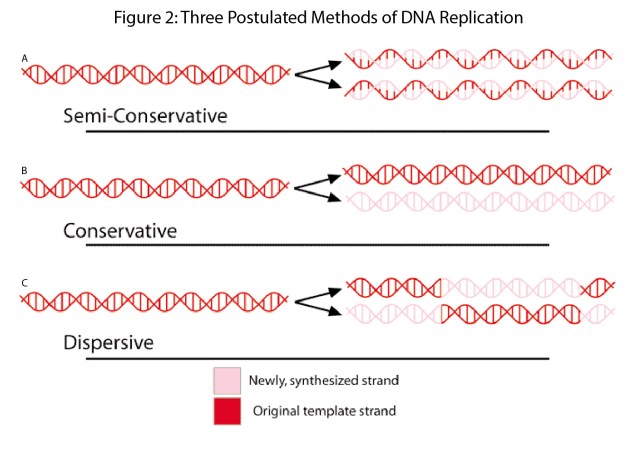
Early on there were three competing models for DNA replication; conservative replication (Figure 2A), semiconservative replication (Figure 2B), and dispersive replication (Figure 2C). The differences in these models can be described based on where the new and old DNA strands are after replication. In conservative replication after one round, you end up with one DNA molecule composed entirely of new DNA and one molecule composed entirely of old DNA. After two rounds of replication, you now have three new DNA molecules and one old DNA molecule. In semiconservative replication after the first round, you get two molecules that both contain one new and one old strand of DNA. After two rounds you get two molecules composed entirely of new DNA and two molecules composed of one new and one old strand. In disrupted replication, the DNA molecule was cut every ten base pairs on alternating strands, and then new DNA would fill in the gaps. After one round you get molecules that are 50-50 old versus new DNA. After two rounds of replication, you get four strands that would have somewhere between 50-50 and 75-25 new versus old DNA.

Cartoon representation of 3 different modes of DNA replication tested in the Meselson and Stahl Experiment.
3 different modes of DNA replication, Dertived from DNAreplicationModes.png by Adenosine from Wikimedia Commons.

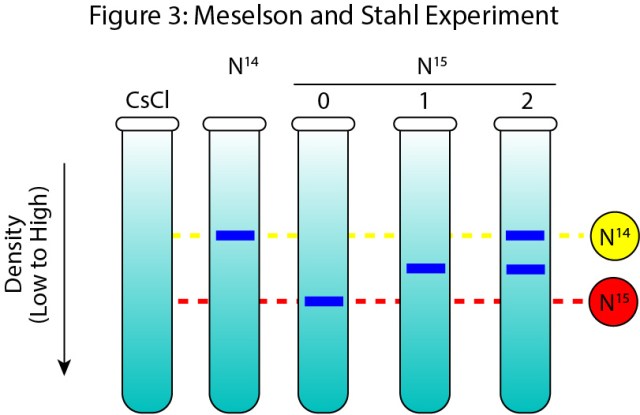
The beauty of these models is that if you can follow the new and the old DNA you can distinguish between all models. Meselson and Stahl marked new and old DNA with nitrogen isotopes specifically N14 and N15 these isotopes differ by one neutron. Which turns out is enough to separate DNA by density in a cesium chloride gradient.

They grew bacteria on media which contained N15 then allowed the cells to grow on media containing N14 for 0, 1, or 2 cycles of replication. The DNA was then isolated from the cells and density was used to separate the DNA molecules.  After zero rounds of replication, there was a single band lower than cells grown only on N14 (Figure 3 N15 0). After one round of DNA replication, there was a single band between the N15 and N14 bands (Figure 3 N15 1). This result ruled out conservative replication since conservative replication should have produced one heavy (N15) and one light (N14) band. However, both semiconservative and disrupted replication should produce 50-50 molecules at round one. After two rounds of replication, we get two band’s one at the 50-50 spot the second at the light (N14) position (Figure 3 N15 3). This position of bands is what you’d expect from semiconservative replication but not dispersive replication. Dispersive replication would have produced a band between the 50-50 and the N14 band. Therefore, DNA replicated semiconservative.

Cartoon representation of the Results from the Meselson Stahl Experiment.
Meselson Stahl Experiment, Derived from Meselson-stahl_experiment_diagram_en.svg: LadyofHats, Wikimedia Commons

Even if you don’t need this experiment to teach your students how semiconservative replication works, the Meselson and Stahl experiment is often referred to as one of the most elegant experiments ever conducted in biology and is worth studying to learning experimental design.

Up until these experiments were conducted the information that we teach as clear and obvious facts was up for debate. While we probably can’t go over every single fundamental experiment in enough details, so our students understand them, because of the total amount of material we need to cover, foundational experiments can be useful. If there’s a topic that your students are having trouble grasping maybe take the students through the experiments that demonstrated the facts. Perhaps the solution is a one-credit recitation that covers the experiments in conjunction with the lector.  That might solve all our problems (shakes head ruefully).  One last thought, if students are having trouble grasping that clear and obvious fact maybe stop and ask if it is clear and obvious?


Thanks for listening to my musings

The teaching cyborg

So, you think you can’t do Inquiry-based Learning: Better ask the gnome

“Scientific inquiry starts with observation. The more one can see, the more one can investigate.”
Martin Chalfie

In 1995 the National Research Council published the National Science Education Standards in which they recommended as one of its central point’s learning science through inquiry. As defined in the National Science Education Standards inquiry has two meanings:

Scientific inquiry refers to the diverse ways in which scientists study the natural world and propose explanations based on the evidence derived from their work. Inquiry also refers to the activities of students in which they develop knowledge and understanding of scientific ideas, as well as an understanding of how scientists study the natural world. (p23)

Five years later a companion book Inquiry and the National Science Education Standards: A Guide for Teaching and Learning was released. The purpose of this companion book was to help teachers understand and implement inquiry in their classrooms. In 2018 almost, a quarter of a century later implementation is still let’s be kind and say incomplete.

If we teach science as a method of looking at the world and asking questions Which is what science is instead of a collection of facts, principles, and ideas that many people view it as then the inquiry-based teaching method is critically important. So why isn’t inquiry-based STEM education universal?

The most common answer I hear is “I can’t do inquiry my class is too big.”  In my mind, this means you can collect bigger data sets. Followed closely by “My students aren’t ready for inquiry,” well instead of full inquiry try guided inquiry.  Lastly, “I have too much material to cover there is no time for inquiry.”  There might be something to say for that last statement, but that is a soapbox for another time, but I would say design your learning goals into the inquiry tasks.

Another way to address these questions, is to ask the question, does inquiry require complicated questions with lots of complicated equipment? Let’s ask a Gnome.

The Gnome Experiment

KERN the gnome in a case with his digital scale
Kern the gnome packed with his scale. Image: Gnome Experiment

The humble garden gnome is practically a cultural icon. To some garden gnomes are a passionate collectible, to others a novelty, and to still others the butt of the joke. However, there is one gnome that taught us about gravity while researching the physical makeup of our planet.

I think I first heard of the Gnome Experiment from a TED talk. The question proposed was could you measure the difference in gravity around the earth on a basic scale. To test their scales the Kern company got one of their scales a garden gnome and started shipping them around the world where the gnome’s recording weight and a picture at each stop. Here are some of the places the gnome has been

KERN the Gnome photographed in four different locations around the world.
Kern the gnome packed with his scale. Image: Gnome Experiment

The result of the experiment is a resounding yes. Kern the gnome weighed different amounts in different places.  Using a similar process what could you teach your students. While the phenomenon of gravity is simple to describe, it’s a difficult concept to grasp in real life.  Weight is dependent on gravity, and the amount of gravitational attraction on the surface of the Earth is dependent on the distance to the center of the planet and mass (density) of the material underneath you.  Apply this information correctly, and it can teach you about gravity and the earth.

For instance, suppose we were to conduct this experiment again.  Only this time in addition to the gnome and scale we also included a GPS/altimeter. I live in Colorado a quick search gives us a list of 20 roads that have an elevation over 12,000ft.  Suppose we took our gnome on a road trip and used our altimeter to measure the weight at 12,000ft on each of these roads. Since we have now controlled for elevation, what would it mean if we got different results?

As a teaching aid, the gnome experiment can be quite fun and useful. The idea that a garden gnome can be used to conduct science is a great icebreaker. More importantly, the Gnome Experiment shows how you can ask a genuine inquiry with a simple experiment and only a little bit of equipment. Stop and think about experiments you can ask you’re not asking your students to win the Nobel prize.  Think up some simple experiments and have your class address them.  I suspect what we need is a database of inquiry-based experiments for education, like the database of test and exam questions that are out there.


Thanks for listening to my musings

The Teaching Cyborg

So, You Think You Recognize the Words, But Do You?

I am sometimes amazed that human beings have any ability to communicate. Have you ever heard the statement “My blue is different than your blue”? One of the ideas behind this statement is if I take a blue object the way my brain processes that color is different than the way your brain processes it. This idea that perception might affect the ways each of us views the world is different from the technical definitions. With my science background, I might define blue as “light with a wavelength between 492-450 nm”. While the Merriam-Webster’s dictionary defines Blue as “1: of the color whose hue is that of the clear sky”.

Perception is not the only point to complicate communication. If you and I had just met and I showed you this cup of tea and said the word “solbränna.”

A cup of tea with milk, in a white cup on a white saucer. The saucer also holds two think rectangular cookies. It all sits on a maroon cloth.
A cup of tea with a cookie Photo by Paul Bowney, CC BY 2.0

Would you know what the word meant? Do I mean tea, cup, saucer, cookie, liquid, hot, how many options are there? Think about it for a while and see what you think. (Take your fingers off the keyboard I didn’t say Google the word!)

I could continue with different ideas showing the complexities of human communication. However, I think this should be good enough to highlight why I think it is amazing any two people can communicate at all. Yes, I hear you “At least within a given group it’s easy. We learn to speak using the same words as everyone else”. Okay, I’m going to give you a list of words.

  • Theory:
  • Law:
  • Insult:
  • Abstract:
  • Significant:
  • Sensitive:

These are all words in the English language. Words that most people can define. In fact, from an educational standpoint, most people knew these words before they started college. So, let me ask you when you’re teaching or giving a presentation do you think about the meaning of the words you are using? Perhaps more importantly do you think about what definitions your audience might be using?

What got me thinking about this was a recent debate I saw about the theory of evolution. What got to me was the fact that the two individuals were talking about two entirely different things. In fact, one of the most common arguments against evolution involves the word theory. People state that we can ignore evolution, or we should teach other things than evolution because after all evolution is just a theory. So, let’s get back to the list of words have you thought about them? What are your definitions?

Did you come up with these definitions?

  • Theory:
    • an unproved assumption: conjecture
  • Law:
    • a binding custom or practice of a community
  • Insult:
    • to treat with insolence, indignity, or contempt
  • Abstract:
    • disassociated from any specific instance
  • Significant:
    • having meaning
  • Sensitive:
    • receptive to sense impressions

How about these definitions?

  • Theory:
    • is a more or less verified explanation accounting for a body of known facts and phenomena.
  • Law:
    • A virtually irrefutable conclusion or explanation of a phenomenon.
  • Insult:
    • An injury, attack, or trauma.
  • Abstract:
    • A condensation or summary of a scientific or literary article or address.
  • Significant:
    • In statistics, denoting the reliability of a finding or, conversely, the probability of the finding being the result of chance.
  • Sensitive:
    • Responding to a stimulus

No matter which set of definitions you choose you are correct. The first set comes from the Merriam-Webster dictionary, while the second set comes from my high school science textbook (interestingly many of these words are not in college texts) and Stedman’s Medical Dictionary. The reason for these different definitions is that in science or any intellectual pursuit existing words are often given new meanings to meet the needs of the field. Since these definitions apply to specific fields, they are not necessarily the general definitions that the public knows.

Let’s apply this to our two debaters if we look at what each said we can see the differences. When the scientist said the theory of evolution he meant “Evolution is a phenomenon that is supported by many scientific studies and experiments over a long period of time.” When his opponent said the theory of evolution, he means “A guess as to how life came to exist as it is.” While I’m not suggesting everyone would have suddenly agreed with each other about the whole concept of evolution if they had taken a little bit time to clarify their meanings they at least could have debated the actual experimental studies of the topics (I know its a dream).

These differences in definitions are one of the reasons it is so important to learn and teach the language of your field. However, when you’re designing your lessons or planning an article do you ever stop and think about what your audience already knows? If you seem to have problems communicating with someone, do you think about how your definitions may vary from there’s? Does your field have definitions outside the common parlance? Do you think about this enough when you are communicating? Lastly, why don’t we use the most powerful of all language tools and coin new words when we need them? It might make communication a little bit easier.  After all, things are just going to get worse, according to this New York Times article, the word Run now has 645 meanings.


Thanks for listening to my musings

The Teaching Cyborg


P.S. The word “solbränna” means tan the color of the tea, did you get it?